

High Quality Boat Flag Poles: Performance Guide
- ianmackinnon4
- 2 days ago
- 12 min read
Most boaters believe a flag pole is a simple accessory until they see their investment snap off at 40 MPH. It is a common frustration to buy a high-performance vessel only to have a generic bracket rattle against the tower or leave streaks of rust on the finish. Finding high quality boat flag poles requires looking beyond the "universal" aisle toward specialized engineering that prioritizes rigidity and material integrity.
You likely agree that every component on your boat should be as reliable as the engine itself. This guide explores the critical differences in marine-grade materials and fabrication to ensure your flag stays secure during high-speed transit. We will examine the performance of carbon fiber versus 316 stainless steel; we will also explain why a precision-fit Flag Pole Bracket is the only way to achieve a maintenance-free, professional aesthetic that stands up to the harshest saltwater environments. By the end, you will know exactly how to choose hardware that complements your boat’s design while delivering absolute mechanical confidence.
Table of Contents
Defining High Quality: What Every Boater Should Look for in a Flag Pole
Material Comparison: Carbon Fiber vs. Stainless Steel vs. Aluminum
Engineering the Mount: Why Precision Fit Trumps Universal Hardware
High-Speed Performance: How Quality Hardware Handles 40+ MPH
The Tower Flags Difference: American-Made Custom Marine Solutions
Defining High Quality: What Every Boater Should Look for in a Flag Pole
True quality in the marine world isn't about how a product looks on the showroom floor; it's about how it performs three years later in a gale. For high quality boat flag poles, excellence is found at the intersection of corrosion resistance and structural integrity. A standard backyard pole, designed for a static garden mount, will fail almost immediately on a moving vessel because it cannot handle the dynamic loads of a wake or the relentless salt-spray of the open ocean. These inferior alternatives often buckle under the first sign of pressure, leaving you with a damaged boat tower and a lost flag.
The mounting hardware plays a vital role in this equation, as even the strongest pole is useless if the bracket fails to maintain a rigid connection. A high-quality marine flag pole is one engineered to withstand both salt-spray corrosion and high-velocity wind drag. Understanding these technical baselines is essential for any captain following traditional maritime flag rules while maintaining their vessel's performance and aesthetic. Precision engineering ensures that every component works as a single unit to dissipate energy rather than absorbing it at a single point of failure.
The "Flag Drag" Factor: Why Speed Changes Everything
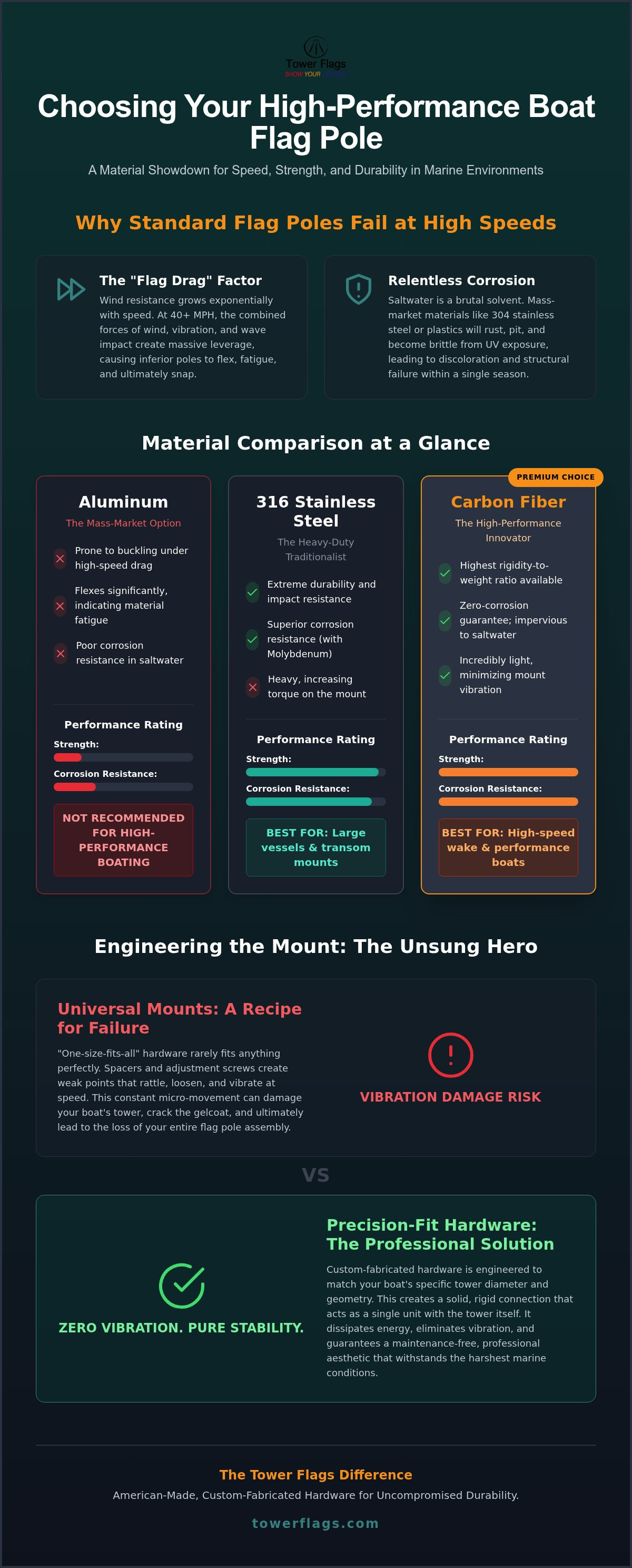
Speed changes the physics of your hardware. Wind resistance doesn't just increase as you accelerate; it grows exponentially. While a car at 60 MPH on a highway encounters relatively steady airflow, a boat at 30 MPH faces a chaotic mix of wind, engine vibration, and hull impact against waves. These "whipping" forces create massive leverage on the pole. Thin-walled aluminum poles often buckle under this stress because they lack the wall thickness or material density to resist the drag of a large flag at cruising speeds. You need a pole that remains rigid, as any flex is a sign that the material is reaching its fatigue limit.
Corrosion Resistance Beyond the Surface
Saltwater is a brutal solvent. Many mass-market manufacturers use 304 stainless steel to save costs, but this grade will tea-stain and pit within a single season. High quality boat flag poles utilize 316 stainless steel or advanced composites like carbon fiber. 316 stainless contains molybdenum, which provides superior resistance to chloride-induced corrosion. Beyond the alloy itself, look for passivated finishes that create a molecular barrier against oxidation. You should also avoid hardware with plastic adjustment knobs or spacers. In a high-performance setup, plastic is almost always the primary point of failure. UV exposure makes it brittle before the mechanical stress of a high-speed run snaps it entirely.
Material Comparison: Carbon Fiber vs. Stainless Steel vs. Aluminum
Selecting the right material for high quality boat flag poles is a calculation of mechanical properties and environmental resistance. In 2026, the choice usually falls between three main contenders: stainless steel, carbon fiber, and aluminum. Each material offers a unique weight-to-strength ratio. This ratio directly impacts the torque exerted on your boat tower or hull. A heavier pole creates more leverage at high speeds. This increases the risk of bracket failure or gelcoat cracking. Conversely, a lighter, stiffer material can handle higher wind loads without compromising the mounting point.
Stainless Steel: The Heavy-Duty Traditionalist
Marine-grade 316 stainless steel remains the gold standard for traditional aesthetics. Its extreme durability and high impact resistance make it nearly indestructible. The mirror-polished finish complements the chrome and brightwork found on many luxury vessels. However, weight is a concern. If you don't choose high-grade 316 steel, you'll likely deal with "tea staining" or surface rust within months. This material is best suited for large vessels or permanent transom mounts where weight is less of a concern than pure physical mass. It's the heavy-duty choice.
Carbon Fiber: The High-Performance Innovator
Carbon fiber is the new benchmark for high-speed wake towers and performance boats. It offers a zero-corrosion guarantee and the highest rigidity-to-weight ratio available. Because carbon fiber is incredibly light, it minimizes the vibration and "whipping" effect that can loosen hardware during transit. The tactical weave pattern provides a modern, high-tech look that sets your boat apart. While the initial investment is higher, the long-term durability makes it a superior choice for serious boaters. Our specialized Flag Poles utilize these advanced materials to ensure your setup remains rigid at speeds exceeding 40 MPH.
Anodized Aluminum: The Lightweight Standard
Aluminum is the most common entry-level material due to its affordability and low weight. When properly anodized, it provides decent resistance to the elements. However, it's the most prone to bending under high wind loads. Over time, the finish can pit or flake, especially in saltwater environments. Aluminum is a functional choice for casual boaters who stay at lower speeds, but it lacks the structural integrity required for high-performance applications. If your goal is a maintenance-free setup that lasts for years, investing in high quality boat flag poles made of composite or premium steel is the more logical path. Quality lasts; cheap parts fail.
Engineering the Mount: Why Precision Fit Trumps Universal Hardware
The performance of high quality boat flag poles is ultimately dictated by the integrity of the mounting point. While material science determines the strength of the pole itself, the bracket is where mechanical forces meet the boat's structure. A poor connection creates a pivot point for destructive energy. If the mount is not perfectly secure, the leverage generated by a flag at cruising speed can lead to metal fatigue or unsightly gelcoat cracking. Precision engineering ensures that these forces are distributed evenly across the hardware rather than concentrated on a single vibrating fastener.
The Danger of Universal Tower Clamps
Many retailers push "universal" clamps that rely on rubber shims or plastic spacers to fit various tower diameters. These shims are a significant mechanical disadvantage. Under the torque of a flying flag, these spacers compress or slip; this causes the bracket to rotate and mar expensive powder-coated towers. This movement is not just an aesthetic issue. Constant vibration at high speeds acts like a hammer against your boat's wake tower. Choosing high quality boat flag poles requires a mounting system that matches the exact geometry of your tower. Without a metal-to-metal precision fit, you are essentially gambling with your boat's finish every time you hit the throttle.
Custom Fabrication and Precision Fit
Specialized Flag Pole Brackets are designed for specific tower geometries found on premium vessels like Malibu or MasterCraft. This level of custom fabrication eliminates the need for compromises like shims or oversized bolts. A key component of this stability is the marine flag pole socket depth. A deeper socket provides more surface area contact with the pole; this significantly reduces the leverage forces that cause poles to snap at the base.
Beyond mechanical superiority, custom boat flag brackets offer a level of aesthetic integration that universal hardware cannot match. When a bracket is engineered for a specific boat model, it complements the lines of the tower rather than looking like an afterthought. This precision fit results in a rattle-free experience even at 40+ MPH. It provides the peace of mind that comes from knowing your hardware is as over-engineered as the rest of your vessel. High-performance boating demands hardware that can handle the load without fail.
High-Speed Performance: How Quality Hardware Handles 40+ MPH
Cruising at 40+ MPH transforms a standard flag into a high-tension sail. At these velocities, the physical forces at play are immense. The drag generated by the fabric creates a massive amount of leverage against the pole and the mounting bracket. Many boaters mistakenly believe that "flex" in a pole is a beneficial feature that absorbs energy. In mechanical engineering, excessive flex is actually a sign of impending failure. Constant bending leads to material fatigue, which eventually causes the pole to snap at its most vulnerable point. A high-quality 1-inch diameter pole should handle a 3x5 flag at 45 MPH without permanent deformation.
The relationship between flag size and pole diameter is non-negotiable for safety. A larger flag captures more wind, requiring a corresponding increase in the structural rigidity of the hardware. When you invest in high quality boat flag poles, you are buying the assurance that the pole will remain vertical and stable even when the throttle is pinned. This stability protects your equipment and ensures your flag remains a proud display rather than a safety hazard or a lost investment.
Testing Rigidity and Deflection
Before you hit open water, it is vital to test your setup for "whip." You can do this by applying manual pressure to the top of the pole to observe how it recovers. A pole with insufficient wall thickness will oscillate wildly or stay bent. For hollow metal options, the internal gauge is just as important as the outer diameter. Thinner walls save weight but sacrifice the ability to resist high-velocity wind drag. Properly rated marine flag poles are designed for these high-wind environments, utilizing specific wall thicknesses that prevent buckling under load.
Secure Attachment Points
High-speed performance also depends on how the flag attaches to the pole. We reject the idea that you should rely on bungees or zip ties to keep your hardware in place. These stop-gap measures are prone to snapping and often rattle, which can damage the finish of the pole. Instead, custom engineered boat flag poles feature integrated anti-wrap systems and heavy-duty clips. These systems ensure the flag rotates freely without tangling, even in shifting winds. Furthermore, avoid hardware that relies on simple set screws. In a high-speed environment, vibration often causes set screws to back out, making them the weakest link in your setup. Precision-machined threads and locking mechanisms are the only way to ensure high quality boat flag poles stay exactly where you installed them.
If you are ready to upgrade to hardware that won't fail when the wind picks up, explore our collection of high-performance Flag Poles today.
The Tower Flags Difference: American-Made Custom Marine Solutions
Tower Flags operates on a simple principle: "Precision over Plastic." This philosophy rejects the generic, mass-produced approach common in the big-box marine industry. By maintaining a specialized workshop environment, we ensure that every component meets rigorous standards for fit and finish. Choosing American-made hardware isn't just about supporting local craftsmanship; it's about transparency in material sourcing and absolute quality control. When you invest in high quality boat flag poles from a dedicated manufacturer, you eliminate the guesswork associated with overseas mass-production. You receive a product that has been hand-inspected for structural integrity before it ever reaches your dock.
Tailored to Your Tower
General marine retailers often prioritize inventory turnover over technical exactness. They sell parts that "should" fit, often resulting in the shim-heavy setups that lead to vibration and damage. We take a different path. Our Flag Pole Brackets are designed for the specific geometries of major boat brands, ensuring a seamless interface between the hardware and the tower. This no-compromise approach ensures that your hardware looks like an integrated part of the vessel rather than a clunky addition. A specialist understands the nuances of wake towers, from the exact diameter of the tubing to the clearance needed for folding mechanisms. This level of detail preserves the aesthetic value of your boat while providing a rock-solid mounting point.
Engineered for the Modern Boater
Our design philosophy combines high-tech materials with robust mechanical designs that are simple to operate. Installation shouldn't require a professional service or a toolbox full of adapters. Because our hardware is built specifically for your vessel, it slides into place with mechanical exactness. This precision results in a setup that lasts the life of the boat, providing long-term value that far outweighs the cost of replacing cheap aluminum poles every season. We believe that high quality boat flag poles should be a one-time investment that performs perfectly every time you hit the water. You can explore our full range of Tower Flags custom solutions to find the perfect match for your specific boat model.
Secure Your Display for Every High-Speed Run
Investing in high quality boat flag poles is about more than just aesthetics; it's about the mechanical confidence that your hardware won't fail when you open the throttle. We've explored how material selection, from carbon fiber to 316 stainless steel, dictates your setup's longevity in harsh marine environments. Precision fit makes the difference. You now understand that a custom mounting system is the only way to eliminate the vibration and "whipping" that damages towers and snaps inferior hardware. By choosing American-made, custom-engineered solutions over generic alternatives, you ensure that every component is built to handle the load of 40+ MPH cruising.
Don't settle for plastic spacers or rattling shims that compromise your boat's finish. It's time to equip your vessel with hardware that reflects the same level of excellence as the boat itself. Precision engineering ensures your flag stays secure, allowing you to focus on the water ahead rather than the gear behind you. Upgrade to a High-Quality Custom Flag Pole Today and enjoy a rattle-free, professional display on your next outing.
Frequently Asked Questions
How fast can I go with a flag on my boat?
Most specialized marine hardware is rated for speeds between 40 and 50 MPH. While standard poles might fail at 25 MPH, precision-engineered Flag Poles are built to withstand the exponential drag forces of high-speed cruising. Always check the specific wind-speed rating of your mounting bracket and pole combination. If you notice the pole oscillating or "whipping" excessively, you've likely exceeded the safe operating limit for that specific flag and hardware configuration.
Will a stainless steel flag pole rust in salt water?
316-grade stainless steel is highly resistant to saltwater corrosion due to its molybdenum content. However, lower grades like 304 stainless will develop "tea staining" or surface rust almost immediately in marine environments. Even with 316 steel, regular freshwater rinsing is recommended to remove salt deposits. Choosing high quality boat flag poles made from passivated 316 stainless ensures that the material remains structurally sound and aesthetically pleasing for years of offshore use.
Do I need a special flag pole for a wakeboard tower?
Wakeboard towers require specialized mounting solutions because they're subject to intense vibration and varying tube diameters. A standard transom-mount pole won't provide the necessary security. You need a dedicated Flag Pole Bracket engineered to match the exact outer diameter of your tower tubing. This metal-to-metal fit prevents the bracket from slipping or marring the tower's finish, providing a stable platform that can handle the leverage of a flying flag.
What is the best diameter for a high-speed boat flag pole?
A 1-inch outer diameter is the optimal standard for high-speed marine applications. This thickness provides the necessary moment of inertia to resist bending while remaining light enough to minimize stress on the mounting base. While smaller 0.5-inch or 0.75-inch poles are common for low-speed pontoon use, they lack the structural wall thickness required for performance vessels. A 1-inch pole offers the best balance of rigidity and aesthetic proportion for modern boat designs.
Can I use a universal mount for a performance boat?
Universal mounts are generally unsuitable for performance boats because they rely on rubber shims or plastic inserts. These components compress under the high torque generated at 40+ MPH, causing the mount to rotate or rattle. This movement often leads to deep scratches on your boat's tower or hull finish. For high-performance use, always opt for a custom-machined bracket that provides a precise, permanent fit without the need for unreliable spacers.
Why do carbon fiber flag poles cost more than aluminum?
Carbon fiber requires a complex, multi-stage fabrication process involving resin infusion and oven curing. This material offers a strength-to-weight ratio that aluminum can't match, providing extreme rigidity without the mass of metal. While aluminum is cheaper to mass-produce, it's prone to permanent deformation and fatigue. Investing in high quality boat flag poles made of carbon fiber provides a lifetime of service without the risk of bending or saltwater pitting.
How do I prevent my flag from wrapping around the pole at high speeds?
Preventing flag wrap requires a mechanical swivel system or specialized anti-wrap clips. These components allow the flag to rotate 360 degrees independently of the pole's orientation. In high-speed environments, wind direction can shift rapidly due to the boat's movement and wake turbulence. A fixed attachment point will cause the flag to tangle almost instantly. High-end poles incorporate these rotating features into the design to ensure the flag remains fully unfurled and visible.
What size flag is safe for a 1-inch marine pole?
A 3x5 foot flag is the maximum recommended size for a high-quality 1-inch diameter pole at cruising speeds. Attempting to fly a larger flag, such as a 4x6, creates significantly more drag than the hardware is typically engineered to handle. For boats reaching speeds over 50 MPH, many captains downsize to a 2x3 foot flag to reduce the leverage on the mounting bracket. Proper sizing ensures the pole remains rigid and the bracket stays secure.


Comments