

High-Speed Wakeboard Tower Flag Mount: 2026 Guide
High-speed stability on the water isn't achieved by over-tightening a generic clamp; it's the result of precision-engineered surface contact. You've likely experienced the frustration of a flag bracket migrating down your tower leg during a hard acceleration or the constant rattle that disrupts an otherwise perfect morning on the lake. Finding the best wakeboard tower flag mount for high speeds is essential for owners of premium boats like Malibu or MasterCraft, where off-the-shelf accessories often fail to meet the engineering standards of the vessel itself.
In this 2026 guide, you'll learn how custom-engineered mounting hardware eliminates bracket slip and prevents hardware failure even during the most aggressive marine maneuvers. We'll explore how 6061-T6 aluminum and 316-grade stainless steel provide a rattle-free experience that requires zero maintenance throughout the boating season. We'll also examine why a CNC-machined, custom-diameter fit is the only way to ensure your flag remains a proud, permanent fixture on your tower regardless of the throttle position.
Table of Contents
The Physics of High-Speed Flag Mounting on Wakeboard Towers
A wakeboard tower is a high-stress environment that transforms a simple flag into a powerful mechanical lever. Unlike a flag mounted to a low-profile boat rail, a tower-mounted display is exposed to undisturbed, high-velocity airflow. This exposure subjects the mounting hardware to constant, punishing forces that generic brackets simply aren't designed to handle. Identifying the best wakeboard tower flag mount for high speeds requires a deep understanding of how wind and vibration interact with your boat's structure.
Wind Drag and Drag Management
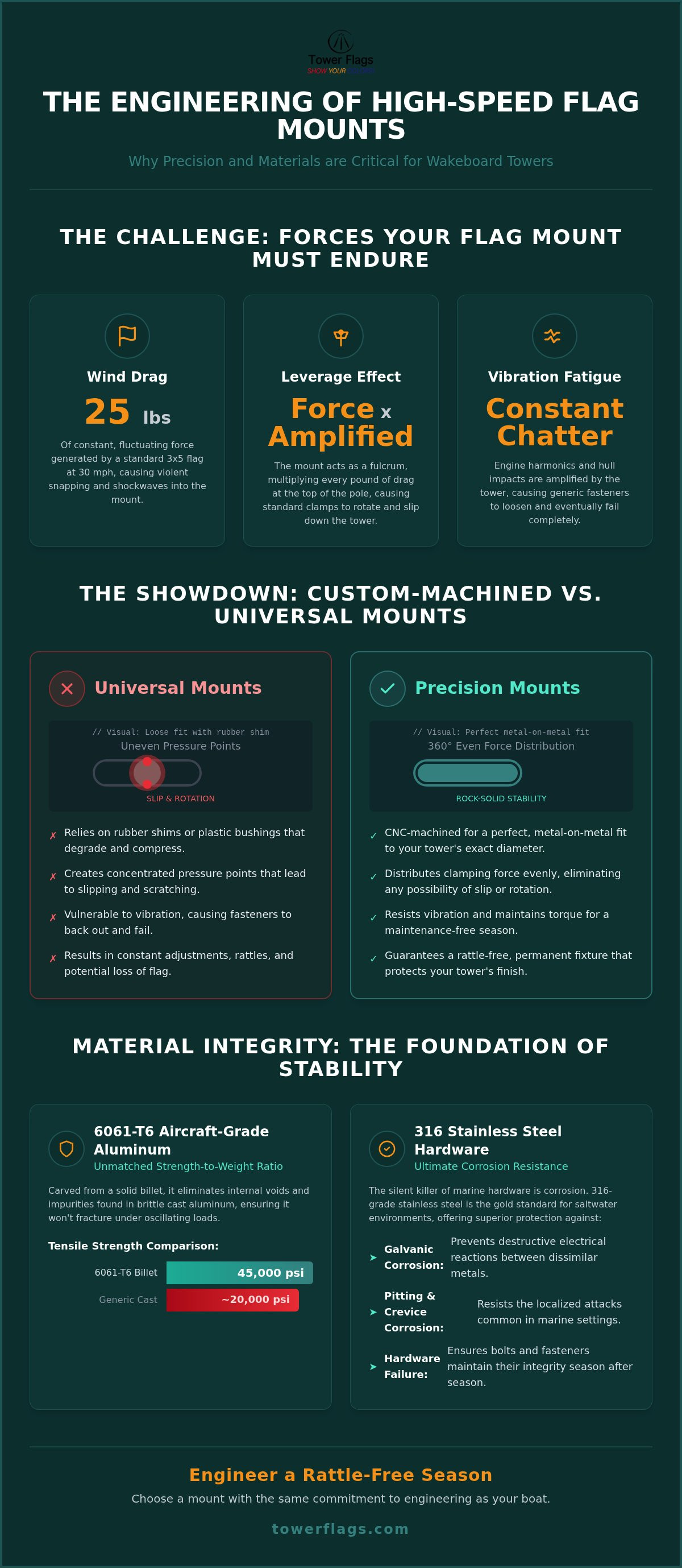
Aerodynamic drag is the mechanical force generated by air resistance as it interacts with the surface area of the flag and pole. When you're cruising at 30 mph, a standard 3x5 marine flag generates approximately 25 lbs of constant pull. This force isn't steady; it fluctuates rapidly due to Vortex shedding. This phenomenon occurs as wind flows around the pole, creating alternating low-pressure zones that cause the flag to snap and flutter violently. This oscillating motion sends high-frequency shockwaves directly into the mounting bracket.
The position of the mount on the tower leg also creates a "Leverage Effect." Because the flag sits several feet above the mounting point, the bracket acts as a fulcrum. Every pound of drag at the top of the pole is amplified at the base. Standard mounts often rotate or slide down the tower because they rely on friction alone. Without a precision-machined fit that matches the exact diameter of your tower, the bracket will eventually yield to this mechanical advantage, resulting in scratched powder coating or hardware failure.
Vibration Fatigue in Marine Environments
Wakeboard towers act like massive tuning forks. They capture engine harmonics and hull impacts from the water, amplifying these vibrations at the highest points of the structure. In a high-speed marine environment, this high-frequency "chatter" is the primary reason generic fasteners fail. Standard thumbscrews are particularly vulnerable; they lack the surface area and thread tension to maintain torque when the tower begins to vibrate. Over a single afternoon, these vibrations can cause a loosely fitted bracket to back out, leading to a total loss of the flag and pole.
Material choice plays a critical role in resisting this fatigue. Many mass-produced mounts use plastic bushings or rubber shims to achieve a "universal" fit. Under the heat of the sun and the pressure of high-speed wind loads, these materials compress and degrade. Once the shim loses its structural integrity, the bracket develops a minute amount of play. This gap allows the metal components to hammer against each other, eventually cracking the aluminum or shearing the bolts. A precision-engineered, metal-on-metal fit is the only way to ensure the assembly remains rock-solid through years of aggressive maneuvers.
Material Integrity: Why 6061-T6 Aluminum and 316 Stainless Win
The structural survival of a flag mount depends entirely on the metallurgical properties of its components. While generic accessories often use 6063 or cast alloys to save on manufacturing costs, these materials lack the internal integrity required to withstand the leverage of a high-speed flag display. When calculating the impact of aerodynamic drag, the yield strength of the mounting material becomes the literal breaking point of the system. Selecting the best wakeboard tower flag mount for high speeds means looking past the surface finish and examining the raw specifications of the metal.
Metallurgy for the Performance Boater
Marine-grade aluminum is defined by its inclusion in the 6000-series alloy group, specifically 6061-T6, which provides superior resistance to stress-corrosion cracking. We utilize 6061-T6 aircraft-grade aluminum because it offers a tensile strength of approximately 45,000 psi. This is significantly higher than the cast aluminum used in mass-market brackets. Cast aluminum is brittle. It contains internal voids and impurities that can lead to sudden fractures under the oscillating loads of a fluttering flag. In contrast, billet 6061-T6 is carved from a solid block, maintaining the grain structure of the metal for maximum load-bearing capacity. This weight-to-strength ratio is critical for tower-mounted accessories; you need a mount that is light enough to avoid stressing the tower's welds but strong enough to remain rigid at 40 mph.
Longevity and Saltwater Resistance
Corrosion is the silent killer of marine hardware. Galvanic corrosion occurs when two dissimilar metals, such as an aluminum bracket and a stainless steel bolt, are joined in a saltwater environment. Without proper engineering, these metals can effectively "weld" themselves together, making the mount impossible to adjust or remove. To prevent this, we specify 316-grade stainless steel for all fasteners. Unlike 304 stainless, 316 contains molybdenum, which provides essential resistance to pitting and "tea-staining" in high-salinity air. These fasteners are passivated to ensure the protective oxide layer is fully intact before they ever reach your boat.
The choice between anodization and powder coating also affects the long-term health of your wake tower. Powder coating is a surface layer that can chip or peel, allowing moisture to trap against the aluminum. Anodization is an electrochemical process that converts the metal surface into a decorative, durable, anodic oxide finish. This finish is integrated into the aluminum itself, providing a hard-as-diamond barrier that won't flake off. Choosing a precision-machined flag pole bracket ensures your hardware remains as pristine as your boat's finish, even after a full season of salt spray and high-speed runs.
Custom-Fit vs. Universal Brackets: The High-Speed Stability Test
Many boaters view a "universal" bracket as a convenient, one-size-fits-all solution. In reality, it's a mechanical compromise that rarely holds up under pressure. The best wakeboard tower flag mount for high speeds doesn't rely on generic inserts to bridge the gap between the bracket and the tower. It uses a custom-machined radius that matches your specific tower diameter to the millimeter. This precision fit ensures that the mount stays exactly where you put it, even when the wind force tries to tear it away.
The Slipping Bracket Problem
Universal mounts typically use rubber or plastic shims to accommodate various tube sizes. These materials are the weakest link in your setup. Under the constant strain of 25 mph winds, these soft inserts compress and lose their structural integrity. This leads to the "slipping bracket" phenomenon, where the entire assembly slides down the tower leg during a hard acceleration. This isn't just an aesthetic annoyance. A sliding bracket can cause permanent gouging and deep scratches on your tower's powder coat or polished finish. These damages are expensive to repair and directly impact your boat's resale value. You can find more details on avoiding these issues in our Ultimate Guide to Custom Boat Flag Brackets 2026.
Precision Engineering for Wake Towers
True high-speed stability is a result of surface contact. Our custom-machined clamp radii distribute pressure evenly across the tower leg, creating a rock-solid metal-on-metal connection. This design allows the bracket to remain secure with significantly less torque than a universal alternative would require. Scientific insights into The Physics of High-Speed Flag Mounting demonstrate that flags reach a critical speed where flapping becomes violent. A precision-engineered mount provides the necessary rigidity to handle these oscillating forces without vibrating loose. When you pair these brackets with Marine Flag Poles: Engineering for Durability and High-Speed Performance, you create a system that thrives at full throttle.
Beyond the technical advantages, custom mounts offer a level of aesthetic integration that generic hardware can't match. A custom-fit bracket looks like an extension of your Malibu or MasterCraft factory hardware. It lacks the bulky, clumsy appearance of universal clamps and their protruding rubber gaskets. By choosing a mount tailored to your boat's specific engineering, you're maintaining the premium look and feel of your vessel while ensuring total reliability on the water.
How to Measure Your Wakeboard Tower for a Precision Mount
Achieving a rock-solid installation starts with engineering-grade data. You can't rely on a best guess or a generic size chart if you expect your hardware to remain stationary at 40 mph. The best wakeboard tower flag mount for high speeds requires a fit that accounts for the specific geometry of your tower, including its taper and surface finish. Precision measurement isn't just about finding a diameter; it's about ensuring total mechanical integration between the bracket and the tubing.
The Precision Measurement Process
Before you reach for your tools, clean the intended mounting area thoroughly. Even a thin layer of salt spray or dried wax can interfere with a precision reading. We recommend using digital calipers for all measurements. While some manufacturers suggest using a string to find circumference and then dividing by pi, this method is prone to user error. It also fails to account for the subtle ovality found in many factory tower legs. Digital calipers provide a direct, unmistakable reading that eliminates the guesswork.
Step 1: Identify the exact vertical position where the bracket will sit. Because many towers are tapered, a measurement taken six inches higher or lower could result in a loose fit that eventually slips.
Step 2: Place the caliper jaws around the tubing. Take at least three readings at different angles around the circumference to verify if the tube is perfectly round.
Step 3: If your tower uses non-round or oval tubing, standard diameter measurements won't be enough. In these cases, you'll need to record the major and minor axis dimensions to ensure a custom-contoured fit.
Clearance and Accessory Compatibility
A secure fit is only half the battle. You must also consider the physical environment of the tower. Check for potential interference with tower speakers, bimini tops, or rotating board racks. The flag's flight path is equally important. Ensure the flag has enough clearance to fly freely without tangling in the tow rope or obstructing the driver's rear-view mirror. Once you've gathered your specific dimensions and confirmed clearance, you can order a custom-fit flag pole bracket designed specifically for your vessel's requirements.
Submitting these custom specs allows us to CNC-machine a bracket that matches your tower to the thousandth of an inch. This level of exactness is what separates a professional marine display from a rattling, universal alternative. By taking the time to provide engineering-grade measurements, you're guaranteeing a rattle-free experience. This process protects the structural integrity of your wakeboard tower and ensures your flag remains a proud, stable fixture through every high-speed maneuver.
The best wakeboard tower flag mount for high speeds is only as reliable as the pole it supports. Pairing our custom brackets with heavy-duty marine flag poles ensures that the entire assembly can handle the mechanical loads discussed previously. Our system utilizes a bolt-on design, which provides a significant advantage over permanent modifications. You don't have to drill holes into your tower's structural tubing, which preserves the integrity of the metal and prevents future corrosion points. This non-invasive approach relies on precision machining to generate clamping force rather than fasteners that penetrate the tower.
The Tower Flags Custom Advantage
Precision is our standard. While mass-produced alternatives prioritize low manufacturing costs, we focus on the structural integrity required for high-speed stability. American-made craftsmanship means we control every stage of the production process, from sourcing raw 6061 billet to the final anodization. Generic alternatives often rely on inferior alloys that look acceptable on a shelf but fail under the stress of high-speed marine maneuvers. This dedication to quality is why our hardware is the preferred choice for owners of Malibu G3 towers and MasterCraft vessels. These boaters understand that a high-performance vessel requires accessories built to the same engineering tolerances as the hull itself.
Final Performance Checklist
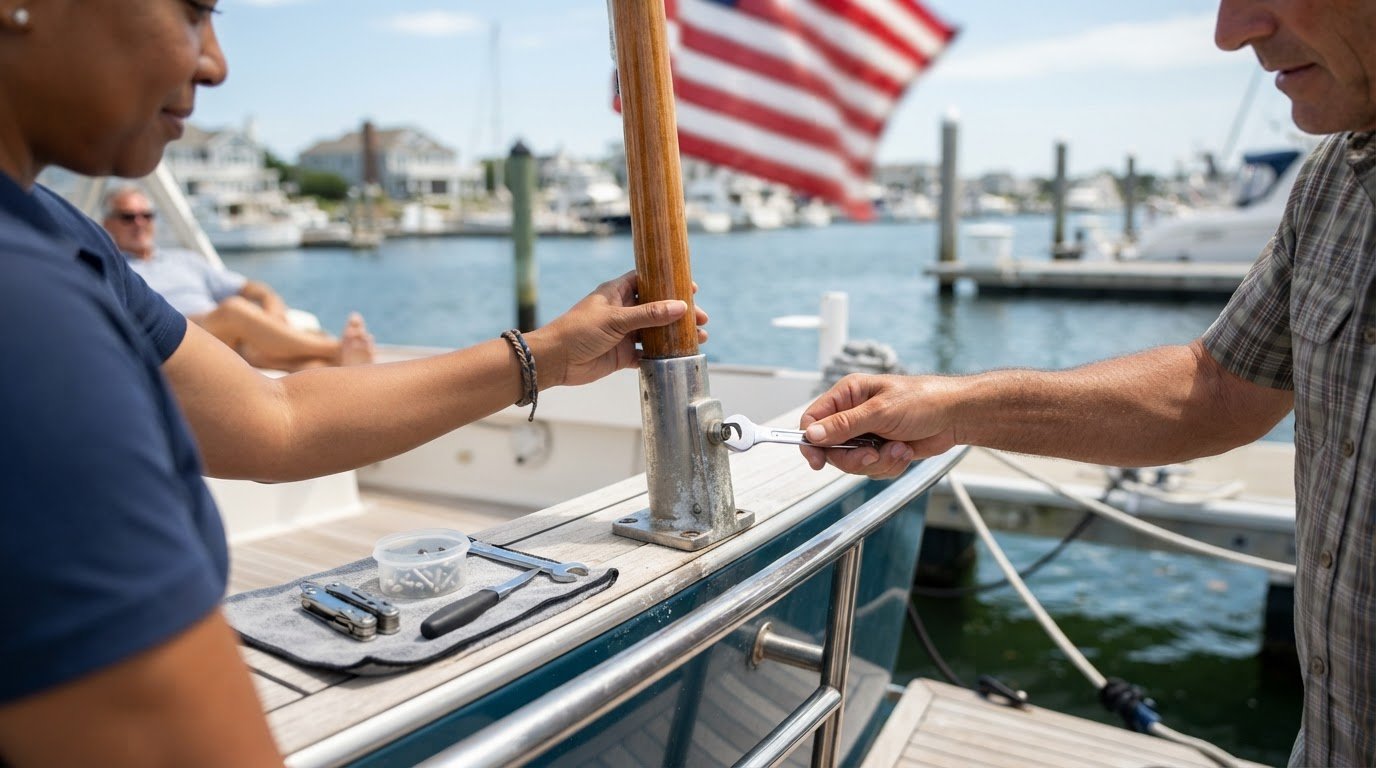
Before heading out, perform a quick inspection of your setup. Check that the 316 stainless steel fasteners are seated correctly. While our custom-fit design requires less maintenance, a routine wipe-down of anodized surfaces with fresh water prevents salt buildup and maintains the hardware’s aesthetic. Follow proper flag etiquette by ensuring your display doesn't obstruct navigation lights or visibility. By choosing hardware that rejects the universal compromise, you're investing in a system that performs as well as it looks. Secure your flag with a custom-fit Tower Flags mount today.
Engineer a Rattle-Free Season
High-performance marine maneuvers require hardware that can withstand the extreme leverage and vibration of the open water. We've explored why precision-engineered 6061-T6 aluminum and 316-grade stainless steel are the only materials capable of surviving these conditions over the long term. By rejecting the universal compromise in favor of a custom-machined fit, you protect your tower's finish and ensure your flag remains a stable, proud fixture even at full throttle.
Finding the best wakeboard tower flag mount for high speeds isn't just about aesthetics; it's about mechanical integrity and peace of mind. When your equipment is built to the exact tolerances of your Malibu or MasterCraft tower, you can focus on the ride instead of checking your mirrors for slipping brackets. It's time to upgrade to a specialized solution that matches the craftsmanship of your boat.
Shop Custom Wakeboard Tower Flag Mounts and experience the difference of American-made, high-speed stability. We look forward to seeing your colors flying high on the lake this season.
Frequently Asked Questions
Will a custom wakeboard tower flag mount fit my specific boat model?
Yes, custom-fit brackets are engineered to match the exact tubing diameter of your boat's tower, regardless of the manufacturer. Whether you own a Malibu with a G3 tower or a MasterCraft with a Z6, we machine the clamp radius to your provided specifications. This precision ensures that the bracket integrates perfectly with your factory hardware, providing a seamless look and a non-slip grip that mass-produced accessories cannot replicate.
Can I fly a 3x5 flag at speeds over 30 mph?
Flying a 3x5 flag at speeds over 30 mph is possible with the right equipment, though most flag poles are not rated for constant speeds exceeding 40 mph. At 35 mph, a 3x5 flag generates approximately 25 lbs of wind force. To handle this load, you must use the best wakeboard tower flag mount for high speeds. Standard mounts often fail under these conditions, but precision-engineered brackets distribute this force evenly to prevent hardware fatigue.
Do I need to drill into my wakeboard tower to install a flag mount?
No drilling is required for the installation of our flag pole brackets. These systems utilize a high-tension, bolt-on design that relies on precision machining to generate superior clamping force. By avoiding permanent modifications, you preserve the structural integrity and resale value of your wakeboard tower. This non-invasive approach also prevents the creation of new corrosion points that often occur when the tower's factory finish is compromised by drilling.
What is the best material for a high-speed boat flag bracket?
The industry standard for high-performance marine hardware is 6061-T6 aircraft-grade aluminum paired with 316-grade stainless steel fasteners. This combination provides the high tensile strength needed to resist the leverage of wind drag at speed. While cheaper alloys exist, they lack the durability required for marine environments. Using 316 stainless is particularly vital because it contains molybdenum, which prevents the pitting and tea-staining common in high-salinity air.
How do I prevent my flag mount from sliding down the tower leg?
Preventing bracket migration requires a metal-on-metal precision fit rather than relying on rubber shims or plastic inserts. Universal brackets often slip because their soft inserts compress under high-speed wind loads. A custom-machined bracket that matches your tower's exact diameter creates maximum surface contact. This design ensures that the mount remains stationary during aggressive acceleration or high-speed runs without the need for excessive torque that could damage your tower's finish.
Are custom-fit brackets better than universal ones for saltwater use?
Custom-fit brackets offer superior performance in saltwater environments because they eliminate the gaps where salt spray and moisture typically collect. Universal mounts often use porous rubber shims that trap brine against the metal, accelerating galvanic corrosion. A precision-machined, anodized aluminum bracket creates a tighter seal against the tower leg. This design, combined with passivated 316 stainless steel fasteners, ensures your hardware remains functional and aesthetically pristine throughout the entire boating season.
How do I measure my wake tower if the tubing is tapered?
Measuring a tapered tower requires identifying the exact vertical position where you intend to install the bracket. Use digital calipers to take a reading at that specific point, as the diameter can vary significantly over just a few inches of tower height. It's helpful to take multiple readings around the circumference to verify the tubing's roundness. Providing these precise dimensions allows for a CNC-machined fit that stays secure on tapered or curved structures.
What is the difference between 6061 aluminum and standard cast metal?
6061-T6 aluminum is a billet material with a tensile strength of approximately 45,000 psi, while standard cast metal is often brittle and contains internal impurities. Cast components are made by pouring molten metal into molds, which can result in structural voids that fail under the oscillating loads of a fluttering flag. Billet 6061 is carved from a solid block, ensuring a consistent grain structure that makes it the best wakeboard tower flag mount for high speeds.
Comments