

2026 Pontoon Accessories: Flag Pole Mount Guide
The "universal fit" flag mount is a mechanical compromise that has no place on a high-performance 2026 tritoon. You've likely felt the frustration of a bracket that rattles at 30 mph or, worse, seen a plastic mount snap after just one season in the sun. It's exhausting to watch hardware vibrate against your luxury powder-coated rails because a generic bracket wasn't engineered for the specific geometry of your boat.
We understand that your vessel represents a significant investment in craftsmanship, and its accessories should reflect that same standard. This guide explores why a precision-engineered pontoon boat flag pole mount is the essential 2026 upgrade for owners who prioritize mechanical integrity over disposable hardware. You will discover how custom-milled aluminum and vibration-dampening linings create a display that remains rock-solid at any cruising speed. We will break down the technical differences between mass-produced nylon and custom-engineered solutions to ensure your hardware lasts as long as your boat does.
Table of Contents
Must-Have Pontoon Boat Accessories for 2026: Elevating Your Vessel
The 2026 marine market reflects a decisive move toward precision. As tritoons evolve into high-speed social platforms, the standard for every bolt-on component has shifted from "adequate" to "engineered." Owners no longer settle for generic, mass-produced plastic bits that yellow under the sun or rattle at full throttle. Instead, there's a growing demand for American-made hardware that matches the vessel's sophisticated design. Accessory categories like integrated LED lighting, high-fidelity audio, and specialized mounting systems are now built to withstand the specific rigors of the water. A high-quality pontoon boat flag pole mount has transitioned from a simple utility item into a primary aesthetic feature. It serves as a statement piece that reflects the owner's commitment to both style and structural integrity, ensuring that the vessel looks as refined as it performs.
The Evolution of Pontoon Utility
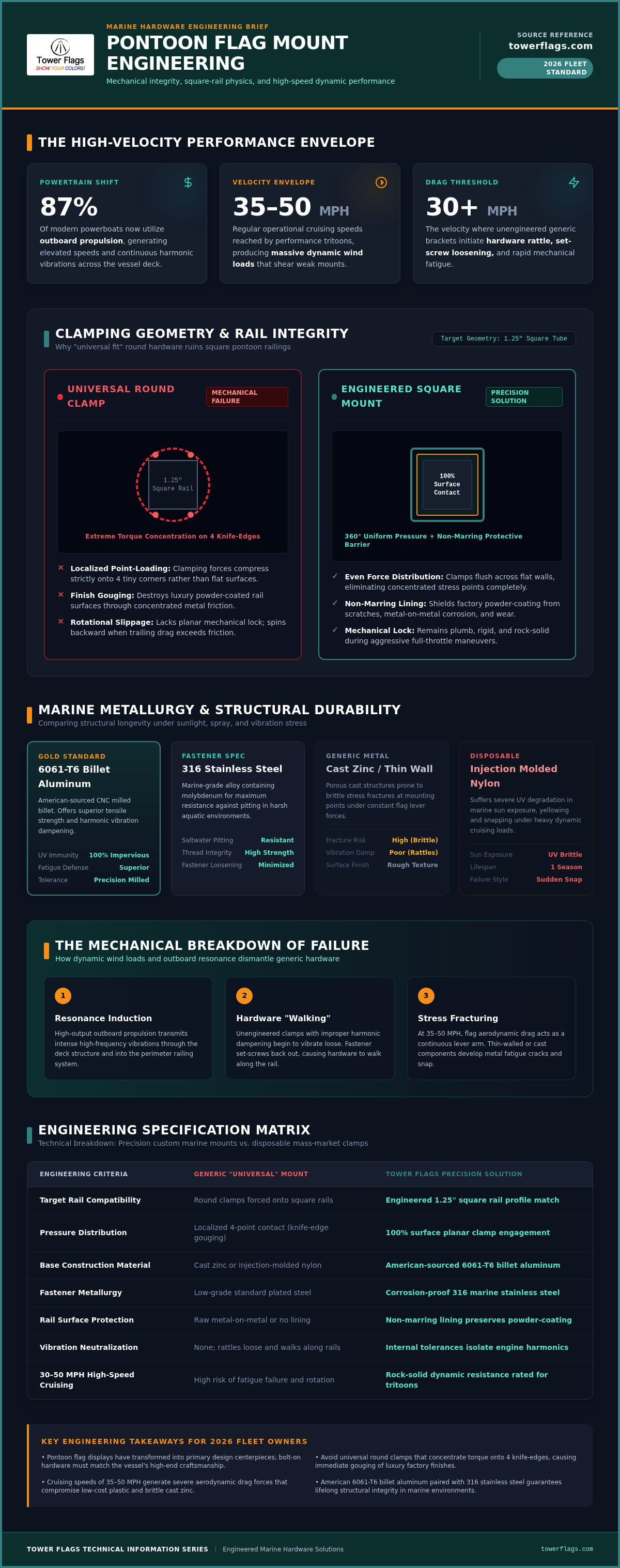
Modern pontoon boats have shed their reputation as slow-moving barges. With 87% of powerboats now utilizing outboard propulsion, performance tritoons regularly reach speeds between 35 and 50 MPH. This increased velocity creates massive dynamic wind loads that traditional "good enough" accessories simply cannot handle. We're seeing a fundamental replacement of standard hardware with custom-fabricated solutions. When a vessel is capable of high-speed maneuvers, every component must be rated for that specific performance envelope. Hardware that lacks this structural foundation will eventually fail under the pressure of cruising speeds.
Identifying Quality in Marine Hardware
True marine quality is found in the materials and the manufacturing method. In 2026, the gold standard remains American-sourced 6061-T6 billet aluminum and 316 stainless steel hardware. These materials offer the necessary tensile strength and corrosion resistance that generic alternatives lack. Low-end plastic accessories often suffer from UV degradation; this leads to brittle failure and snapping under pressure during heavy cruising. High-end engineering is visible in the details. Look for clean, precision-milled edges rather than the rough textures of cast parts. A premium pontoon boat flag pole mount will feature a non-marring lining to protect your boat's powder-coated finish. This attention to detail proves that the hardware was designed with the vessel's long-term value in mind, avoiding the metal-on-metal wear that ruins factory railings.
The Engineering Behind a Secure Pontoon Boat Flag Pole Mount
Standard marine sockets are typically designed for round stanchions or flat fiberglass decks, but these designs fail when applied to the unique architecture of a pontoon. A pontoon boat flag pole mount must account for the specific stresses of a square rail system and the high-frequency vibrations of outboard engines. A precision-engineered mount is a specialized bracket designed with exact internal tolerances to neutralize harmonic vibration while ensuring a flush, non-marring fit against specific rail profiles. Unlike generic hardware that relies on friction and luck, a custom-fit bracket utilizes mechanical advantage to lock onto the railing, providing a foundation that won't budge even when the boat is pushed to its performance limits.
Square Rail vs. Round Rail Mounting
Most aftermarket accessories are sold as "universal," which usually means they utilize a round clamp. When you attempt to secure a round clamp to a 1.25-inch square pontoon rail, you encounter the physics of point loading. The clamp only makes contact with the four knife-edges of the square tubing. This concentrates all the torque and vibration onto four tiny points, which leads to immediate gouging of your boat's powder-coated finish. Custom-fit Flag Pole Brackets solve this by matching the flat geometry of the rail, distributing the clamping pressure evenly across the entire surface area. This prevents slipping and ensures the bracket remains vertical under the heavy drag of a trailing flag.
Vibration Dampening and Metal Fatigue
Pontoons experience a unique type of harmonic vibration caused by the interaction of the deck structure and outboard power. This resonance can cause standard hardware to "walk" down the rail or vibrate set-screws loose over time. Precision engineering accounts for these frequencies by utilizing materials like 6061-T6 billet aluminum, which offers superior dampening characteristics compared to brittle cast zinc or thin-walled stainless steel. Material thickness is also a critical factor in preventing metal fatigue. A bracket that is too thin will eventually develop stress fractures at the mounting points due to the constant leverage effect of a four-foot pole. By prioritizing structural mass and exact fitments, you eliminate the rattling and movement that eventually leads to hardware failure.
High-Speed Performance: Why Generic Mounts Fail
Modern high-performance tritoons aren't just floating docks; they're machines capable of speeds exceeding 50 MPH. At these velocities, your pontoon boat flag pole mount is subjected to intense aerodynamic stress that would shear standard hardware. A 3x5 foot flag acts like a sail. At 30 MPH, it exerts massive drag force that concentrates directly on the mounting bracket. Generic hardware isn't designed for these specific loads. It's built for the lowest common denominator, usually failing when the boat leaves the no-wake zone. Understanding the physics of wind resistance is the first step in ensuring your display remains secure during high-speed transit.
Drag Forces and Flag Size
Wind resistance doesn't increase linearly; it increases exponentially. If you double your boat's speed, you quadruple the drag force on the flag. This is why a 3x5 flag requires a heavy-duty bracket compared to a small 12x18 inch pennant. Cheap injection-molded plastic mounts often suffer from material fatigue in these high-wind scenarios. They lack the tensile strength of 6061-T6 billet aluminum and will eventually snap under the pressure. Utilizing high-quality marine flag poles is only half the battle. If the base isn't rock-solid, the entire assembly becomes a liability the moment you throttle up.
Securing Your Investment
The "Leverage Effect" is a primary cause of equipment loss on the water. A four-foot pole acts as a long lever arm, multiplying the force of the wind at the point where the bracket meets the rail. If there's even a millimeter of play in a "universal" clamp, the resulting vibration will eventually cause the hardware to walk or fail entirely. Losing a premium pole and a custom flag to the lake is a costly and avoidable mistake. Precision-fit custom boat flag brackets provide the peace of mind needed for aggressive maneuvers. They eliminate the movement that leads to failure, ensuring your hardware stays exactly where you installed it. When your bracket is machined to match your rail's exact dimensions, you don't have to worry about the display tilting or vibrating loose at cruising speeds.
Selection Guide: Choosing Pontoon Hardware
Selecting the right pontoon boat flag pole mount requires a shift in perspective from buying a commodity to investing in a precision component. You must evaluate the physical dimensions of your vessel alongside the aesthetic goals of your build. The goal is a seamless integration that feels like a factory-installed feature rather than an aftermarket addition. Beyond the fit, you must consider the placement. Maritime protocol suggests flying the national ensign from the stern rail, but you must also ensure the location doesn't obstruct docking lights or the operation of your bimini top. A well-placed mount maximizes visibility without compromising the safety or utility of the deck. You also need to balance the stability of a permanent mount with the practical need for rapid removal when using tight-fitting boat covers.
Measuring for a Precision Fit
Precision begins with an accurate measurement of your rail's exterior dimensions. While approximately 90% of modern pontoon boats utilize 1.25-inch square aluminum tubing, older models or custom luxury builds may feature 1.125-inch or even 1.0-inch profiles. Use a digital caliper to verify these dimensions before ordering. Guessing leads to the "universal" fit issues where gaps cause vibration and finish damage. Exact measurements are the foundation of durable boat flag hardware that remains secure over thousands of miles. Check the intended mounting area for weld beads or existing hardware that might interfere with the bracket's footprint. A clear, flat section of rail is necessary for the bracket to achieve full surface contact.
Style and Finish Considerations
The aesthetic finish of your bracket should complement the boat's trim. If your vessel features matte black powder-coated rails, a matching anodized finish provides a stealthy, high-end look. For boats with polished accents, a bright-dipped aluminum finish adds a classic marine touch. Be mindful of galvanic corrosion; always use high-grade 316 stainless steel fasteners with your aluminum brackets. This prevents the chemical reaction between dissimilar metals that causes pitting and white rust in brackish environments. Ensure your pontoon boat flag pole mount doesn't create a snag point for fishing lines or mooring ropes. By choosing hardware that matches the vessel's existing material science, you preserve the boat's resale value and structural health.
The Tower Flags Difference: Precision-Engineered Marine Solutions
We don't believe in "one size fits most." On the water, that phrase usually means "one size fits nothing well." Tower Flags exists to solve the specific mechanical failures that plague pontoon owners who rely on generic hardware. Our approach to the pontoon boat flag pole mount is rooted in specialized marine engineering rather than retail convenience. By focusing on the exact tolerances required for square rail systems, we provide a solution that eliminates the rattling and marring common with mass-market brackets. We understand the relief of finding hardware that actually fits, and we take pride in manufacturing products that outperform the industry standard.
Craftsmanship Over Mass Production
We operate as a dedicated specialist, prioritizing the fit and finish that only custom fabrication can provide. Every bracket is machined from American-sourced 6061-T6 billet aluminum, a material chosen for its exceptional strength-to-weight ratio and corrosion resistance. This precision manufacturing process ensures that every edge is clean and every dimension is exact. Mass-produced alternatives often rely on cheap castings or injection-molded nylon that degrades under UV exposure. These inferior materials eventually snap or warp, but our billet aluminum components are designed for permanent durability. Our hardware is built to endure the lifetime of your vessel, making it the final pontoon boat flag pole mount you'll ever need to buy.
Ready to Upgrade Your Pontoon?
Upgrading your boat shouldn't involve guesswork or manual modifications. We've streamlined our collection to help you find the exact high speed boat flag mounts your tritoon requires. Our system is designed for the modern boater who values both performance and aesthetic elegance. Whether you're running a standard 1.25-inch rail or a custom profile, our ordering process ensures you receive a bracket designed specifically for your hardware. You can select from various finishes to match your trim, ensuring your flag display looks like an integrated part of the boat's design. We provide the rock-solid foundation needed so you can focus on the water, not your hardware.
Commit to Precision on the Water
Investing in a high-performance vessel requires accessories that match its engineering. We have explored how the shift toward custom-fabricated hardware is essential for modern boating standards. A specialized pontoon boat flag pole mount is no longer just an aesthetic choice; it is a structural necessity for those who cruise at speeds over 30 mph. By prioritizing 6061-T6 billet aluminum and precision fitments, you eliminate the vibration and finish damage caused by generic, mass-produced brackets. Your boat deserves hardware that reflects its value. Precision matters. Our commitment to specialized marine engineering ensures that your display remains rock-solid during every aggressive maneuver. It's time to stop settling for universal compromises. Start investing in hardware designed to last the lifetime of your vessel. High-grade materials are the only way to ensure your flag stays exactly where it belongs. Secure your style with a custom-engineered Tower Flags mount today. We look forward to helping you elevate your experience on the water with hardware you can trust.
Frequently Asked Questions
Will a pontoon boat flag pole mount fit on square rails?
Yes, a specialized pontoon boat flag pole mount is designed specifically for the square aluminum tubing found on modern vessels. You've likely seen generic round clamps that only touch the corners, but custom-engineered brackets provide full surface contact. This design prevents the bracket from slipping or rotating under the heavy wind loads experienced during high-speed cruising. Always verify your rail dimensions, such as 1.25-inch or 1.125-inch, to ensure a precision fit.
What is the best material for a marine flag pole bracket in 2026?
American-sourced 6061-T6 billet aluminum paired with 316 marine-grade stainless steel hardware is the gold standard for 2026. This combination provides the high tensile strength required to handle the leverage of a flag pole without the risk of brittle failure. Unlike injection-molded plastic or chrome-plated zinc, these materials resist UV degradation and the harsh effects of brackish environments. Precision-milled aluminum offers a superior finish that doesn't compromise the high-end aesthetic of modern luxury pontoons.
Can I leave my flag up while cruising at high speeds?
You can safely display your flag at cruising speeds if your mounting hardware is rated for high-speed performance. Drag forces on a flag increase exponentially as your velocity rises, which can snap inferior plastic mounts or pull loose "universal" brackets. A precision-engineered pontoon boat flag pole mount utilizes mechanical advantage and exact tolerances to remain rock-solid at 30 mph or more. We recommend using high-strength flag poles to ensure the entire assembly handles the aerodynamic stress.
Do I need to drill holes in my pontoon rails to mount a flag pole?
You don't need to drill into your factory rails when using a high-quality clamp-on bracket system. Modern engineering allows for a secure, non-destructive installation that relies on exact fitment rather than permanent holes. These brackets utilize a split-clamp design that locks onto the square tubing, providing a foundation as stable as a bolted mount. This approach preserves the structural integrity and resale value of your boat while allowing for easy repositioning or removal.
How do I prevent my flag pole mount from scratching the boat's finish?
Preventing finish damage requires a bracket with a non-marring protective lining and a precision-milled interior. Generic hardware often lacks these cushions, leading to metal-on-metal contact that gouges powder-coated or anodized rails. A custom-fit bracket distributes clamping pressure evenly across the flat surfaces of the rail rather than concentrating it on the edges. This even distribution, combined with an internal elastomer or neoprene lining, ensures your hardware stays secure without leaving a single mark on the boat's finish.
What size flag is recommended for a standard pontoon boat pole?
For a standard 20 to 24-foot pontoon, a 20x30 inch or 2x3 foot flag is generally recommended. It's helpful to remember that maritime etiquette suggests one inch of flag length for every foot of boat length. While a 12x18 inch flag is a common utility standard, larger flags are popular for better visibility on open water. Just ensure your bracket and pole are engineered to handle the increased wind resistance that comes with larger surface areas.
Is there a difference between a wakeboard tower mount and a pontoon rail mount?
The primary difference lies in the clamping geometry and the mounting surface profile. Wakeboard towers typically utilize round tubing with varying diameters, requiring a circular clamp. Pontoon rails are predominantly 1.25-inch square aluminum extrusions, which require a flat-faced bracket for a secure fit. Using a tower mount on a square rail results in point loading, which causes slippage and rail damage. Specialized hardware is necessary to match the specific architecture of your vessel's railing system.
How do I maintain my marine flag hardware to prevent corrosion?
Regular maintenance involves rinsing your hardware with fresh water after every outing, especially in saltwater environments. This simple step removes salt crystals that can lead to pitting or corrosion over time. We utilize 316 stainless steel fasteners to prevent the galvanic corrosion that occurs when dissimilar metals react. Periodically check the bracket's internal lining for wear and ensure all fasteners remain tight. High-grade anodized aluminum requires very little upkeep beyond basic cleaning to maintain its finish.


Comments