

Cuddy Cabin Flag Mount Buying Guide 2026
At 40 knots, a "universal" flag mount isn't just a compromise; it's a liability waiting to vibrate loose and scar your gelcoat. Most boaters understand the frustration of finding rust streaks on a pristine white deck or discovering that a generic bracket simply won't grip their specific rail diameter. You deserve a cuddy cabin flag mount that matches the premium engineering of your boat rather than something pulled from a bargain bin. It's about finding a specialized solution that respects the craftsmanship of your vessel while standing up to the rigors of the open water.
Choosing the right hardware means looking past the surface finish to the mechanical integrity underneath. This guide breaks down the technical requirements for high-performance flag displays specifically designed for the unique layout and speed requirements of a cuddy cabin. We will detail the necessity of 316 stainless steel for saltwater durability, explain how to achieve a precision fit on modern rail systems, and provide the peace of mind that your colors will remain flying true during the most aggressive offshore runs. By the end of this guide, you will know exactly how to secure a rock-solid display that looks as good as it performs.
Table of Contents
The Unique Challenges of Cuddy Cabin Flag Mounting
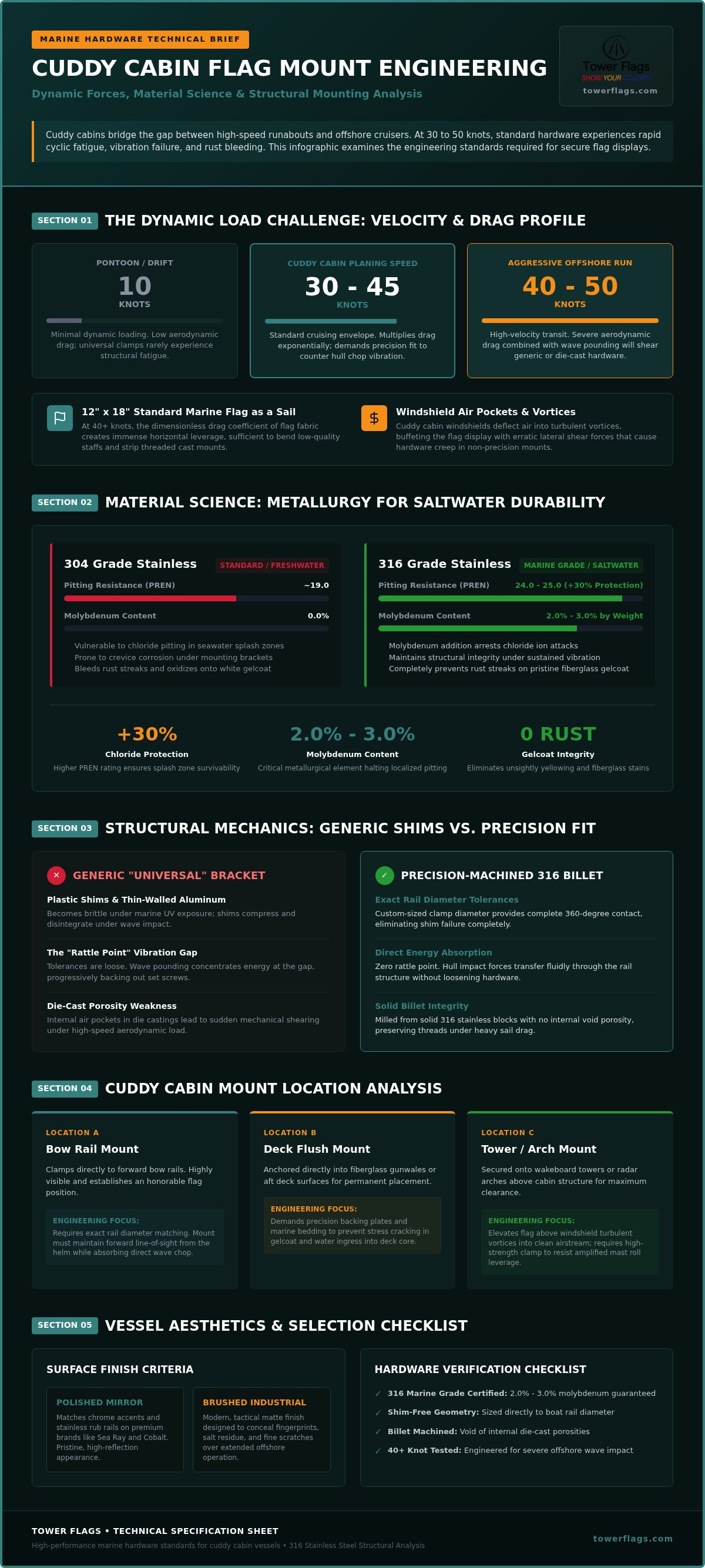
Cuddy cabins occupy a specific niche in the boating world. They combine the speed of a runabout with the offshore capability of a larger cruiser. This combination creates a punishing environment for hardware. While a pontoon boat might drift at 10 knots, a modern cuddy cabin frequently planes at 30 to 45 knots. At these speeds, a standard cuddy cabin flag mount faces forces that would snap inferior components. It's not just about holding a pole; it's about resisting the relentless cyclic fatigue caused by hull geometry and wave impact.
A true marine-grade mount for 2026 must be engineered for these specific stresses. Generic hardware often relies on universal fitments that use plastic shims or thin-walled aluminum. These materials can't handle the high-frequency vibrations of a V-hull slicing through chop. To maintain a permanent, rock-solid display, you need hardware crafted from marine-grade stainless steel. This material provides the necessary molybdenum content to prevent chloride pitting while offering the structural rigidity required for high-speed transit.
Aerodynamics and Drag at Cruising Speed
Physics doesn't take a day off on the water. A flag acting as a sail creates significant aerodynamic drag. When you're running at 40 or 50 knots, even a standard 12x18 inch flag generates enough force to bend a low-quality staff or strip the threads on a cast mount. Cuddy cabins present an additional challenge: the windshield. These large glass surfaces create turbulent air pockets and vortices that buffet the flag. In marine flag displays, the drag coefficient represents a dimensionless quantity used to quantify the aerodynamic resistance of the flag fabric as it interacts with relative wind speed while the vessel is underway. Without a precision-engineered bracket, this turbulence leads to hardware creep and eventual failure.
Vibration and Material Fatigue
Wave pounding is the silent killer of marine hardware. Every time your hull hits a swell, that energy travels directly through the rails. In generic mounts, this energy finds the rattle point, which is the small gap between a universal bracket and the rail. Over time, this vibration backs out set screws and rounds off mounting holes. Plastic components become brittle under UV exposure and snap under the first heavy load. Precision-machined 316 stainless steel eliminates these gaps. By utilizing custom-fit tolerances, specialized brackets absorb the shock rather than fighting against it. You won't have to worry about your hardware vibrating loose when you're miles offshore.
Material Science: Why 316 Stainless and Precision Engineering Matter
The integrity of a cuddy cabin flag mount depends entirely on its metallurgical composition. In the 2026 marine market, the term "stainless steel" is often used loosely to mask inferior alloys. For a vessel that lives in a saltwater environment, the choice between 304 and 316 grade stainless steel is the difference between a lifetime of service and a single season of utility. 316 stainless steel contains 2.0% to 3.0% molybdenum by weight. This specific addition provides the critical corrosion resistance in seawater applications that prevents localized pitting and crevice corrosion in splash zones. While 304 stainless has a Pitting Resistance Equivalent Number (PREN) of roughly 19.0, 316 grade reaches 24.0 to 25.0, offering nearly 30% more protection against chloride attack.
Aesthetics also play a vital role in choosing hardware that complements a high-end boat. Polished finishes offer a mirror-like shine that matches the chrome accents and stainless rub rails found on premium brands like Sea Ray or Cobalt. Conversely, a brushed finish provides a modern, industrial look that hides fingerprints and minor scratches better over time. Regardless of the finish, the underlying material must be solid. Precision-machined billet hardware will always outperform die-cast alternatives that often hide internal porosities and structural weaknesses.
Corrosion Resistance in the 2026 Marine Market
The hidden cost of cheap hardware is the damage it leaves behind. When a low-grade mount begins to oxidize, it bleeds rust streaks onto the white gelcoat. These stains are difficult to remove and can cause permanent yellowing of the fiberglass. Galvanic corrosion is another risk; when dissimilar metals like a cheap aluminum bracket and a stainless rail meet, the resulting electrical reaction eats away at the softer metal. This is why Tower Flags prioritizes high-grade durable boat flag hardware designed to remain inert even in high-salinity environments. Using 316 stainless fasteners with 316 mounts ensures the entire assembly reacts uniformly to the elements.
The Engineering of a Secure Fit
Precision fabrication eliminates "hardware creep," which is the slow migration of a bracket under the constant pressure of wind and vibration. Mass-produced molds often have loose tolerances, forcing boaters to use rubber shims to fill the gaps. These shims eventually dry out, compress, and fall out, leaving the mount loose. A custom-fabricated bracket is machined to the exact outside diameter (OD) of your rail, whether it's the standard 7/8 inch or the heavy-duty 1-1/4 inch tubing. This perfect fit distributes clamping pressure evenly, removing the need for damaging over-tightening. You can find a permanent, rock-solid solution by browsing our custom flag pole brackets, where American-made craftsmanship ensures every detail meets high-performance standards.
Comparing Cuddy Cabin Mount Locations: Rail vs. Deck vs. Tower
Selecting the optimal placement for a cuddy cabin flag mount requires balancing visibility, aesthetics, and structural integrity. Unlike center consoles with open gunwales, cuddy cabins feature enclosed forward decks and crowded transoms. The bow rail is a popular choice for pennants, but it presents a visibility challenge. If the flag is too large or the mount is positioned poorly, it can obstruct the operator's line of sight during planing. It's critical to consult the Coast Guard navigation and vessel rules to ensure your flag placement doesn't interfere with required visibility arcs or navigation lights.
Gunwale and deck mounting offer a traditional look, utilizing permanent sockets. This method is ideal for the U.S. Ensign at the stern. However, the fiberglass crown of a cuddy cabin's aft section often hides fuel vents or shore power inlets. When through-bolting a deck mount, you must use a backing plate. A flag staff acts as a lever arm; at 30 knots, it exerts significant torsional load on the gelcoat. Without proper weight distribution, you risk spiderweb cracking in the fiberglass. A permanent socket provides a clean profile but requires a commitment to a specific location that won't interfere with motor tilt or boarding ladders.
Rail Mount Performance
Rail-based systems are the most versatile option for cuddy cabins. They allow you to test different positions before finalizing a location. The primary failure point for these systems is a loose fit. Most recreational rails measure 7/8 inch or 1 inch, but modern offshore vessels may use 1-1/4 inch tubing. Using a generic bracket with shims leads to hardware creep as the vessel pounds through waves. A precision-machined solution ensures the bracket grips the metal directly, preventing rotation. For a detailed look at selecting the right specs, see our custom boat flag brackets guide.
Tower and Arch Integration
Wakeboard towers and radar arches are the gold standard for high-speed flag display. They offer the greatest height, ensuring your colors are visible even when the boat is in a deep trough. This location also keeps the flag away from the turbulent air pockets created by the cabin's windshield. However, height brings clearance concerns. You must consider bridge heights and boat lifts when choosing a tower mount. Modular tower-clamp brackets are superior here because they can be rotated or removed quickly before trailering. If your vessel is equipped with a tower, a high-speed wakeboard tower flag mount provides the most secure attachment point for sustained cruising above 40 knots.
The Selection Checklist: Finding Your Cuddy Cabin Flag Mount
Purchasing a cuddy cabin flag mount requires more than a visual estimate. Because high-performance vessels generate significant torque, every millimeter of fit matters. Follow this structured checklist to ensure your hardware remains secure at 40 knots and beyond.
Step 1: Measure your rail or tower diameter. Use a digital caliper to get a reading within 0.01 inches.
Step 2: Determine flag size relative to boat length. A 24-foot boat typically carries a 12x18 inch or 16x24 inch flag.
Step 3: Assess the mounting angle. Angled displays provide a classic silhouette, while vertical mounts often distribute drag more evenly during high-speed runs.
Step 4: Verify material compatibility. Ensure your fasteners and brackets are both 316 stainless steel to prevent galvanic corrosion.
Step 5: Choose functionality. Fixed mounts offer maximum simplicity, while quick-release systems are essential for boaters who trailer their vessels frequently.
Precision Measurement Guide
A perfect bracket fit starts with accurate data. Most modern cuddy cabins from manufacturers like Sea Ray and Chaparral utilize standard rail diameters of 1 inch or 1-1/4 inches. However, some towers feature oval tubing or custom diameters that generic hardware cannot accommodate. To ensure an exact fit, place the jaws of the digital caliper around the widest part of the rail and tighten the thumb screw until the tool is snug but can still slide along the tubing. If your measurements fall between standard sizes, a custom-machined bracket is the only way to avoid the "universal shim" failure point mentioned previously.
Flag to Pole Ratio Safety
Safety on the water depends on mechanical synergy. Your marine flag poles must match the internal diameter of the bracket precisely to prevent rattling and structural fatigue. For a typical 21 to 28 foot cuddy cabin, we recommend a maximum flag size of 20x30 inches for stern mounts and 12x18 inches for bow rails. Exceeding these dimensions increases aerodynamic drag exponentially, which can bend the staff or strip the mounting threads in high-wind conditions. You can secure your vessel's display by selecting from our professional-grade flag pole brackets, engineered for total stability.
Why Custom-Engineered Hardware is the Logical Conclusion
Investing in a custom-engineered cuddy cabin flag mount represents the final step in shipboard discipline. For the discerning owner, hardware isn't just an accessory; it's a component of the vessel's structural integrity. At Tower Flags, our "Install it and Forget it" philosophy is born from a refusal to accept the industry standard of mediocrity. We understand that a flag display shouldn't require constant tightening or seasonal replacements. By choosing hardware designed for the specific rigors of your boat, you transition from temporary fixes to a permanent solution that respects the craftsmanship of your vessel.
The long-term ROI of precision-engineered hardware is undeniable. While a bargain-bin bracket might seem cost-effective initially, the cycle of failure is expensive. Replacing five cheap mounts over three seasons costs more than a single high-quality investment. Beyond the financial aspect, there is the hidden cost of damage to your gelcoat and the frustration of a failed display during a long-awaited weekend on the water. A low-profile, high-strength mount provides an aesthetic advantage that matches the sleek lines of a modern cruiser, ensuring your hardware looks like a factory-installed component rather than an afterthought.
Eliminating the Universal Fit Compromise
We firmly reject the "one size fits all" mentality that dominates the mass market. Universal mounts rely on rubber shims and oversized clamps to accommodate various rail sizes, but these shims eventually compress and fail under high-speed pressure. Our dedicated workshop focuses exclusively on marine flag hardware, ensuring every bracket is machined to exact tolerances. This specialized focus is why our high speed boat flag mounts are the preferred choice for owners who value vessel longevity. Custom fabrication removes the "rattle point" and ensures that the wind load is transferred safely to the boat's frame rather than stressing the mounting surface.
Final Recommendation for Cuddy Cabin Owners
Achieving a secure, professional flag display requires a commitment to quality materials and precision fitment. For cuddy cabin owners, the path to peace of mind at 40+ knots starts with accurate measurement and ends with American-made 316 stainless steel. Don't settle for hardware that vibrates loose or stains your deck with rust streaks. You've invested in a high-performance boat; it's time to equip it with hardware that can keep up. We invite you to explore our full selection of custom-engineered brackets and poles to find the perfect match for your vessel. Visit our online store today to secure a display that is built to last a lifetime.
Elevate Your On-Water Presentation
Securing a high-performance vessel requires hardware that matches its engineering. You now understand that the difference between a permanent display and a failed bracket lies in the metallurgical properties of 316 stainless steel and the precision of a custom fit. By moving away from universal shims and toward specialized fabrication, you eliminate the vibration and hardware creep that plague generic alternatives. It's about ensuring your colors fly true even when pushing through heavy chop at 40 knots.
Finding the right cuddy cabin flag mount shouldn't be a game of trial and error. Our workshop focuses on providing a specialized solution that integrates seamlessly with your boat's specific geometry. We invite you to Shop Precision-Engineered Cuddy Cabin Flag Mounts at Tower Flags to experience the benefits of custom-fit, zero-vibration performance. Every bracket we produce is manufactured from premium marine-grade materials and backed by proud American-made engineering. Take pride in the details and enjoy the peace of mind that comes with professional-grade hardware. Your boat deserves nothing less than perfection.
Frequently Asked Questions
Will a universal flag mount damage my cuddy cabin's stainless rails?
Yes, universal mounts often use rubber shims that compress over time, allowing the metal bracket to rub directly against your rails. This movement creates unsightly scuffs and deep scratches on your stainless steel. A precision-engineered cuddy cabin flag mount eliminates this friction by utilizing a custom-fit diameter that grips the rail without slipping. By distributing clamping pressure evenly, you protect your vessel's finish while ensuring the hardware remains rock-solid during high-speed transit.
What is the best material for a saltwater flag mount in 2026?
Marine-grade 316 stainless steel remains the gold standard for saltwater environments in 2026. Unlike 304 stainless or chrome-plated zinc, 316 contains molybdenum, which provides superior resistance to chloride pitting and crevice corrosion. This metallurgical composition prevents the bleeding rust streaks that often ruin a boat's white gelcoat. When you invest in high-quality billet hardware, you're choosing a material that withstands the corrosive salt spray encountered during offshore cruising.
How do I prevent my flag pole from vibrating at high speeds?
Vibration is usually caused by gaps between the bracket and the rail or the pole and the mount. You can eliminate this by using custom-fit flag pole brackets machined to the exact dimensions of your hardware. Standard universal mounts rely on loose tolerances that rattle at 30 knots, leading to material fatigue. A precision-engineered system ensures a snug, metal-to-metal connection that absorbs energy rather than vibrating loose, providing peace of mind during aggressive runs.
Can I mount a flag on my cuddy cabin if I don't have a wakeboard tower?
You don't need a tower to display your colors securely. Rail-mount brackets are the most common solution for cuddy cabins, attaching directly to the bow pulpit or stern rails. Alternatively, you can install a flush-mount deck socket on the gunwale for a permanent, traditional look. Both options provide excellent stability if you choose hardware designed for the specific geometry and speed requirements of your cruiser rather than relying on generic, light-duty accessories.
Is it better to mount the flag on the bow or the stern of a cuddy cabin?
Maritime protocol dictates that the U.S. Ensign belongs at the stern, which is considered the senior position of honor. This location also keeps the flag out of the operator's line of sight. Bow mounts are reserved for yacht club pennants or burgees. Mounting at the stern ensures you follow nautical etiquette while preventing the flag from obstructing forward visibility, which is a critical safety consideration for cuddy cabin operators navigating congested coastal waters.
What size flag is appropriate for a 25-foot cuddy cabin cruiser?
A 16" x 24" flag is the standard recommendation for a 25-foot cuddy cabin. The general maritime rule suggests one inch of horizontal flag length for every foot of boat length. For larger sport cruisers up to 28 feet, a 20" x 30" flag is also appropriate. Choosing the correct size ensures your cuddy cabin flag mount isn't overloaded by excessive aerodynamic drag while maintaining a balanced, professional appearance on the water.
How do I know if my boat rail is a standard size for a bracket?
Don't guess your rail size based on visual estimates. Use a digital caliper to measure the outside diameter of your tubing. While 7/8 inch and 1 inch are standard for many recreational rails, modern offshore cuddy cabins often utilize 1-1/4 inch heavy-duty tubing. Knowing your exact measurement within 0.01 inches allows you to select a custom-fit bracket that provides a permanent, zero-vibration grip without the need for unreliable plastic or rubber shims.
Do I need to remove my flag mount when trailering my boat?
You should remove the flag pole and flag before highway transit, but a high-quality bracket can remain permanently attached. Highway speeds often exceed 60 mph, creating aerodynamic loads that can bend poles or stress mounting points. Custom-engineered brackets are designed with a low-profile silhouette that doesn't interfere with boat covers or clearance. Removing the pole protects your investment from road debris and ensures your hardware is ready for the next launch without additional maintenance.


Comments