

5 Signs You Need Precision Engineered Boat Flag Mounts
- ianmackinnon4
- Aug 15
- 11 min read
Most "universal" boat flag mounts are designed to sit on a retail shelf, not to withstand the brutal physics of a 40-knot run across open water. You've likely experienced the frustration of watching a flag tear away at high speeds or hearing the constant, rhythmic rattle of a bracket that isn't quite the right diameter for your tower. It's a common problem for boaters who demand a high-end aesthetic but find themselves relying on mass-produced hardware that mars the finish of their vessel. Investing in precision engineered boat flag mounts is the only way to ensure your display remains secure and vibration-free regardless of the conditions.
We understand that a premium boat is a significant investment, and every component should reflect that level of quality. In this guide, you'll discover why generic hardware fails under the stress of high-speed drag and how specialized engineering protects your equipment from long-term damage. We will walk you through the five critical signs that your current setup is failing, from visible marring on your tower to the structural instability that leads to lost flags. You will learn how to identify hardware that matches the high-performance standards of your boat while providing long-term durability in harsh saltwater environments.
Table of Contents
What are precision engineered boat flag mounts?
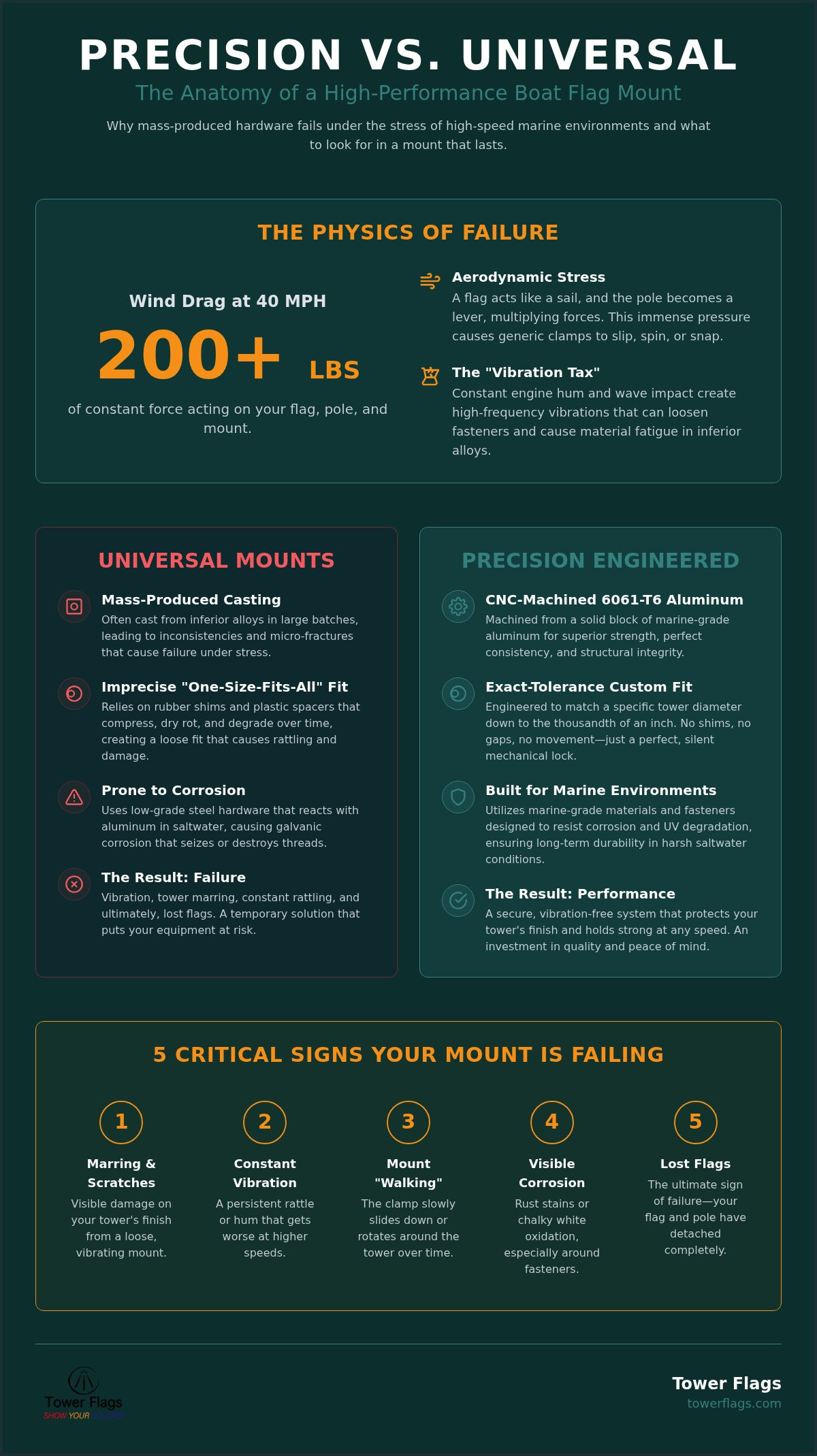
Precision engineered boat flag mounts represent a departure from the "one-size-fits-all" approach of mass-market marine accessories. In the manufacturing world, precision isn't a vague marketing descriptor; it refers to specific mechanical tolerances and the use of high-grade materials like 6061-T6 aluminum. While generic mounts are often cast from inferior alloys in large batches, Tower Flags Flag Pole Brackets are CNC-machined to exact specifications. This subtractive manufacturing process allows for exact dimensions that match a specific tower diameter perfectly. This level of exactness ensures that the bracket functions as a structural extension of the boat rather than a temporary, ill-fitting attachment.
The role of exact tolerances in marine hardware
A difference of just 0.001 inches might seem negligible, but in a marine environment, it's the gap between a silent mount and a constant rattle. When a bracket is slightly too large, it relies on rubber shims or plastic spacers to fill the space. These shims compress and degrade over time, leading to hardware that hums at low speeds and vibrates violently when you open the throttle. Precision engineering eliminates the need for thick, failing spacers. By matching the exact radius of your wakeboard tower, these mounts provide a secure grip that protects your powder-coated finish from friction damage and preserves the structural integrity of your tower over years of use.
Beyond the bracket: the engineered system
A truly engineered solution treats the flag, pole, and mount as a single aerodynamic unit. When you consider the drag forces involved in maintaining Maritime flag etiquette while cruising at 40 mph, the limitations of plastic or thin-walled metal become clear. Mass-produced alternatives are prone to snapping or stripping under the weight of wet fabric and wind resistance. In contrast, custom-fabricated hardware provides the rigidity needed to handle hundreds of pounds of wind force without bending. Beyond pure function, these mounts offer an aesthetic that matches the high-end design of modern tow boats. They don't look like an aftermarket addition; they look like original equipment, maintaining the clean lines and professional finish of your vessel.
The physics of failure: why generic mounts lose flags
Flags don't just fly off because of high winds; they fail because of a cumulative physical breakdown. Generic hardware isn't designed to manage the specific stresses of a marine environment. When you're cruising at 40 mph, a standard 3x5 flag creates a massive amount of surface area that acts like a sail. This generates hundreds of pounds of force. Without the mechanical integrity of precision engineered boat flag mounts, this force is transferred directly to the mounting screws and the tower surface. This stress eventually overcomes the friction of the clamp, leading to the "walking" effect where the mount slides down the tower or spins out of position.
Then there's the "vibration tax." Boats are constant vibration machines. The hum of the engine combined with the rhythmic pounding of waves creates a frequency that slowly backs out standard fasteners. Cheap alloys used in mass-produced mounts are prone to material fatigue. Under repetitive stress, these metals develop microscopic cracks that eventually lead to a clean snap. This is often why a mount that worked for three months suddenly fails on a calm day. The metal simply reached its limit after thousands of vibration cycles.
Drag and aerodynamic stress at high speeds
The flag pole acts as a lever, multiplying the force of the wind against the bracket base. If the bracket doesn't have a perfect mechanical lock on the tower, that leverage will cause it to slide down the vertical supports. Drag coefficient is a dimensionless quantity used to quantify the drag or resistance of an object in a fluid environment, such as air or water. In practical terms, the larger the flag, the more vertical stability is required to prevent the pole from becoming a projectile. Choosing a dedicated Flag Pole Bracket built for these specific loads prevents this mechanical failure before it starts.
Material science and corrosion resistance
Saltwater is a relentless chemical catalyst. When you pair low-grade steel screws with a generic aluminum mount, you're essentially building a battery that accelerates galvanic corrosion. This chemical reaction fuses parts together or eats away at the threads until the mount can no longer hold tension. Utilizing Corrosion-resistant materials is a non-negotiable requirement for hardware exposed to sea spray. High-quality boat flag poles must be paired with mounts made from compatible, high-grade metals to ensure the system doesn't seize or crumble after a single season. Precision engineering accounts for these chemical realities by selecting materials that remain stable in the harshest coastal conditions.
Precision engineered vs. universal boat flag mounts
The "one-size-fits-all" marine bracket is a myth that often leads to damaged equipment. Universal mounts are engineered for mass production, not for the specific geometry of your boat tower. These generic products rely on a series of plastic adapters or rubber inserts to bridge the gap between a standard bracket size and your tower's actual diameter. This creates a weak link in your setup. While a custom-fit Flag Pole Bracket installs in minutes with a single hex key, universal kits often require a frustrating trial-and-error process with multiple shims that never quite feel secure.
Over time, the cost of generic hardware adds up. Replacing lost flags or broken plastic poles is a recurring expense that precision engineering eliminates. When you invest in precision engineered boat flag mounts, you're paying for a permanent solution rather than a temporary fix. You won't have to worry about the bracket spinning mid-run or the hardware failing when the wind picks up.
The hidden dangers of rubber shims and spacers
Rubber shims are the primary failure point in universal mounting kits. In a marine environment, constant exposure to UV rays and saltwater causes these materials to harden, crack, and lose their friction-based grip. Once the shim loses its integrity, the bracket begins to shift. This movement often results in deep scratches or gouges in your tower's powder coat as the metal bracket grinds against the surface. A direct metal-to-metal precision fit avoids this entirely. By machining the bracket to the exact radius of the tower, you achieve a mechanical lock that doesn't rely on perishable materials to stay in place.
Custom fabrication: designed for your specific tower
Custom fabrication ensures that your hardware is tailored to the specific dimensions of popular tower models like the Malibu G3 or MasterCraft. This approach provides a 360-degree clamping force that distributes pressure evenly around the entire circumference of the tower tube. This uniform grip prevents the localized stress points that can cause structural fatigue in the tower itself. Beyond the mechanical benefits, custom-fit hardware provides a seamless factory look. It integrates with your boat's design language, appearing as an original component rather than a clunky aftermarket addition. This level of craftsmanship is what defines precision engineered boat flag mounts and separates them from retail-grade alternatives.
What to look for in a high-quality marine flag holder
High-performance boating demands hardware that doesn't just look the part but performs under pressure. When evaluating marine flag holders, you should prioritize 6061-T6 aluminum and 316 stainless steel. These materials provide the structural foundation for precision engineered boat flag mounts. Unlike cheap cast alloys, these metals won't become brittle or snap when subjected to the repetitive loading of a flag snapping in the wind. A hard-anodized or high-polish finish adds another layer of protection, ensuring the mount retains its aesthetic appeal even after seasons of salt spray exposure.
Functionality is just as important as durability. A high-quality mount must allow for rapid removal. Whether you're docking, trailering, or passing under a low bridge, you need to be able to take your flag down in seconds without hunting for specialized tools. This ease of use shouldn't compromise security. The locking mechanism must remain seated during heavy wakes and high-speed runs, providing peace of mind that your equipment is safe. Invest in a dedicated Flag Pole Bracket to ensure your setup meets these professional standards.
Evaluating the clamping mechanism
Safety and durability on a boat tower start with the clamping hardware. Look for designs that utilize recessed hardware. This prevents bolt heads from protruding where they can snag tow lines, life jackets, or clothing. The quality of the bolts themselves is a primary indicator of the mount's engineering. Thread depth is critical; deeper threads allow for higher torque and a more secure grip on the tower tube. 316-grade stainless steel is the superior choice for bolts and fasteners in saltwater environments. These components must be able to withstand the constant "vibration tax" without backing out or losing tension over time.
Flag pole compatibility and security
The connection between the mount and the pole is the most frequent point of failure in generic setups. Your mount must be designed to accommodate heavy-duty Flag Poles without any internal "play." While set screws offer a semi-permanent and extremely rigid lock, quick-release pins are better for boaters who prioritize convenience. You can test the integrity of a mount before you ever hit the open water. Apply firm pressure to the top of the flag pole while the boat is stationary. If you detect any shifting or movement at the base, the tolerances are too loose. Precision engineered boat flag mounts eliminate this movement entirely, ensuring the pole stays vertical and secure regardless of the boat's speed or the water conditions.
Securing your legacy with Tower Flags hardware
Tower Flags operates on a simple principle: marine hardware should be as refined as the boat it's mounted on. We reject the compromise of mass-produced, "good enough" solutions that dominate the retail market. Our philosophy centers on precision engineering for the modern boater who understands that the details matter. When you choose our Flag Pole Brackets, you're investing in a component designed to last the lifetime of your vessel. These aren't just accessories; they're specialized tools built to eliminate the rattles, scratches, and lost flags that plague generic setups. We take pride in the quiet confidence that comes from knowing your equipment is technically superior.
Custom design for a perfect fit
We maintain a strict commitment to manufacturing hardware that matches your tower's exact specifications. By focusing on custom fabrication, we eliminate the guesswork and frustration inherent in "universal" mounting kits. You don't need to fumble with rubber spacers or worry about whether the clamp will hold during a tight turn. Our brackets provide a seamless integration with your boat’s existing wakeboard tower, reflecting the high standards of American-made craftsmanship. Finding a secure fit shouldn't be a gamble; it should be a mechanical certainty. This dedicated approach ensures that every bracket we ship meets the precise tolerances required for a "no-rattle" experience on the water. For more detailed information, you can explore the ultimate guide to custom boat flag brackets.
Built for high-speed performance
Performance boaters trust our precision engineered boat flag mounts because we test them against the harshest marine conditions. We understand that a 40 mph run isn't just a test of speed; it's a test of every fastener and bracket on your boat. Our Flag Poles and brackets are engineered to manage the extreme drag and vibration that cause lesser products to fail. This dedication to technical superiority ensures that your display remains stable and silent, even in heavy wakes or high winds. We prioritize mechanical efficiency so you can focus on the experience of being on the water rather than the integrity of your hardware.
Getting started with a custom flag setup is a straightforward process. We've identified the specific needs of modern tower designs and filled that gap with highly engineered, specialized solutions. By choosing a partner that values functional elegance and bespoke results, you're securing a legacy of quality for your boat. If you're ready to upgrade your vessel with hardware that matches its performance, shop our precision engineered flag mounts today to experience the difference of a custom-engineered solution.
Elevate Your On-Water Experience with Professional Hardware
Choosing the right hardware is about more than just aesthetics; it's about mechanical certainty. You've seen how universal mounts rely on failing shims and how the physics of high-speed drag can turn a flag into a liability. By prioritizing precision engineered boat flag mounts, you eliminate the rattle and vibration that degrade your equipment and your time on the water. Our solutions are custom-fit for exact tower diameters, ensuring a secure lock that protects your boat's finish. We take pride in our American-made craftsmanship and high-speed stability testing, providing you with a mounting system that matches the performance of your vessel.
Don't settle for generic hardware that risks your gear or mars your tower. It's time to invest in a permanent solution that handles the wind and waves with ease. Upgrade to a precision engineered flag mount for your boat and enjoy the peace of mind that comes with a master-crafted fit. We're here to help you secure your flags and your legacy on the water.
Frequently Asked Questions
What makes a flag mount 'precision engineered'?
Precision engineering refers to manufacturing standards that prioritize exact mechanical tolerances, often within 0.001 inches. Unlike mass-produced cast parts, these mounts are CNC-machined from solid blocks of 6061-T6 aluminum to match specific tower radii. This technical exactness ensures a perfect mechanical lock that doesn't rely on temporary shims or fillers to stay in place during a run.
Can I use a universal flag mount on a wakeboard tower?
You can use a universal mount, but it's a compromise that often leads to hardware failure. Universal designs use rubber inserts to adapt to different tube sizes, but these spacers inevitably compress or rot under constant UV exposure. This creates a loose fit that causes the bracket to spin, slide, or vibrate violently when you're cruising at higher speeds.
Why do flags often fly off boats at high speeds?
Flags fly off because of the extreme aerodynamic drag generated at speeds over 30 mph. A standard flag acts like a sail, exerting hundreds of pounds of force on the mounting hardware. If the bracket or pole isn't built to manage this leverage, the components will snap or the fasteners will strip under the intense pressure of the wind.
What is the best material for marine flag mounting hardware?
6061-T6 marine-grade aluminum and 316 stainless steel are the superior choices for long-term durability. These materials resist the corrosive effects of saltwater and maintain their structural integrity under constant engine vibration. You should avoid plastic or low-grade "pot metal" alloys that become brittle and fail after exposure to the harsh marine environment for a single season.
How do I measure my boat tower for a custom flag bracket?
Use a digital caliper to measure the outside diameter of the tower tube at the exact spot you plan to install the mount. If you don't have a caliper, wrap a piece of string around the tube to find the circumference, then divide that number by 3.14 to calculate the diameter. Precise measurements are vital for ensuring a rattle-free fit.
Are precision engineered mounts worth the extra cost?
Yes, because precision engineered boat flag mounts eliminate the recurring cost of replacing lost flags and damaged poles. They also protect your boat tower from the deep scratches caused by slipping universal brackets. Investing in a permanent, high-quality solution saves you significant money and frustration over the life of your vessel.
Will these mounts damage the finish on my boat tower?
No, a custom-fit bracket makes uniform contact around the entire circumference of the tower tube. This distributes clamping pressure evenly and prevents the localized friction that mars powder-coated or polished surfaces. Generic mounts with shims are far more likely to cause surface damage because they inevitably slip and grind against the tower finish.
Do I need special tools to install a custom flag bracket?
You typically only need a standard set of hex keys or an Allen wrench for the installation process. Because the bracket is machined to the exact specs of your tower, there's no need for cutting, drilling, or complex modifications. Most boaters can complete the installation in less than five minutes without any professional assistance.


Comments