

Best Wakeboard Tower Flag Accessories 2026: A Precision Engineering Guide
That "universal" clamp you bought online is likely the most expensive mistake you'll make for your boat's aesthetic. While generic mounts promise a quick fix, they often result in scratched powder coating and hardware that fails under the stress of high-speed runs. You've invested heavily in your vessel; it's only natural to want a flag display that reflects that same level of engineering and pride.
Choosing the right wakeboard tower flag accessories shouldn't involve crossing your fingers every time you hit the throttle. This guide will show you why custom-engineered hardware outperforms mass-produced alternatives and how to find mounts that stay secure in high winds. We'll cover the technical advantages of vibration-resistant designs and the durability of marine-grade materials like 6061-T6 aluminum. We'll also look at why materials like 316L stainless steel carry a 25 to 50 percent price premium over 304 stainless steel in 2026, a cost often justified by superior corrosion resistance.
We're moving beyond basic brackets to explore the precision fitment required for modern towers. You'll learn how to protect your finish while meeting 2026 safety regulations. This ensures your flag stays upright and your tower remains pristine, regardless of the conditions on the water.
Table of Contents
Why Standard Boat Flag Hardware Fails on Wakeboard Towers
Standard boat hardware often relies on a "good enough" philosophy. While a simple bracket might survive on a pontoon railing at trolling speeds, the physics of Wakeboard boat design present a far more aggressive environment. Wakeboard towers act as high-altitude levers for wind shear and drag. When you're cruising at 25 mph into a 15 mph headwind, the effective force on your flag is significant. Generic wakeboard tower flag accessories simply aren't designed to handle these specific mechanical loads.
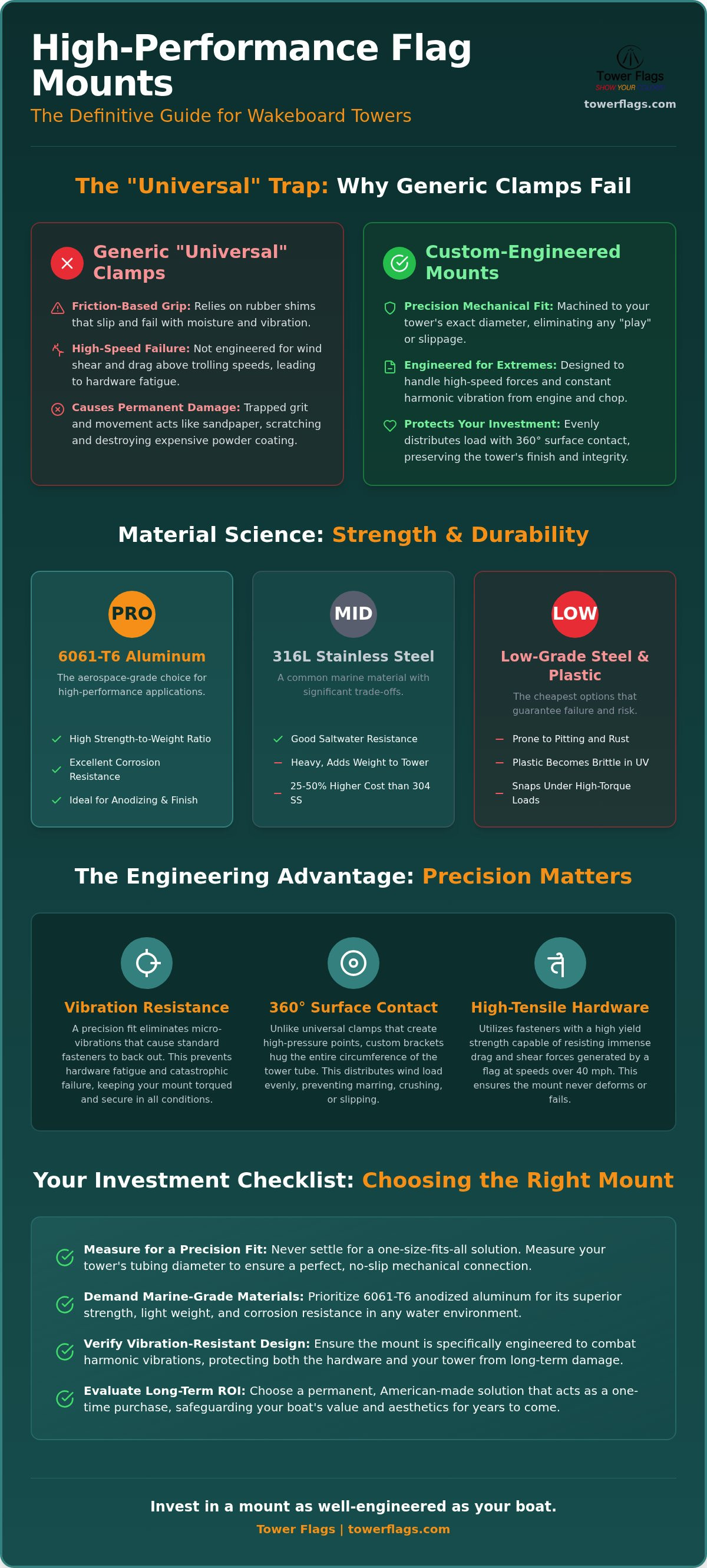
Most retail options fall into the "Universal Trap." These one-size-fits-all clamps use rubber shims or plastic inserts to adapt to different tubing diameters. This creates a dangerous reliance on friction alone. Friction-based clamps in marine environments inevitably fail because the combination of moisture and constant vibration reduces the static friction coefficient required to keep the mount stationary. This movement doesn't just look sloppy; it actively destroys your boat. The grit and salt trapped under a loose clamp act like sandpaper, marring expensive powder coating and leaving permanent scars on your tower.
The Impact of High-Speed Vibration
Engines and water slap create a constant harmonic vibration that travels directly up the tower. This micro-vibration is the primary enemy of standard thumbscrews and spring pins. Over a single afternoon, these forces can back out traditional fasteners, leading to hardware fatigue or total failure. A vibration resistant boat flag mount solves this through precision fitment. By machining a bracket to the exact outer diameter of your specific tower tubing, we eliminate the "play" that allows vibration to do its damage. This ensures the hardware stays torqued and secure, even in rough chop.
Material Corrosion in Marine Environments
Cheap accessories often utilize plastic housings or low-grade stainless steel. While some steel is common, it often lacks the molybdenum required to resist pitting in saltwater. Plastic brackets are even worse; they become brittle under UV exposure and snap under the high-torque conditions of wakeboarding. Custom-engineered solutions prioritize 6061-T6 anodized aluminum. These materials offer superior galvanic corrosion resistance and high strength-to-weight ratios. Poorly secured flags aren't just a nuisance; they're a safety hazard. A flag that detaches at speed becomes a projectile, endangering your passengers and other boaters on the water. Investing in precision-fabricated wakeboard tower flag accessories prevents these failures before they occur.
The Engineering Behind High-Performance Wake Tower Accessories
High-performance hardware starts with superior material selection. While 316L stainless steel is a common choice for marine environments due to its corrosion resistance, its weight can be a liability on a wakeboard tower. Precision-engineered wakeboard tower flag accessories typically utilize 6061-T6 aluminum. This aerospace-grade alloy provides a high strength-to-weight ratio that ensures durability without adding excessive mass to the top of the tower. Reducing weight at this height is critical for maintaining the structural integrity of the tower welds during high-speed maneuvers and heavy chop.
Mechanical reliability also depends on the quality of the fasteners. We utilize high-tensile stainless steel hardware designed to withstand the constant tension and shear forces of a flag at speed. At speeds exceeding 40 mph, a flag pole must possess a yield strength capable of resisting the immense drag force generated by a 3x5 flag without permanent deformation. These engineering tolerances are the difference between a mount that lasts a decade and one that fails in its first season. If you want a mount that won't let you down, it's worth investing in hardware that respects these physical limits.
Custom Brackets vs. Universal Clamps
The primary technical failure of universal clamps is their limited surface contact area. Most universal mounts touch the tower tubing at only two or three points, creating high-pressure zones that can crush or mar the finish. Custom-fabricated brackets are machined to the exact diameter of the tower, providing nearly 360 degrees of surface contact. This distributes the wind load evenly across the tower frame, preventing localized stress. This "no-slip" engineering ensures your flag maintains its orientation even during aggressive towing. Adhering to these mechanical principles aligns with broader international maritime safety standards by ensuring all mounted equipment is secured against the dynamic forces of the open water.
Flag Pole Durability Standards
Wall thickness is the most overlooked specification in flag pole design. Standard poles often use thin-walled tubing that buckles under the weight of a wet flag at cruising speeds. Heavy-duty marine flag poles feature increased wall thickness and reinforced base points to handle the leverage exerted by large 3x5 displays. When you combine a thick-walled pole with a precision bracket, you create a system that stays rigid regardless of the wind conditions. If you're tired of replacing bent poles, you can explore our American-made brackets that are built for these exact high-speed requirements.
Essential Wakeboard Tower Flag Accessories for 2026
The standard for wakeboard tower flag accessories has shifted toward integrated, low-profile designs that prioritize mechanical integrity without compromising the boat's silhouette. In 2026, high-performance boaters expect hardware that handles speeds exceeding 40 mph while maintaining a clean, factory-installed look. Achieving this requires a specialized kit consisting of a precision-fit bracket, a reinforced pole, and high-strength attachment hardware. Each component must work in unison to manage the dynamic forces of wind shear and vibration.
Safety and durability are the primary drivers of these 2026 trends. Standard accessories often fail because they treat the flag as an afterthought rather than a high-drag aerodynamic load. By selecting components rated for high-speed performance, you ensure your flag remains visible and secure, regardless of the throttle position. This level of reliability is only possible through American-made fabrication and rigorous testing against the specific stresses of the wakeboard environment.
Precision-Fit Flag Brackets
The bracket serves as the foundation of your entire mounting system. Model-specific brackets offer a technical advantage over generic options by matching the exact geometry of your tower's tubing. This precision fit allows the accessory to integrate seamlessly with the tower’s existing lines, creating a cohesive aesthetic rather than a clunky addition. Beyond looks, these brackets provide the necessary surface area contact to prevent slipping. When a bracket is machined to a thousandth of an inch, it stays exactly where you put it, protecting your finish and ensuring the flag stays in the "sweet spot" for visibility.
Heavy-Duty Marine Flag Poles
A high-quality pole must balance rigidity with weight. Look for poles that feature reinforced bases and increased wall thickness to prevent buckling under load. Visibility is paramount, but the pole length must be calculated to avoid obstructing the driver's view or interfering with the bimini top. American-made fabrication ensures that these poles utilize superior alloys that won't fatigue over time. Many 2026 models also incorporate anti-wrap clips, which allow the flag to rotate freely around the pole, preventing the "tangle" that often occurs when decelerating or changing direction.
Secure Flag Attachments and Clips
The connection between the flag and the pole is frequently the weakest link in a setup. Moving beyond simple zip-ties or plastic hooks is essential for longevity. High-strength stainless steel clips and specialized rings prevent flag fraying at the grommet points by distributing the tension more evenly. These attachments should also feature easy-release mechanisms. This functionality is critical for trailering, as it allows you to remove the flag in seconds without needing tools or cutting through temporary fasteners. Investing in these small but vital wakeboard tower flag accessories ensures your display remains professional and intact for years.
How to Select and Position Your Wake Tower Mounting System
Selection is more than just choosing a bracket; it's about engineering a system that integrates with your boat's specific geometry. Proper placement influences both the longevity of your hardware and the safety of your crew. When evaluating wakeboard tower flag accessories, you must account for the dynamic environment of a moving vessel. A poorly positioned flag can snag tow lines, obstruct the driver's view, or create excessive drag that stresses the tower structure.
Modern wakeboard towers rarely feature perfectly vertical tubes. Most designs incorporate a distinct "swoop" or forward-leaning angle that complicates standard mounting. Choosing a bracket that accounts for this angle ensures your flag pole remains vertical, providing a professional appearance and optimal aerodynamics. If your bracket doesn't compensate for the tower's tilt, the flag will fly at an awkward angle, increasing wind resistance and the likelihood of hardware fatigue.
Measuring for Custom Fit
Precision measurement is the only way to avoid the slippage and vibration issues common with universal hardware. You should use digital calipers to determine the exact outer diameter of your tower tubing. A standard tape measure is insufficient for this task, as even a 1/16-inch discrepancy can lead to a loose fit. Common tower sizes include 1.875, 2.375, and 2.5 inches, but many manufacturers use proprietary dimensions that require a custom-fit solution. We prioritize exactness because a bracket machined to your specific diameter provides the total surface contact necessary for a "last mount you will ever buy" experience. You can view our custom-fit brackets to find the exact match for your tower diameter.
Strategic Placement for Performance
Identifying the "sweet spot" on your tower requires balancing visibility with mechanical safety. The ideal location is typically on the upper rear portion of the tower, above the speakers and lights but below the tow point. This position ensures the flag is visible from 360 degrees while staying clear of the tow line's arc. Avoiding interference with tower speakers is critical; vibration from high-output audio can accelerate fastener loosening if the mount is placed too close to the speaker housing. To ensure your setup handles the pressure of a full day on the water, consult our guide on the best wakeboard tower flag mount for high speeds. By placing your hardware strategically, you minimize drag and protect your boat's finish from the constant whipping of a high-speed flag display.
Precision Fabricated Solutions: Why Custom Mounts Outlast Generic Clamps
At Tower Flags, we prioritize engineering over marketing. Many retailers treat wakeboard tower flag accessories as simple impulse buys, but we view them as critical components of your boat's rigging. A mount isn't just a piece of metal; it's a precision tool designed to manage aerodynamic stress. We reject the "one-size-fits-all" approach because it fundamentally ignores the mechanical reality of high-performance boating. Choosing the right hardware requires an understanding that your tower is a dynamic environment, not a static display rack.
Long-term ROI is the primary reason to choose custom-engineered hardware. While a generic import might save you money upfront, it often results in hidden costs. A single failure that allows a flag pole to swing into your gelcoat, or a loose clamp that mars your powder coating, can result in repair bills that dwarf the cost of a premium mount. Our custom brackets are designed to be the last mount you'll ever buy for your boat. We build them to survive the salt, the wind, and the vibration that eventually destroy lesser equipment.
American-made fabrication ensures a level of quality control that mass-produced imports simply can't match. We maintain strict tolerances throughout the machining process, ensuring every bracket fits its intended tower diameter perfectly. This domestic oversight allows us to verify the integrity of our alloys and the strength of our fasteners before they ever reach your vessel. When you buy domestic, you're investing in a product that has been scrutinized by specialists who take pride in the final fit and finish.
The Custom Fabrication Advantage
We design specifically for the boat owner who values exactness. High-performance boaters choose our precision-engineered mounts because they understand that universal compromises lead to mechanical failure. By focusing on the specific needs of different tower geometries, we provide a solution that integrates with your boat rather than just sitting on top of it. This rejection of the "universal" standard means your accessories won't slip, rotate, or rattle, even when the water gets rough.
Ready to Upgrade Your Tower?
Before you finalize your setup, use this checklist to ensure your wakeboard tower flag accessories are up to the task:
Verify the exact diameter of your tower tubing with digital calipers.
Confirm your bracket is machined from 6061-T6 marine-grade aluminum.
Ensure your flag pole has the wall thickness to handle 40+ mph wind drag.
Select a mounting location that avoids tow lines and speaker vibration.
If you're ready to secure your display with hardware that matches the caliber of your boat, you can explore our custom boat flag brackets. Our online store makes it easy to find the exact fit for your tower, ensuring a seamless experience from ordering to installation. Don't settle for a compromise when you can have a specialized solution built for the long haul.
Secure Your Boat with Professional Marine Hardware
The path to a professional flag display starts with moving away from universal compromises. We've established that precision fitment is the only way to protect your boat's finish while ensuring your hardware survives the relentless vibration of high-speed runs. By prioritizing high-performance materials like 6061-T6 aluminum and American-made fabrication, you're investing in the long-term integrity of your vessel. These wakeboard tower flag accessories are custom-fabricated for a perfect fit and engineered specifically for high-speed performance, providing the reliability that generic imports lack.
You shouldn't have to worry about hardware failure or scratched powder coating when you're out on the water. Choosing a specialized solution provides the relief of knowing your equipment is built to handle the specific mechanical loads of a wakeboard tower. It's time to equip your boat with the functional elegance and durability it deserves. Shop Precision-Engineered Wakeboard Tower Accessories at Tower Flags and experience the difference that dedicated craftsmanship makes for your next outing. Your boat is an investment; protect it with the best hardware on the market.
Frequently Asked Questions
What are the best wakeboard tower flag accessories for high speeds?
The most reliable wakeboard tower flag accessories for high speeds include custom-machined 6061-T6 aluminum brackets and thick-walled poles. These components are engineered to handle the massive drag forces generated when cruising at 40 mph or more. Unlike generic options, these specialized kits use high-tensile fasteners that won't shear or bend under pressure. This ensures your flag remains visible and secure throughout aggressive maneuvers on the water.
Can I use a universal flag mount on my wakeboard tower?
While universal mounts are widely available, they're often a compromise that leads to mechanical failure. These clamps use rubber or plastic shims to fit various tube sizes, which creates a reliance on friction. At high speeds, wind shear can cause these mounts to rotate or slip. This movement doesn't just look bad; it creates a safety hazard for other boaters and can permanently scratch your tower's expensive powder coating.
How do I prevent my flag pole from vibrating loose on the tower?
Vibration-induced loosening is prevented by using hardware with tighter tolerances. A bracket that matches your tower's exact diameter removes the "play" where vibration starts. You should also look for hardware that utilizes high-tensile stainless steel bolts rather than plastic thumbscrews. These precision-engineered wakeboard tower flag accessories maintain their torque even in rough chop or during long hauls, providing a "set and forget" solution for boat owners.
What is the best material for marine flag pole brackets?
Aerospace-grade 6061-T6 aluminum is the superior choice for marine brackets. This material provides the necessary strength to resist wind shear while remaining light enough to avoid stressing the tower's welds. While some boaters look for 316L stainless steel, it carries a 25 to 50 percent price premium and is significantly heavier. Anodized aluminum offers excellent resistance to saltwater corrosion and a high-end aesthetic that matches modern vessel designs.
Do custom boat flag brackets damage the tower finish?
Precision-fit brackets are specifically engineered to protect your tower's finish. By providing total surface contact around the tubing, they eliminate the gaps where salt and grit can accumulate. Universal mounts often trap these abrasive particles, which then grind into the finish when the mount vibrates. A custom-fabricated bracket stays perfectly stationary, ensuring your tower remains in pristine condition for the life of the boat.
How do I measure my wakeboard tower for a flag mount?
To ensure a precision fit, use digital calipers to measure the outer diameter of your tower tubing. It's critical to measure the exact spot where the mount will be placed, as many towers are tapered or use different tube sizes for different sections. Avoid using a tape measure or a piece of string, as even a minor discrepancy can result in a mount that slips or rattles at speed.
Are Tower Flags accessories made in the USA?
Every component from Tower Flags is fabricated in the USA. This American-made approach ensures that each bracket and pole meets our rigorous standards for mechanical exactness and material integrity. We don't rely on generic imports that often use lower-grade alloys or inconsistent manufacturing processes. By keeping production local, we can guarantee that your mounting system is built to survive the harshest marine environments.
What size flag is best for a wakeboard tower?
Many states, including California and Arizona, require a skier-down flag that is at least 12x12 inches. For national ensigns or decorative flags, a 3x5 foot display is popular but requires much stronger mounting hardware. You must match your flag size to the speed rating of your pole and bracket. Larger flags create significantly more drag, which can bend thin-walled poles if they aren't engineered for high-speed use.


Comments