

Boat Flag Etiquette Guide: Mastering Marine Traditions and Mounting in 2026
- ianmackinnon4
- Aug 14
- 12 min read
Updated: 4 days ago
A tattered flag or a slipping mount isn't just a minor maintenance oversight. It's a breach of maritime respect that signals a lack of preparation to every seasoned boater in the marina. You want your vessel to reflect your commitment to quality, yet the reality of high-speed cruising often leaves generic flags shredded and inferior mounts sliding down tower bars. It's frustrating to invest in a premium boat from a specialist like Marina Bahari Raya (MBR) only to have the finishing details fail when you hit open water.
We understand that maintaining a professional appearance requires both knowledge of tradition and hardware that performs under pressure. This boat flag etiquette guide provides the definitive rules for displaying your colors with honor while introducing the precision-engineered mounting solutions required for the modern marine environment. You'll learn how to navigate the complex hierarchy of nautical flags without confusion, ensuring your display is both respectful and secure.
We'll break down the exact placement for the U.S. ensign and burgees according to 2026 standards. We'll also examine the mechanical advantages of custom-fit flag pole brackets that eliminate the vibration common with mass-produced alternatives. By the end of this guide, you'll have the confidence to fly your flags proudly, knowing they're anchored by hardware built to last.
Table of Contents
The Fundamentals of Nautical Flag Etiquette
Nautical flag etiquette serves as the language of the sea. It's a non-verbal communication system that ensures safety and mutual respect between vessels. While some boaters view these rules as optional decor, they're actually rooted in centuries of maritime tradition. Understanding maritime flag basics is the first step toward commanding a vessel that looks as professional as it performs. This boat flag etiquette guide establishes the standards you need to follow to avoid common mistakes at the marina.
Legally, the national ensign identifies a boat's nationality. For American vessels, this is the U.S. flag. While recreational boats aren't always mandated by federal law to fly the ensign in domestic waters, doing so according to tradition is a hallmark of a disciplined captain. Traditional requirements are often stricter than legal ones. They dictate not just what you fly, but how you fly it to show respect for the nation and the water.
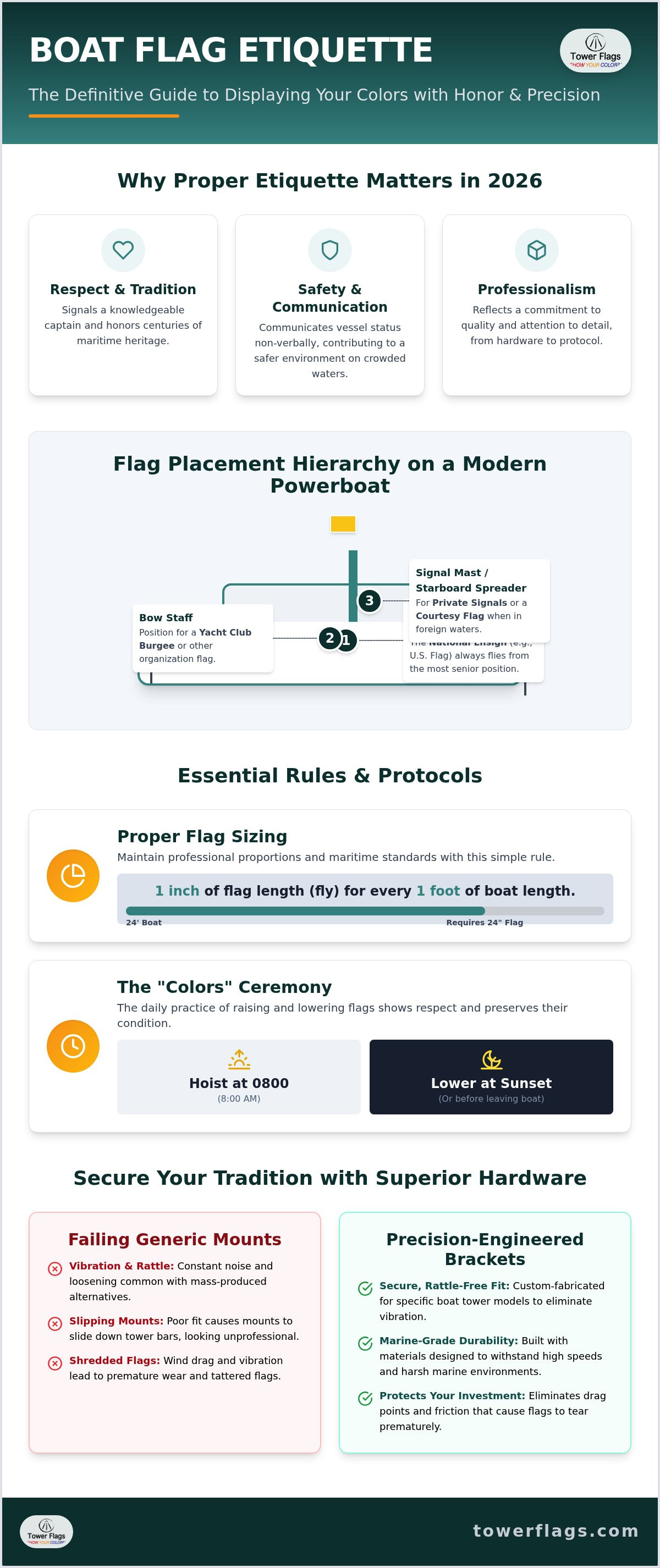
The ceremony of "Colors" is the daily practice of raising and lowering flags. Traditionally, flags are hoisted at 0800 (8:00 AM) and lowered at sunset. If you aren't on board to lower your colors at sunset, you should take the flags down before you leave the vessel. This prevents the disrespect of leaving a national ensign flying in the dark without proper illumination. It also protects your flags from unnecessary wear during overnight weather changes.
Why Proper Etiquette Matters in 2026
Professionalism on the water isn't just about the shine of your gelcoat or the horsepower of your engine. A well-flagged boat signals a responsible captain who understands the nuances of their craft. In 2026, where waterways are increasingly crowded, clear communication is vital for safety. Specific flags communicate status immediately. They can indicate a diver in the water, a vessel in distress, or a boat under tow. Following these protocols ensures you aren't just following tradition; you're actively contributing to a safer environment for everyone on the water.
For boaters who want to ensure their entire maritime experience—from acquisition to maintenance—meets these high standards, you can discover Preferred Yachts and their team of professional brokers dedicated to expert representation.
The Hierarchy of Marine Flags
Flags aren't placed at random. There is a strict hierarchy that dictates which colors take precedence. The National Ensign is the most senior flag and represents the country of registry. Burgees are small, usually triangular flags that represent a yacht club or boating organization. Private Signals are custom flags that represent the individual owner. The "Honor Position" for modern powerboats is located at the stern on the centerline or to the starboard side. This positioning allows the ensign to fly clearly away from the engine exhaust and wake, maintaining its dignity even at cruising speeds.
Decoding the Hierarchy: Which Flags to Fly and Where
The hierarchy of nautical flags is not a suggestion. It's a structured system of respect. This boat flag etiquette guide clarifies exactly where each color belongs on your vessel to ensure you're following 2026 standards. Correct placement demonstrates your competence as a captain and ensures your vessel is recognized appropriately by others on the water.
The U.S. Ensign remains the most significant flag on any American vessel. It must always occupy the most senior position, which is the stern. For motorboats, this means the flagpole should be mounted on the centerline of the stern. If a central obstruction like an outboard motor exists, move the mount to the starboard side of the transom.
The National Ensign: Rules for the Stern
Proper sizing is a detail many captains overlook. The standard rule is one inch of "fly" (the horizontal length of the flag) for every foot of boat length. A 24-foot boat requires a flag with a 24-inch fly. You must also choose between the 50-star U.S. flag and the Yacht Ensign, which features a circle of 13 stars surrounding an anchor. While the Yacht Ensign is a traditional favorite for recreational vessels in domestic waters, the 50-star flag is the only correct choice when entering international territory.
Burgees and private signals follow the Ensign in the hierarchy. A burgee represents your yacht club or squadron and traditionally flies from the bow staff or the masthead. Private signals are your personal trademark. They fly from the starboard spreader or a dedicated signal mast. International travel requires a courtesy flag of the nation you're visiting, typically flown from the starboard spreader as a sign of respect to the host country.
Adapting Tradition for Wakeboard Towers
Modern performance boats often lack traditional masts, making wakeboard towers the primary structure for mounting. This shift complicates the "highest point" rule. Traditionally, the burgee flies at the masthead, but on a tower-equipped boat, the tower itself becomes the functional mast. This requires a shift in how we apply historical rules to modern engineering.
Using a marine tower flag pole mount allows you to maintain the proper hierarchy without compromising the boat's sleek profile. These mounts provide the elevation needed for clear visibility while staying secure at high speeds. If a traditional bow staff isn't an option, the tower serves as the functional equivalent of a signal mast. You should ensure your custom flag pole brackets are positioned so no flag interferes with the driver's line of sight or the operation of tow lines. This approach respects tradition while embracing the mechanical reality of modern boat design.
Speed, Wind, and Hardware: The Practical Side of Etiquette
A common objection to maintaining a full flag protocol is the perceived hassle of hardware failure. Many captains have experienced the frustration of a flag shredding or a mount slipping mid-cruise. However, a comprehensive boat flag etiquette guide must address the physical integrity of the display. True maritime respect isn't just about where you place the flag; it's about ensuring the flag remains in pristine condition, even when your vessel is under power. A tattered flag is a sign of neglect, regardless of its placement.
The physics of drag at sea are unforgiving. When a boat cruises at 40 MPH, the wind resistance on a flag's surface area creates a mechanical load that generic hardware simply wasn't designed to handle. This force often leads to "flag wrap," where the fabric entangles itself around the pole, or total mounting failure. High-quality materials like marine-grade stainless steel and carbon fiber are essential for managing these stresses. They provide the rigidity needed to keep the flag flying straight without bending or snapping under pressure.
Maintenance is an overlooked pillar of etiquette. Flying a tattered, faded, or salt-encrusted flag is a sign of neglect that reflects poorly on the captain. If your colors are frayed at the edges, it's time to replace them. A clean, crisp flag anchored by professional-grade hardware demonstrates that you value both tradition and technical excellence. It shows that you've chosen a specialized solution over a mass-produced compromise.
Engineering for High-Speed Performance
There's a fundamental difference between "stationary" mounts intended for the dock and high-speed brackets engineered for the open water. Precision-engineered swivel systems are critical for high-speed performance. These systems allow the flag to rotate 360 degrees freely, preventing the fabric from binding during sudden turns or gusty conditions. Custom-fit brackets outperform generic plastic alternatives because they're machined to the exact tolerances of your boat's tower or rail. This eliminates the vibration and "creeping" that often lead to hardware fatigue and surface damage on your vessel.
Selecting Durable Boat Flag Hardware
Material choice is the most important factor in hardware longevity. Rust-proof metals like 316 stainless steel are mandatory for saltwater environments. Inferior alloys might look similar initially, but they quickly succumb to pitting and corrosion. When evaluating a marine flag pole socket, you should look for thick-walled construction and secure locking mechanisms. Check your hardware regularly for signs of fatigue, such as hairline cracks or loose set screws, before a failure occurs. Investing in high-integrity hardware ensures your display remains a point of pride rather than a maintenance headache.
Displaying Your Colors: A Step-by-Step Protocol
Executing a proper display requires more than just buying a flag. It demands a methodical process that ensures your vessel remains compliant with tradition while maintaining mechanical safety. This boat flag etiquette guide outlines a five-step protocol to help you achieve a professional result every time you leave the dock. Following these steps prevents the common errors that lead to lost hardware or tattered fabric.
Step 1: Determine your boat type. Powerboats, sailboats, and tower-equipped vessels each have distinct mounting requirements. Your hardware must match the specific geometry of your rails or tower bars to prevent slipping.
Step 2: Calculate the correct flag size. Ensure your Ensign follows the standard of one inch of fly for every foot of boat length. Burgees should be slightly smaller, typically measuring 1/2 inch for every foot of vessel length.
Step 3: Identify the primary honor position. For most modern powerboats, this is the centerline of the stern. This position ensures the National Ensign remains the most prominent feature of your display.
Step 4: Secure the flag to the pole. Use high-tension marine clips to attach the grommets. Don't rely on plastic hardware that can become brittle and fail under the constant vibration of the engine at cruising speeds.
Step 5: Inspect the mount for stability. Before getting underway, verify that your brackets are torqued correctly. A mount that feels secure at the dock can still slip once the hull begins to take on the impact of waves and high-speed wind resistance.
Timing and Occasions
The tradition of "Morning Colors" dictates that flags should be raised at 0800 precisely. If you're participating in a holiday regatta or special event, you might consider "Dressing Ship." This involves stringing international maritime signal flags from the waterline at the bow, up over the mastheads, and down to the waterline at the stern. However, this is a ceremonial display used only while at anchor. For daily use, "Evening Colors" occur at sunset. If you aren't equipped with a dedicated light for your flag, you must strike the colors at this time to maintain proper respect. You'll find that following these timings earns immediate respect from fellow captains at the marina.
Along with dressing your ship for a holiday regatta, many couples also choose to coordinate their personal attire with matching hubby and wifey shirts to create a unified and festive look for the occasion.
Common Etiquette Mistakes to Avoid
The most frequent error is flying the flag in total darkness. Without proper illumination, the flag should be stowed. Another mistake is halyard overcrowding. You should never fly more than one national flag on the same halyard. Lastly, ensure your pole is long enough for the flag's fly. A pole that's too short causes the flag to brush against the deck or engine cowling, leading to premature wear and a cluttered appearance. Secure your display with precision-engineered flag poles designed for high-speed stability.
Securing the Tradition with Custom Mounting Solutions
Adhering to a boat flag etiquette guide is an act of respect, but that respect is undermined if your hardware fails at the first sign of a wake. True maritime tradition requires a display that is as secure as it is symbolic. Investing in custom-fabricated mounts is the ultimate way to honor the colors you fly. When your hardware is engineered specifically for your vessel, you eliminate the mechanical failures that often lead to tattered flags and lost poles.
Many boaters settle for generic mounting options, only to find that the resulting wobble causes permanent gelcoat damage. These mass-produced alternatives lack the structural integrity required for high-performance marine environments. By choosing custom boat flag brackets, you ensure a perfect fit that remains rock-solid regardless of your speed. This precision-engineered approach protects your boat's finish while providing a stable platform for your Ensign or burgee.
The Tower Flags Advantage
We prioritize precision engineering to provide a seamless, no-drill installation on specific tower models. Our flag pole brackets are machined to exact tolerances, ensuring they won't slip or vibrate loose during aggressive maneuvers. Unlike generic poles that bend under high-wind resistance, our specialized flag poles are built to maintain their verticality. This creates a look that matches the sleek aesthetics of a high-performance boat, ensuring your hardware looks like an integrated component rather than an afterthought.
American-made quality is at the core of our manufacturing process. We use marine-grade materials designed to withstand a lifetime of exposure to salt, sun, and wind. Choosing hardware from a focused workshop means you're investing in functional elegance and technical superiority. It's a commitment to doing things right the first time, ensuring your vessel stands out for its professional appearance and mechanical reliability.
Next Steps for Your Vessel
As you prepare for the 2026 season, take a moment to audit your current flag setup. Check for compliance with the hierarchy rules discussed earlier and inspect your hardware for signs of wear. If your mounts are slipping or your poles are showing signs of fatigue, it's time for an upgrade. Transitioning to professional-grade hardware ensures your display remains a source of pride rather than a point of frustration. For a deeper dive into selecting the right hardware for your specific vessel, consult our Ultimate Guide to Custom Boat Flag Brackets 2026.
Elevate Your Vessel’s Standard for 2026
Mastering the hierarchy of nautical display is a mark of a disciplined captain. By following this boat flag etiquette guide, you've learned that proper placement at the stern and bow is only half the battle. The other half is ensuring your colors remain intact when you're running at wide-open throttle. You now understand that maintaining tradition requires a rejection of generic, slipping mounts in favor of specialized engineering that respects the physics of high-speed cruising—a philosophy of quality that often extends to the home, where a durable outdoor rectangular concrete fire table can anchor a patio with the same level of technical integrity.
Don't let a failing mount or a tattered flag compromise your vessel's professional appearance. It's time to secure your tradition with hardware that matches the high-performance standards of your boat. Upgrade to precision-engineered flag hardware at Tower Flags to experience the difference of custom-fit brackets for wakeboard towers. Our marine-grade durability ensures your display remains rock-solid during high-speed performance, eliminating the frustrations of inferior alternatives. Take pride in the fine details of your boat. When your flags fly straight and secure, you send a clear message of competence to everyone at the marina.
Frequently Asked Questions
Where is the honor position for a flag on a boat without a mast?
The honor position for a boat without a mast is located at the stern on the centerline. If an outboard motor or other equipment obstructs this area, move the mount to the starboard side of the transom. This placement ensures the U.S. Ensign remains the most prominent feature of your vessel. Following this specific rule is a fundamental part of any boat flag etiquette guide, signaling your competence to other captains.
Can I fly the US flag at night while my boat is docked?
You can fly the U.S. flag at night only if it is properly illuminated. Standard maritime tradition requires you to strike the colors at sunset. If your docking area or vessel lacks a dedicated light that keeps the flag clearly visible in the dark, you shouldn't fly it. This practice maintains respect for the flag and prevents unnecessary wear on the fabric during overnight weather changes.
What size flag should I buy for a 24-foot center console?
A 24-foot center console requires a flag with a 24-inch fly to maintain professional proportions. The standard rule for a national ensign is one inch of horizontal length for every foot of boat length. Using a flag that is too small looks like an afterthought, while a flag that is too large can obstruct your view or get caught in your fishing gear or engine cowling.
Is it disrespectful to fly a flag while trailering my boat?
It is generally considered disrespectful and mechanically unwise to fly a flag while trailering your boat on the highway. High speeds on the road create extreme wind turbulence that can shred the fabric in minutes and stress your mounting hardware. Most captains remove their flags and poles before transport to preserve the integrity of their gear and ensure they're following proper maritime protocol.
How many flags can I fly on my boat tower at once?
You should limit the number of flags on your boat tower to two to maintain a clear hierarchy and visual order. Typically, the U.S. Ensign occupies the starboard side or centerline, while a burgee or private signal flies on the port side. Overcrowding a tower with multiple flags creates unnecessary drag and increases the risk of lines tangling during high-speed maneuvers or sudden turns.
What should I do if my boat flag becomes tattered or faded?
You must replace a flag immediately if it becomes tattered, faded, or salt-stained from exposure to the elements. Flying a damaged flag is a sign of neglect and a direct breach of maritime respect. For U.S. flags, ensure you retire the old one with dignity. Many boaters bring their retired flags to a local VFW, American Legion, or yacht club for a proper disposal ceremony.
Do I need a different flag pole for high speeds?
You definitely need a specialized flag pole designed for high speeds if you cruise above typical trolling speeds. Generic poles often bend or snap under the intense drag created at 40 MPH or faster. Precision-engineered poles made from carbon fiber or heavy-duty marine-grade stainless steel provide the mechanical rigidity required to keep your display secure and upright during your most demanding performance runs.
What is the proper way to fly a "Diver Down" flag?
The "Diver Down" flag must be flown from the highest point of your vessel to ensure maximum visibility for other boaters. This is typically the top of your tower or mast. It should only be displayed when divers are actually in the water and must be struck once they're back on the boat. This flag serves as a critical safety signal that requires strict adherence to protocol.


Comments