

Carbon Fiber vs Aluminum Flag Brackets: Which Survives High-Speed Boating?
Did you know a standard 3' x 5' marine flag generates over 50 pounds of continuous lateral drag when you hit 45 mph? At those speeds, the aerodynamic force creates massive torque at the mounting base, often exceeding 200 ft-lbs of bending moment. It's a mechanical reality that catches many boaters off guard. You've likely felt the frustration of watching a generic bracket snap or seeing vibration turn your hardware into a rattling liability. It's exhausting to constantly check your mirrors to ensure your flag hasn't vanished into the wake.
We understand that you want a mounting solution that reflects the precision of your vessel's engineering. This guide investigates the technical performance of a carbon fiber vs aluminum flag bracket to ensure your hardware survives the rigors of high-speed cruising. You'll discover the critical differences in fatigue resistance and how specialized materials combat the destructive effects of saltwater corrosion. We'll show you how to move away from mass-produced compromises toward a secure, high-end installation that truly allows you to set it and forget it.
Table of Contents
The Marine Stress Test: Why Flag Brackets Fail
The flag pole bracket is the single most important component of your marine display. While many boaters focus on the quality of the flag itself, the mounting hardware absorbs the full brunt of aerodynamic force and mechanical vibration. Generic, mass-produced mounts often fail because they aren't engineered for the unique environment of a performance boat. When you're cruising at high speeds, the bracket becomes the primary failure point, often snapping under pressures it was never designed to withstand.
Identifying the "snap point" in generic hardware is a matter of understanding material limits. Cast plastic or thin-walled pot-metal mounts are rated for static residential use, where wind speeds rarely create the sustained torque found on open water. On a boat, the bracket doesn't just hold the pole; it acts as the anchor for a high-tension lever system that is constantly trying to pull itself apart.
The Physics of High-Speed Drag
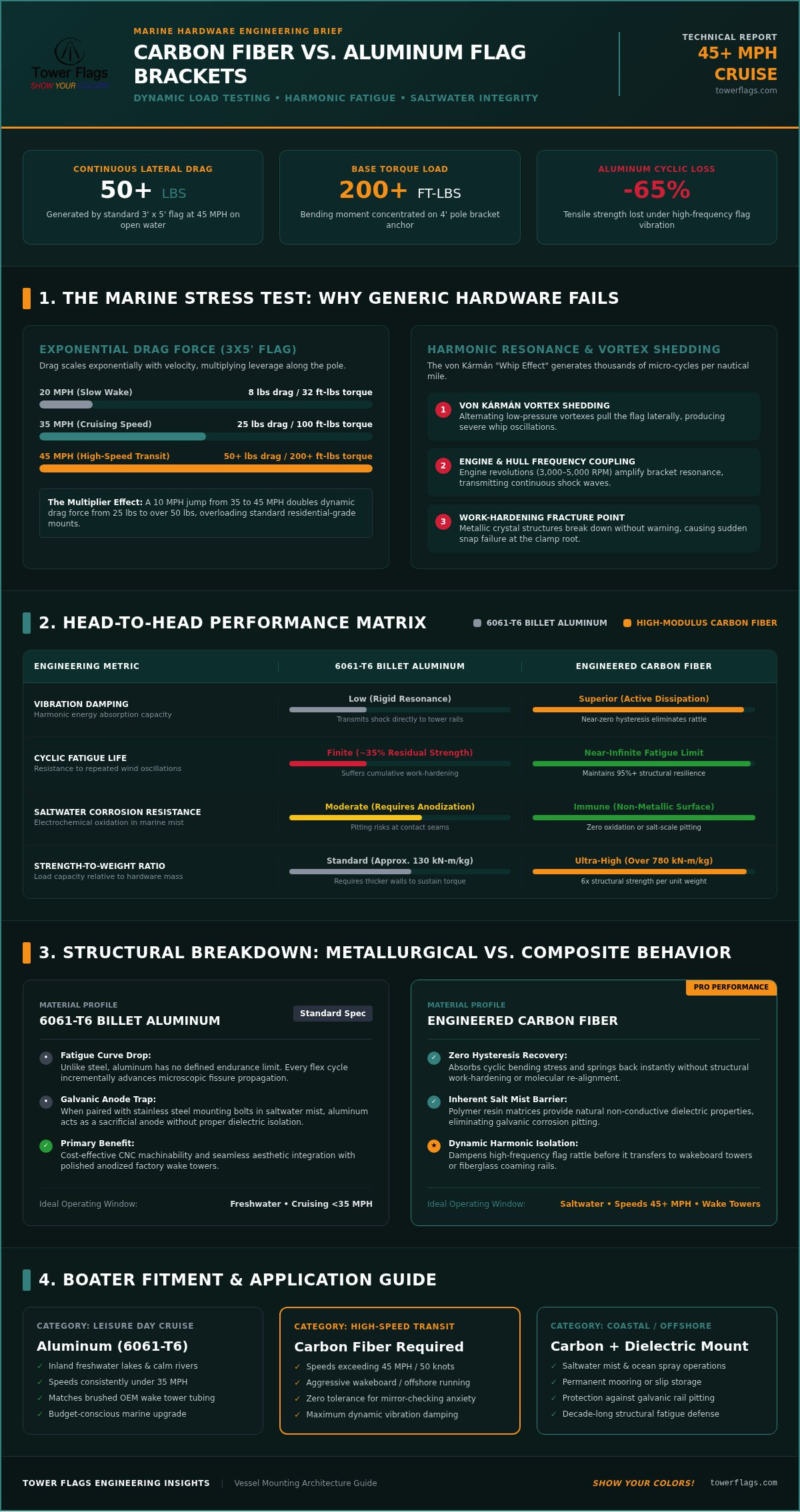
Aerodynamic drag doesn't increase linearly with your boat's speed; it scales exponentially. A standard 3x5 marine flag generates approximately 25 lbs of continuous lateral drag at 35 mph, but that force jumps to over 50 lbs once you hit 45 mph. This drag creates a massive amount of leverage. On a 4-foot flagpole, this translates to over 100 to 200 ft-lbs of bending moment at the bracket base. Residential wind ratings are irrelevant here because they don't account for the quadrupled drag force caused by vessel velocity. Without a specialized carbon fiber vs aluminum flag bracket comparison, it's easy to underestimate the sheer strength required to keep a flag secure at 50 knots.
Vibration and Harmonic Resonance
The second silent killer of marine hardware is harmonic resonance. As air separates alternately off a flapping flag at high speeds, it creates von Kármán vortex shedding, more commonly known as the "whip effect." This high-frequency lateral oscillation cyclically fatigues the mounting hardware. Engine and water vibrations add to this stress, causing micro-vibrations that lead to stress fractures over time.
While 6061-T6 aluminum is a robust material, it can lose more than 65% of its tensile strength under continuous cyclic load. In contrast, carbon fiber reinforced polymers offer superior vibration damping. These composites exhibit near-zero mechanical hysteresis, meaning they can flex and return to their original shape without the work-hardening that causes aluminum to snap. Understanding how these materials handle dynamic marine loads is the difference between a "set it and forget it" solution and losing your hardware to the wake.
Aluminum Flag Brackets: The Industry Standard
Aluminum remains the baseline material for the marine hardware industry. Its dominance in the mass market stems from a favorable balance of weight, machinability, and production cost. For boaters who prioritize a specific look, polished or powder-coated aluminum provides an aesthetic that seamlessly matches the anodized finish of most factory wake towers. When evaluating a carbon fiber vs aluminum flag bracket, it's clear that aluminum offers a lower entry price for casual users who don't frequently push their vessels to extreme speeds.
However, being the "industry standard" often means a product is designed for the average user rather than the performance enthusiast. While aluminum is rigid and functional, it's a metallic compromise that requires diligent maintenance to survive the harsh realities of a saltwater environment. High-quality flag pole brackets machined from solid billet are significantly more reliable than cast alternatives, yet they still face inherent metallurgical limitations on the open water.
Pros of Aluminum Mounting Hardware
The primary advantage of aluminum is its versatility. It's significantly lighter than stainless steel, which reduces the static load on your tower or rails. Manufacturers favor it because it adheres to well-documented aluminum alloy standards, such as those for 6061-T6 billet. This material is easy to fabricate into custom shapes, allowing for precision-fit clamps that wrap securely around various tube diameters. For boaters operating in freshwater or at moderate cruising speeds, aluminum provides a sturdy, attractive mounting point that performs reliably for several seasons.
The Weakness: Metal Fatigue and Corrosion
The greatest threat to aluminum hardware is its lack of an infinite fatigue limit. Unlike certain composites, aluminum undergoes work-hardening when subjected to the constant "whip effect" of a flag at high speeds. Engineering data shows that 6061-T6 aluminum can lose more than 65% of its tensile strength under continuous cyclic vibration. This leads to brittle failure, where the metal snaps suddenly without prior bending or warning.
Saltwater acts as a powerful electrolyte, accelerating the oxidation process. Even with high-quality anodization, salt spray can penetrate microscopic pores in the metal, leading to pitting and seized hardware. Without regular rinsing and the application of anti-seize lubricants, aluminum brackets can become fused to the tower or fail structurally at the stress-concentration points. For those seeking a more permanent, resilient solution, understanding these metallurgical boundaries is essential before committing to a mounting system.
Carbon Fiber Brackets: Precision Engineering
Carbon fiber isn't just a luxury material. It's a high-performance composite engineered to solve the mechanical shortcomings of traditional metals. While aluminum relies on mass for strength, carbon fiber utilizes a matrix of woven fibers bonded with resin to achieve superior rigidity. When weighing a carbon fiber vs aluminum flag bracket, the primary distinction lies in how the material handles sustained stress without deforming.
In the racing and aerospace industries, carbon composites are the standard because they offer an unmatched strength-to-weight ratio. For a boat owner, this means your hardware can withstand the same 50 lbs of drag force as a metal bracket while weighing significantly less. This reduction in weight is critical for wakeboard towers and radar arches. Minimizing top-heavy loads helps maintain the vessel's stability and reduces unnecessary strain on mounting hardpoints during aggressive maneuvers.
You've likely heard marketing claims that carbon fiber is unbreakable. While it's true that high-modulus carbon fiber offers 5 to 7 times the tensile strength of structural aluminum, it's not indestructible. Its strength is anisotropic, meaning it's strongest when force is applied in the direction of the fibers. A well-engineered bracket uses specific layer orientation to ensure it resists the exact twisting and bending forces experienced at 45 mph. It's a specialized solution that rejects the "one-size-fits-all" approach of generic alternatives.
Strength-to-Weight Superiority
The physical density of carbon fiber is approximately 1.6 g/cm³, compared to about 2.7 g/cm³ for marine-grade aluminum. This allows for a thicker, more robust bracket design without adding bulk. By orienting the composite layers to counter the leverage of a 4-foot flag pole, engineers create a mount that dampens vibration rather than conducting it. This damping effect prevents the "whip" of the flag from vibrating through the tower, protecting both the hardware and the boat's structural integrity.
Zero Corrosion: The Saltwater Advantage
The most significant benefit of carbon fiber in a marine environment is its chemical composition. Metals are inherently susceptible to marine corrosion and hardware failure because they react with saltwater through electrochemical processes. Carbon fiber is chemically inert. It doesn't oxidize, pit, or seize, even after years of exposure to salt spray and intense UV radiation.
Choosing a carbon fiber vs aluminum flag bracket means you can stop worrying about polishing hardware or applying protective coatings. While aluminum requires constant vigilance to prevent galvanic pitting, carbon fiber maintains its structural integrity and finish without maintenance. It's a reliable, high-integrity solution that matches the longevity of a high-end vessel, ensuring your flag stays secure for many seasons to come.
Head-to-Head: Performance Comparison for Boaters
Choosing between a carbon fiber vs aluminum flag bracket requires looking past the initial price tag. While both materials serve a purpose, their performance under pressure reveals a clear hierarchy. Aluminum offers high rigidity and a traditional aesthetic; however, carbon fiber provides a level of mechanical damping that metal simply cannot replicate. In the high-vibration environment of a performance boat, these technical differences determine whether your hardware lasts a single season or the life of the vessel.
Evaluating the total cost of ownership over five seasons often favors the composite option. A standard aluminum bracket is susceptible to salt pitting and work-hardening. This frequently leads to a replacement cycle every two to three years. Carbon fiber remains unaffected by the elements, effectively making it a one-time investment. When you factor in the time spent polishing metal and the risk of losing an expensive flag to a snapped mount, the value of precision-engineered composites becomes undeniable.
Noise and installation also differentiate these two contenders. Aluminum brackets, especially generic universal models, tend to conduct engine vibration and wind whistle. This resonance can be heard throughout the tower. Carbon fiber naturally absorbs these frequencies, leading to a quieter ride. To ensure a "set it and forget it" experience, always prioritize custom-fit clamps over universal shims. Explore our precision-engineered Flag Pole Brackets to find the perfect match for your high-speed vessel.
Fatigue Resistance and Life Cycles
Aluminum has a finite fatigue limit. Every time the flag whips at 40 mph, the metal undergoes microscopic stress. Eventually, these cycles lead to a sudden, brittle fracture. As of 2026, marine hardware fatigue life is measured by a material's capacity to maintain structural integrity through 500 million cycles of high-frequency vortex shedding without microscopic stress fracture. Carbon fiber excels here because it lacks a traditional fatigue limit within its normal operating envelope. It can flex millions of times without losing its original tensile strength.
Impact Resistance and Sudden Loads
Sudden gusts or aggressive high-speed turns create peak loads that test the limits of your hardware. A rigid aluminum mount handles these forces well until it reaches its yield point, after which it permanently deforms or snaps. Carbon fiber offers a degree of elastic flexibility. This allows the mount to absorb a sudden surge in wind resistance and return to its original shape. This "spring" effect protects the boat's mounting points from the jarring impact of a sudden load. It provides a safety margin that rigid, brittle metals can't offer.
Beyond Materials: The Custom Engineered Solution
Selecting between a carbon fiber vs aluminum flag bracket is a critical first step, but material science alone cannot prevent hardware failure. Even the most advanced composite or high-grade billet will fail if the fitment is imprecise. In the marine environment, "universal" is often a synonym for "compromise." When hardware doesn't match the mounting surface perfectly, the resulting gap becomes a breeding ground for vibration and mechanical instability. This instability is what ultimately leads to stripped screws, snapped mounts, and lost flags.
Universal-fit brackets are a primary cause of frustration for performance boaters. These generic systems typically rely on rubber shims or plastic spacers to accommodate various tube diameters. At cruising speeds, the massive leverage generated by the flag compresses these shims. This creates "bracket creep," where the mount begins to slide or rotate around the tower. This movement doesn't just loosen your hardware; it creates friction that mars the powder coating or polished finish of your boat's structural arches.
Tower Flags bridges the gap between high-end material science and exact marine fit. We understand that a permanent mounting solution requires more than just strength. It requires a design that respects the vessel's integrity. Transitioning from generic, mass-produced hardware to a custom-engineered mount ensures that every ounce of material performance is utilized to keep your display secure at top speeds.
Precision Fit for Marine Towers
Custom engineering ensures that the mounting base matches the exact diameter of your wakeboard tower or arch. By eliminating the need for shims, you create a direct bond that distributes stress evenly across the mounting surface. This precision fit is the only way to stop high-frequency vibrations from turning into structural damage. For a deeper look at how fitment impacts longevity, consult our Ultimate Guide to Custom Boat Flag Brackets 2026. Correct sizing is the difference between a mount that rattles loose and one that stays silent and secure for years.
The Tower Flags Difference
We focus on high-speed performance and American-made durability because we know the stakes of offshore boating. Our approach rejects the "good enough" standard of the mass market. We prioritize bespoke results that match the aesthetics and engineering of high-end vessels. To stay updated on the latest shifts in marine hardware, read about High-Speed Boat Flag Mounts. Choosing specialized hardware is an investment in your boat’s integrity. It provides the peace of mind that comes from knowing your equipment is as capable as the vessel it's mounted on.
Securing Your Display for the Open Water
Choosing between a carbon fiber vs aluminum flag bracket is ultimately a decision about the longevity of your hardware and the safety of your vessel's finish. While billet aluminum provides a classic look and solid initial strength, carbon fiber stands as the superior choice for dampening the violent harmonic vibrations found at 45 mph and beyond. Beyond the material itself, the security of your flag depends on a precision fit that eliminates the rail damage and "bracket creep" caused by generic, universal mounting systems.
Tower Flags serves as the authoritative expert in marine flag mounting solutions. We reject mass-produced compromises in favor of hardware engineered specifically for high-speed marine environments. Our specialized custom-fit designs ensure that your display remains a permanent fixture on your boat tower, regardless of the conditions. Don't settle for hardware that wasn't built to handle your vessel's performance limits. Upgrade to precision-engineered flag pole brackets from Tower Flags and enjoy the peace of mind that comes with professional-grade craftsmanship. Your flag belongs on your boat, not in the wake.
Common Questions About Marine Flag Hardware
Is a carbon fiber flag bracket worth the extra cost over aluminum?
A carbon fiber vs aluminum flag bracket comparison reveals that the composite option is a superior long-term investment for performance boaters. Carbon fiber provides better vibration damping and possesses a near-infinite fatigue life. While aluminum costs less initially, it eventually work-hardens and snaps under the cyclic stress of high-speed transit. Choosing carbon fiber means you won't have to replace your hardware after a few seasons of hard use.
Do carbon fiber brackets corrode in saltwater environments?
Carbon fiber is chemically inert, meaning it doesn't corrode or oxidize when exposed to saltwater. Metals are susceptible to galvanic corrosion, which leads to pitting and structural failure over time. When evaluating a carbon fiber vs aluminum flag bracket, the composite material's resistance to UV radiation and salt spray makes it a more reliable choice for offshore environments. It maintains its structural integrity without the need for protective coatings.
Can I use an aluminum bracket on a wakeboard tower for high speeds?
You can use aluminum, but it must be high-grade billet rather than a generic cast mount. Even with high-quality billet, aluminum has a finite fatigue limit. Sustained speeds over 40 mph create significant drag force that can lead to material failure over time. While aluminum is rigid, it lacks the vibration absorption of carbon fiber, which can cause hardware to rattle loose during aggressive runs.
What is the most common reason for boat flag bracket failure?
The primary cause of failure is harmonic resonance, often called the "whip effect." As air flows over the flag at high speeds, it creates high-frequency lateral oscillations. This cyclic stress fatigues the material at the mounting base until it snaps. Generic universal brackets often fail because they don't provide the precision fit required to distribute these violent forces evenly across the boat's structural tower.
How do I know if my bracket is suffering from metal fatigue?
Look for hairline fractures or microscopic cracks, especially near the mounting base or stress-concentration points. Discoloration, pitting, or surface oxidation can also hide underlying structural weaknesses. If you notice an increase in wobble or vibration while cruising, the material's integrity is likely compromised. Aluminum is known for brittle failure, meaning it often snaps suddenly without significant bending or visible warning signs beforehand.
Are carbon fiber flag mounts lighter than aluminum ones?
Carbon fiber is significantly lighter, with a density of approximately 1.6 g/cm³ compared to 2.7 g/cm³ for marine-grade aluminum. This reduction in weight is vital for hardware mounted on wakeboard towers or radar arches. It lowers the center of gravity and reduces the static load on your vessel's structural points. Despite its lighter weight, carbon fiber offers five to seven times the tensile strength-to-weight ratio of structural aluminum.
Does Tower Flags offer custom-engineered brackets for specific boat models?
We specialize in manufacturing custom-fit Flag Pole Brackets tailored to your specific boat tower or rail dimensions. We reject the "one-size-fits-all" approach because generic hardware often leads to bracket creep and rail damage. By matching the exact diameter of your tower, we eliminate the need for shims and ensure a secure, permanent mount. Our precision engineering process provides a specialized solution that matches the quality of your boat.
What maintenance is required for marine flag mounting hardware?
Aluminum hardware requires regular rinsing with freshwater and the occasional application of anti-seize lubricants to prevent oxidation and seized bolts. You should also inspect all mechanical fasteners for loosening caused by engine vibration. Carbon fiber is virtually maintenance-free because it doesn't pit or rust. However, we still recommend checking the tightness of the mounting hardware after high-speed runs to ensure the display remains perfectly secure.


Comments