

Choosing the Perfect Custom Length Boat Flag Pole for Performance Vessels
A "universal" boat flag pole is almost always a compromise that fails the moment you throttle up. Most off-the-shelf options are either too short to provide visibility or so long they become a liability under bridge clearances. When you're running a performance vessel, a flimsy, vibrating mount isn't just an eyesore; it's a mechanical failure waiting to happen. Finding a custom length boat flag pole that matches the specific dimensions of your tower or bimini is the only way to ensure your display remains secure at high speeds.
You shouldn't have to settle for hardware that rattles or snaps the second you hit 40 mph. We understand that a clean, professional look requires a level of precision that mass-produced alternatives simply can't provide. This article will show you how to select and measure a precision-engineered pole that maintains its structural integrity without the vibration noise common in poorly fitted mounts. We'll walk through the technical steps of calculating perfect tower clearance and choosing American-made materials built for the rigors of the marine environment.
Table of Contents
The Problem with Universal Fit: Why Length Matters for Marine Poles
Most boaters begin their search with a generic three-foot fiberglass rod from a big-box retailer. It's a mistake that becomes obvious the moment you attempt to mount it to a specialized wakeboard tower or radar arch. These universal poles ignore the specific geometry of modern performance vessels, leading to a display that looks like an awkward afterthought rather than a professional installation. When you've invested in a high-end boat, settling for "good enough" hardware compromises the entire aesthetic of the craft.
The frustration often starts with the mount. Universal brackets rarely account for the specific diameters of custom towers, leading to a loose fit that vibrates at cruising speeds. Beyond the noise, an incorrectly sized pole creates a logistical nightmare. A flag that is too long will inevitably tangle with expensive tower speakers or snag on the delicate fabric of a bimini top. Conversely, a pole that is too short leaves your flag hidden behind the tower structure, defeating the purpose of the display entirely. A custom length boat flag pole eliminates these variables by providing a fit tailored to your boat's specific hardware and clearance needs.
Clearance and Visibility Challenges
Achieving the perfect display requires balancing visibility with practical clearance requirements. Your flag needs to fly high enough to be seen by other vessels, yet low enough to clear bridge spans and dock overhangs. One often overlooked factor is the "dirty air" created by the boat windshield. At high speeds, this turbulence can keep a flag from unfurling properly if the pole isn't long enough to reach the clean, laminar flow of air above the tower. Choosing the right length also prevents "flag slap," where the fabric repeatedly strikes the hull or tower finish, causing premature wear to both the flag and the boat's gelcoat.
The Structural Risk of Excessive Length
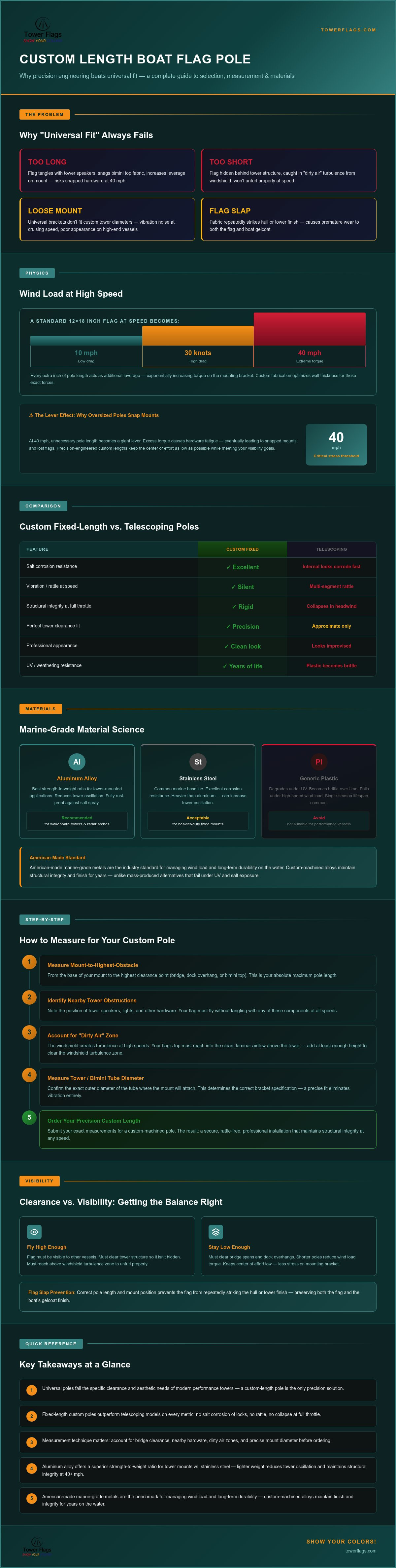
Physics is the primary reason to avoid oversized universal poles. Every inch of unnecessary length increases the leverage applied to your mounting bracket. At 40 mph, the wind load on a flag creates significant torque; a pole that is too long acts as a giant lever, which can lead to hardware fatigue or snapped mounts. A precision-engineered custom length boat flag pole reduces this stress by keeping the center of effort as low as possible while still meeting your visibility goals.
While some manufacturers suggest telescoping poles as a solution, these are often the weakest link in a marine setup. Saltwater quickly corrodes the internal locking mechanisms, and the multiple segments create a "rattle factor" that is both annoying and indicative of poor structural integrity. A fixed-length, custom-machined pole offers a much quieter ride and won't collapse when you hit a headwind at full throttle.
Engineering for Performance: Materials and Wind Load
While many boaters focus on the durability of the flag fabric, the engineering of the pole determines whether the display survives a single season. Generic plastic or thin-walled fiberglass poles frequently fail because they lack the mechanical properties required for the marine environment. High-performance vessels require materials that resist both salt-water corrosion and the intense physical stress of high-speed travel. Settling for inferior materials often results in snapped hardware and lost flags.
Marine-Grade Material Science
Stainless steel is a common baseline for marine hardware, yet specialized aluminum alloys often provide a superior strength-to-weight ratio for tower-mounted applications. Excess weight on a wakeboard tower or radar arch can increase the oscillation of the structure, so choosing lightweight yet rigid materials is a functional necessity. Every component must be entirely rust-proof to withstand constant exposure to salt spray. Unlike mass-produced plastics that degrade under UV exposure and become brittle, custom-machined alloys maintain their structural integrity and finish for years. These high-end materials allow for a custom length boat flag pole that looks as professional as the vessel it's mounted on.
Calculating Stress at High Speeds
A standard 12x18 inch flag may seem insignificant, but at 30 knots, it transforms into a high-drag sail that exerts immense pressure on the mounting bracket. Wind load is the force exerted by moving air on the flag surface area. As your vessel accelerates, this force compounds, testing the limits of the pole's rigidity. Secure attachment points are critical; if the pole flexes too much, the flag will wrap around the structure or, worse, create enough leverage to fatigue the mounting hardware. Custom fabrication ensures that the pole's wall thickness is optimized for these specific forces, providing a stable display even in heavy headwinds.
A custom length boat flag pole allows for much tighter tolerances between the pole and its bracket. This precision fit eliminates the "chatter" or micro-vibrations that cause metal fatigue over time. When a pole is machined for a specific tower diameter or mounting location, the entire system acts as a single, solid unit. This level of engineering ensures your flag remains a proud, steady display rather than a vibrating distraction that compromises your boat's hardware. For those seeking reliable, high-speed solutions, choosing specialized flag poles designed for performance towers is the most effective way to ensure long-term durability on the water.
Custom Length vs. Telescoping Poles: A Durability Comparison
Many boaters are tempted by the perceived convenience of telescoping poles. While the ability to adjust height sounds useful in theory, these multi-segmented designs are fundamentally ill-suited for the marine environment. A single-piece custom length boat flag pole offers a level of structural integrity that telescoping alternatives simply can't match. When you're running at high speeds, the last thing you want is a segmented pole that collapses or rattles incessantly against your tower.
Telescoping mechanisms rely on internal locking collars, often made of plastic or thin metal. In a saltwater environment, these components are primary failure points. Salt crystals build up inside the joints, causing the mechanism to seize or lose its grip entirely. Once the locking friction is compromised, the pole will often slide down under its own weight or the force of a headwind. A fixed-length pole eliminates these moving parts, ensuring that your hardware remains functional for years rather than a single season. This transition from adjustable "gadgets" to purpose-built hardware is what separates a professional display from a temporary fix.
Reliability in Motion
The "rattle factor" is a common complaint among owners of adjustable hardware. Every joint in a telescoping pole introduces a small amount of play. At cruising speeds, these tiny gaps translate into significant vibration and noise. A precision-machined custom length boat flag pole provides a quieter, more stable experience because there are no internal segments to knock against one another. This rigidity also ensures your flag maintains a consistent height, preventing it from drooping into your line of sight or tangling with other tower-mounted equipment. While some argue that telescoping poles are easier to store, a custom-length pole is designed to fit your specific vessel, making it easy to tuck into a rod locker or side pocket without fussing with adjustments.
Aesthetic and Functional Superiority
Beyond mechanical performance, there is a clear aesthetic difference between custom hardware and universal adjustable poles. Telescoping poles often look bulky and "cheap" due to the visible collars and varying tube diameters. In contrast, a custom-engineered pole features a streamlined, uniform profile that complements the lines of a high-end wakeboard tower. This isn't just about looks; it's about the confidence that comes from using hardware designed specifically for your boat. Investing in a permanent solution prevents the cycle of repetitive replacement that plagues owners of generic hardware. For a deeper look at the technical standards of these components, see our guide on Marine Flag Poles: Engineering for Durability.
How to Measure for Your Custom Length Boat Flag Pole
Precision is the difference between a professional marine display and a rattling eyesore. To get the most out of a custom length boat flag pole, you must move beyond guesswork and utilize exact measurements. Unlike universal kits that rely on plastic shims, a custom setup requires a perfect fit to handle the mechanical stress of high-speed travel. You will need a high-quality tape measure and, ideally, a set of digital calipers to ensure your hardware integrates seamlessly with your vessel's existing structure.
The measurement process follows a logical progression to ensure both structural safety and aesthetic balance:
Identify the Mounting Location: Decide if the bracket will sit on a wakeboard tower, a bow rail, or a stern cleat. Each location has different vibration profiles and clearance needs.
Determine the Clearance Zone: Measure the distance to nearby obstructions like tower speakers, radar arches, or bimini frames. Ensure the flag has a 360-degree rotation radius without snagging.
Factor in Flag Size: A standard 12x18 inch flag requires less vertical clearance than a larger 2x3 foot ensign. The pole length must accommodate the flag's height plus a three to five-inch buffer at the top and bottom.
Measure the Mounting Surface: If you're mounting to a pipe, you need the exact outer diameter to ensure the bracket doesn't slip or mar the finish.
Determining the Ideal Height
A common rule of thumb is to ensure at least two-thirds of the flag flies above the highest point of the tower or windshield. This placement captures clean air and prevents the flag from drooping into the cockpit. When measuring, start from the base where the pole will sit inside the bracket and extend the tape to your desired peak. Don't forget to account for your bimini top. If you frequently run with the shade extended, the custom length boat flag pole must be long enough to clear the canvas, yet short enough to avoid hitting low-hanging bridge spans in your local waterways.
Measuring Tower and Rail Diameters
For tower-mounted hardware, "close enough" isn't an option. Wakeboard towers vary wildly in diameter, often by small increments like 1/8th or 1/16th of an inch. Using a digital caliper is the only way to guarantee a non-slip fit that won't vibrate loose at 40 mph. A bracket that's even slightly too large will eventually rotate under wind load, potentially scratching your powder coat or polished aluminum. Once you have your diameter and desired length, you can order your precision-cut flag pole with total confidence. For more details on choosing the right mounting hardware for these measurements, consult our Ultimate Guide to Custom Boat Flag Brackets.
Tower Flags: The Standard for Custom Marine Hardware
Tower Flags operates with a quality-first mindset that rejects the "one size fits none" approach of mass-produced retailers. We understand that a performance vessel is a significant investment; it deserves hardware that reflects that level of excellence. Every custom length boat flag pole we manufacture is the result of a specialized engineering process designed to eliminate the common frustrations of vibration, mechanical failure, and poor fit. We take pride in the precision of our American-made hardware, ensuring that each component functions as a seamless extension of your boat's tower.
Our commitment to durability is rooted in a deep understanding of the mechanical stress that occurs at speeds exceeding 40 mph. While generic alternatives rely on flimsy materials, we utilize high-integrity alloys that maintain their structural rigidity under intense wind loads. This focus on engineering excellence ensures that your flag remains a steady, professional display rather than a rattling distraction. Professional boaters choose our hardware because it solves the specific problems created by specialized marine environments, providing a level of reliability that off-the-shelf products cannot match.
Craftsmanship and Customization
The benefit of ordering from Tower Flags is the assurance that your hardware was designed by marine enthusiasts for marine enthusiasts. We have identified the gaps left by universal manufacturers and filled them with bespoke solutions. Our fabrication process eliminates the need for generic plastic shims or "adjustable" components that inevitably fail in salt water. When you order a custom length boat flag pole from us, you receive a product machined to your exact specifications. This results in a streamlined fit for wakeboard towers and radar arches, maintaining the clean lines and aesthetic integrity of your vessel. We focus on the fine details of fit and finish so you can enjoy a seamless experience on the water.
Securing Your Flag with Confidence
High-integrity, rust-proof hardware provides the peace of mind necessary for offshore use and high-speed lake runs. Our proprietary mounting solutions are built to withstand the harshest salt-water conditions without losing their luster or structural strength. We don't just sell flag poles; we provide a complete system of brackets and poles that work in total harmony. Starting your custom order is a straightforward process that leads to a permanent solution for your boat. You can Explore our custom boat flag poles and brackets today to see how precision engineering transforms your marine flag display into a high-performance feature of your craft.
Elevate Your Performance Vessel with Precision Hardware
Performance boating is defined by precision, and your flag display shouldn't be the weak link in your vessel's setup. By moving away from universal "one size fits none" poles that vibrate and fail, you ensure your craft maintains its aesthetic and structural integrity. A custom length boat flag pole provides the exact clearance needed for your specific wakeboard tower while standing up to the intense mechanical stress of high-speed travel. You've seen how material science and accurate measurement are the foundation of a display that stays secure even when you're pushing 40 knots.
Our American-made marine hardware is specifically engineered to eliminate the rattle and salt-water corrosion found in generic, mass-produced alternatives. It's time to invest in a solution that matches the quality and performance of your boat. Order Your Custom Precision-Engineered Boat Flag Pole today to secure a master-crafted fit for your tower. Your boat deserves a professional display that flies with total confidence every time you hit the open water.
Frequently Asked Questions
What is the best material for a custom length boat flag pole?
High-strength aluminum alloys are the ideal choice for marine flag poles due to their exceptional strength-to-weight ratio. Unlike generic plastics that degrade under UV exposure, these metals maintain structural integrity in harsh salt-water environments. While stainless steel is durable, specialized aluminum alloys offer the rigidity required to prevent oscillation on wakeboard towers without adding unnecessary weight to the boat's upper structure, ensuring a stable display at any speed.
How do I know what length flag pole I need for my wakeboard tower?
You determine the correct length by balancing visibility requirements with your boat's specific clearance zones. A custom length boat flag pole should be long enough to fly the flag in clean air above the tower line, typically requiring at least two-thirds of the flag to clear the highest point of the boat. You must also measure the distance to nearby obstructions like tower speakers and bimini tops to prevent snagging during high-speed runs.
Can a custom length flag pole handle high speeds on the water?
A precision-engineered flag pole can easily handle speeds exceeding 40 mph if it is built with the correct wall thickness and material rigidity. High speeds exert significant wind load on the flag surface, which translates into torque at the mounting base. Custom-fabricated poles are designed to manage this leverage without flexing or snapping, providing a stable and professional display even when the vessel is operating at full throttle.
Do I need a specific bracket for a custom length pole?
Using a specialized bracket is essential for securing a custom length boat flag pole to a performance tower. Universal brackets often rely on rubber shims that compress and slip under high wind loads, leading to hardware failure or damaged powder coating. A custom-machined bracket provides a metal-to-metal precision fit that eliminates vibration and ensures the pole remains vertical regardless of the boat's speed or the weather conditions.
What are the benefits of a fixed-length pole over a telescoping one?
Fixed-length poles offer superior durability because they lack the moving parts and plastic locking mechanisms found in telescoping models. Saltwater often causes telescoping segments to seize or fail, leading to poles that collapse unexpectedly. A single-piece custom pole eliminates the rattle factor caused by segmented joints, resulting in a much quieter and more stable ride for everyone on board the vessel while maintaining a consistent flag height at all times.
How do I measure my boat tower for a flag pole mount?
To measure your boat tower accurately, you should use a set of digital calipers to determine the exact outer diameter of the pipe. Wakeboard towers are not standardized and can vary by as little as 1/16th of an inch. Taking a precise measurement ensures that your mounting bracket fits perfectly without slipping or marring the finish. You should also measure the vertical clearance from the mount to the nearest obstruction to define your ideal pole length.
Is stainless steel better than aluminum for marine flag poles?
Aluminum is generally better for tower-mounted flag poles because it is significantly lighter than stainless steel while offering comparable resistance to corrosion. Reducing weight aloft is critical for maintaining the stability of a wakeboard tower and preventing excess vibration. While stainless steel is excellent for deck-mounted hardware, the weight-to-strength ratio of specialized aluminum alloys makes them the standard for high-performance marine applications where rigidity and weight management are both priorities.


Comments