

CNC Boat Flag Bracket: A Buyer’s Guide to Precision and Fit
A CNC boat flag bracket can be precisely machined and still be the wrong choice for your boat. CNC machining uses computer-controlled tools to shape a part, but it doesn’t tell you whether the bracket’s mounting interface matches your tower, rail, or other mounting point. Fit depends on the bracket’s design as well as how it’s made.
Precision can help produce consistent features, but it doesn’t confirm compatibility, suitability for saltwater or freshwater exposure, or whether the bracket works at your preferred display location. Those details matter just as much as how accurately a part is made.
This guide explains what CNC machining can and can’t tell you, then shows how to compare bracket design, mounting location, fit, and marine use. You’ll learn which details to match to your vessel and flag display needs, and why a purpose-designed mount may address challenges a generic bracket misses. Tower Flags designs custom-fit boat flag brackets and poles for marine use, with attention to the mounting needs of individual vessels.
Table of Contents
What Is a CNC Boat Flag Bracket, and What Does CNC Actually Tell You?
A CNC boat flag bracket is made using computer-controlled machining. This process can create repeatable features, but the label “CNC” doesn’t tell you whether the bracket is designed for your boat or the way you’ll use it. To choose well, separate how a bracket is made from what its design is intended to fit and do.
Quotable definition: CNC describes how a part is shaped; fit and performance depend on the finished design, mounting interface, materials, and intended use.
How CNC machining shapes a flag bracket
Computer Numerical Control (CNC) uses programmed instructions to guide cutting tools along planned paths. In machining, tools remove material from a workpiece to create the bracket’s shape and features, such as surfaces or openings for mounting. This differs from forming material into shape or assembling separate components, though a product can involve more than one manufacturing process.
Programmed paths can help produce repeatable shapes. But the word CNC alone doesn’t identify the material, tolerances, finishing process, or quality of a particular bracket. Look for product-specific information about those details.
Why precision alone does not establish boat compatibility
A precisely machined bracket can still be unsuitable if its mounting geometry doesn’t correspond to the boat’s actual attachment point. A rail, tower, or cleat presents a different interface. The bracket’s contact surfaces and attachment arrangement need to align with that location for the parts to fit together as intended.
Fit also involves how the setup works after mounting. The pole must be retained appropriately, the flag needs adequate clearance, and the arrangement should suit its intended use. A difference in interface shape or available space can matter, even when the bracket itself was manufactured accurately.
That’s why a CNC label is a starting point, not a complete buying specification. Compare the bracket’s design with your vessel’s mounting point and the way you plan to display the flag. Generic hardware may suit some arrangements, while a purpose-designed bracket can address vessel-specific mounting needs. The key question isn’t simply whether a part was machined precisely. It’s whether its geometry and application align with your boat.
How CNC Design Can Affect Bracket Fit, Strength, and Everyday Use
Machining can shape a bracket’s features, but the design determines how those features meet the boat, hold the pole, and work during regular use. Look beyond the manufacturing label. The interface, contact surfaces, attachment points, and clearance all affect whether the bracket suits its intended mounting location.
Which design details influence fit and function?
The bracket’s interface should correspond to the shape and arrangement of the boat’s mounting point. Contact surfaces that sit and align properly help the bracket meet that interface as designed. Attachment points matter too: their position and arrangement need to work with the mounting location and available space.
Check how the pole is retained and whether the finished setup leaves enough clearance for the flag and nearby boat features. A quick-release feature can be convenient if you regularly remove the pole, but it isn’t essential for every boat or display routine. Start with the intended application, then compare it with your mounting point and how you’ll use the flag.
Strength depends on the complete setup
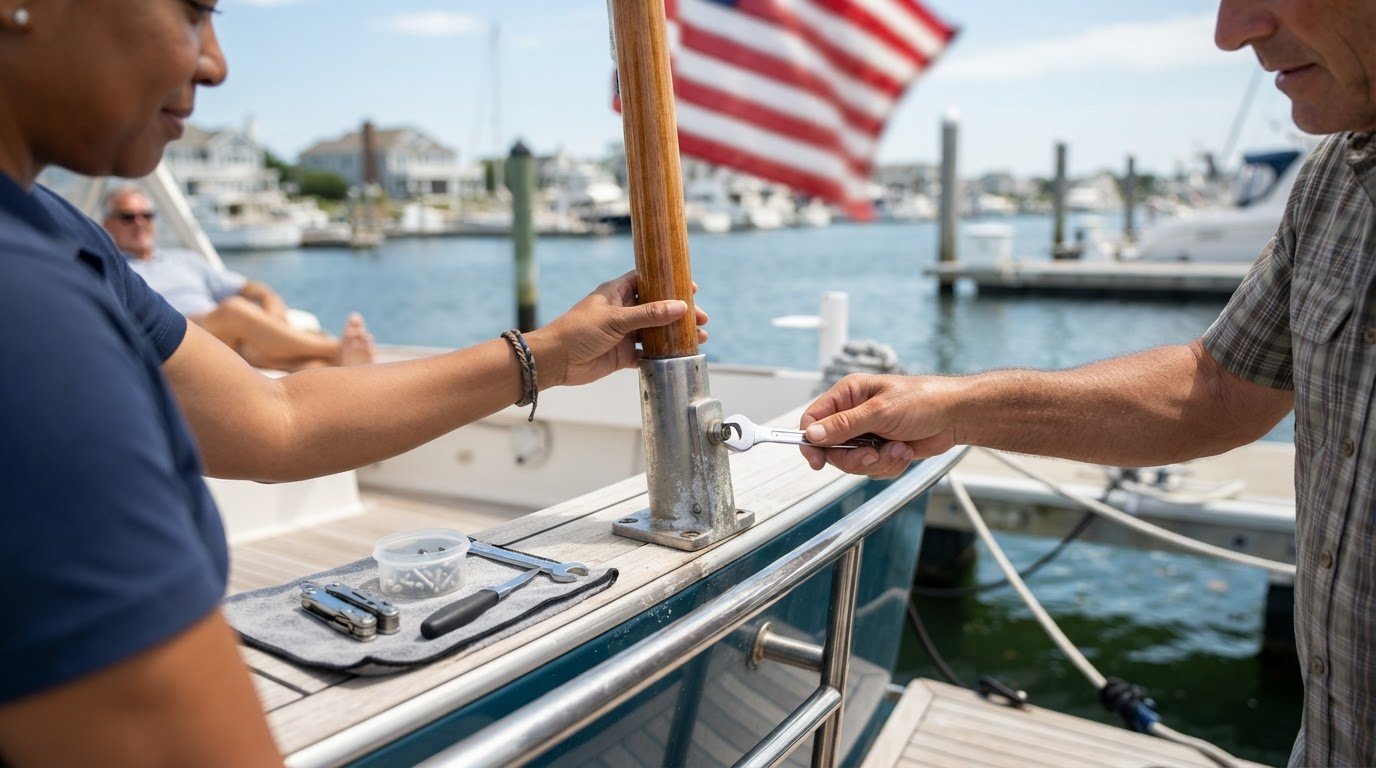
A bracket’s performance depends on the complete mounting system, not the bracket alone. The bracket, pole, fasteners, mounting surface, and installation all contribute to how the assembly behaves. A sturdy bracket can’t compensate for an unsuitable pole, mismatched fasteners, or an attachment that doesn’t fit its mounting surface.
Repeated handling and vibration are also useful design considerations. Think about how often you’ll insert or remove the pole and whether the bracket’s retaining mechanism suits that routine. These factors help you assess the whole arrangement without assuming a machining label or one feature guarantees a particular result. Material is another part of the decision. Choosing metal for marine accessories involves trade-offs to consider alongside the bracket’s intended application.
What marine exposure means for bracket design
Moisture, salt, and repeated exposure are part of the environment marine hardware may face over time. Consider the bracket’s material and finish in relation to where and how you boat. Don’t infer corrosion resistance from appearance or a CNC label alone; those depend on product-specific details. For more context on selecting hardware for marine conditions, see this guide to durable boat flag hardware.
Assess a CNC boat flag bracket as a designed component in a working system. Match its interface and intended use to your vessel, then consider the pole, fasteners, clearance, and exposure together. Tower Flags designs custom boat flag brackets and poles for marine use. Explore its custom boat flag brackets for a purpose-designed option for vessel-specific mounting needs.
CNC Boat Flag Bracket vs. Generic Mount: Compare the Whole Mounting Solution
A marketplace search can show marine flag brackets beside mounts intended for trucks, ATVs, or other vehicles. Similar-looking hardware may use a different attachment interface or suit a different application. Compare the complete mounting solution, not just the product label or machining method. CNC machining doesn’t automatically make a product the right choice for your boat.
When a custom-engineered bracket may be the better fit
A vessel-specific bracket can be useful when the boat’s attachment point, surrounding geometry, or available clearance doesn’t match a standard interface. Custom fit addresses particular mounting requirements; it doesn’t mean custom hardware is always superior. Tower Flags designs and manufactures custom marine flag brackets and poles for boat owners’ vessel-specific mounting needs. For a broader look at bracket selection, read the custom boat flag bracket guide.
When a simpler mount may suit the application
If your boat has a compatible attachment point and a generic mount fits it as intended, a simpler option may meet your needs. Your routine matters too. A mount that allows convenient removal may suit a flag you take down often, while a fixed arrangement may suit a different display preference. Neither category is right for every boat; compatibility comes first.
Use the comparison to narrow your options: identify the attachment point, check the interface, and consider adjustment, display habits, and marine exposure. A CNC boat flag bracket is worth considering when its design matches the boat and its intended use. The machining label is only one detail in that decision.
Use This Checklist to Choose a CNC Boat Flag Bracket
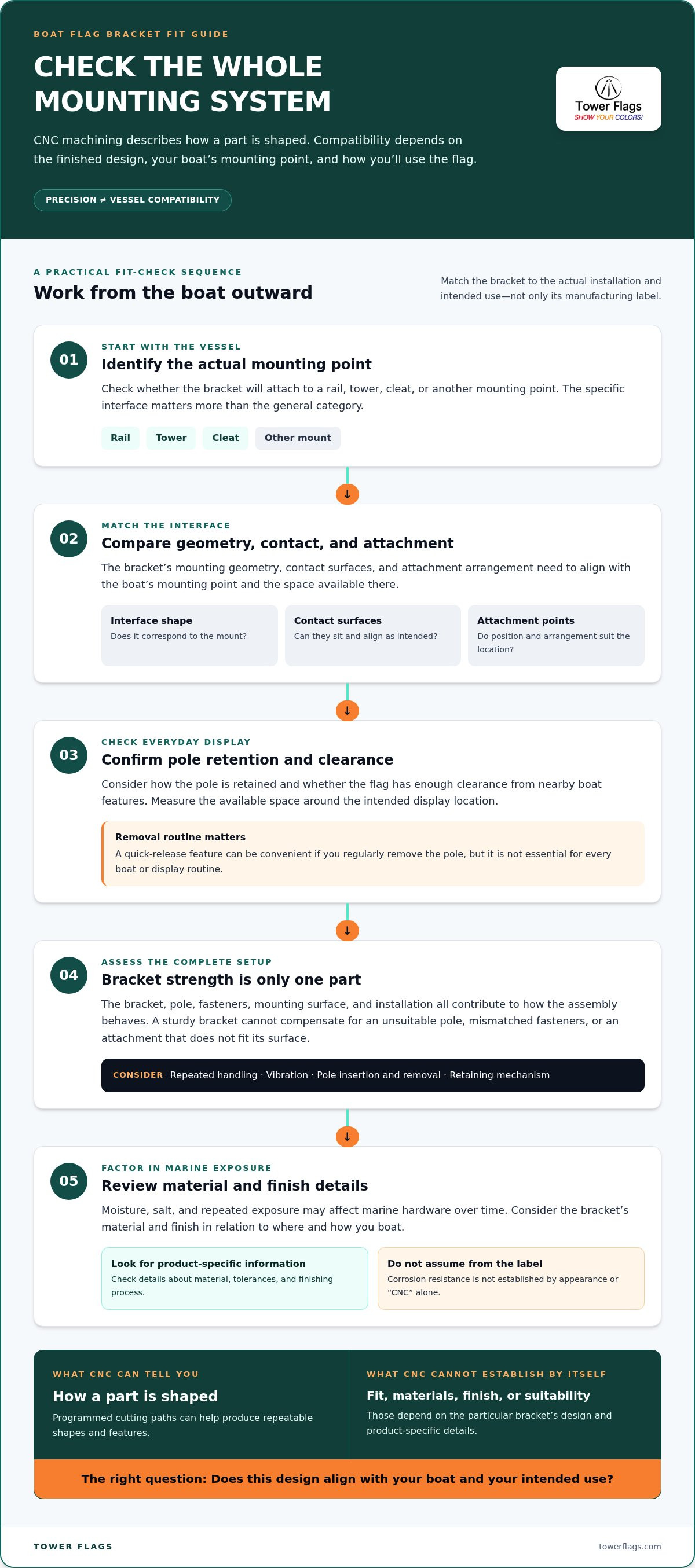
A useful fit check starts with the boat, not the product label. Work through these five steps before choosing a bracket and pole. The details you record will help you compare designs with your actual mounting location and display routine.
Identify the mounting point. Note whether the bracket will attach to a tower, rail, cleat, or another structure. Describe the surface’s shape and orientation, since a bracket intended for one interface may not suit another.
Measure the interface and clearance. Record relevant dimensions, such as width, diameter, or spacing at the attachment point. Also note nearby structures and the space available for the bracket, pole, and flag to sit without interference.
Define how you’ll use the flag. Consider how often you plan to display, remove, or reposition it. If you’ll remove the pole regularly, access to its retention feature may be especially important. A less frequently changed display may call for different priorities.
Compare the design with your use. Review the bracket’s attachment method, pole retention, adjustment options, and intended application. Consider the vessel’s operating conditions, but don’t assume a machining label establishes a load or speed rating.
Confirm the complete fit. Check that the bracket, pole, attachment point, and fasteners work together as a system. A bracket that appears to match in a listing still needs to suit the actual mounting surface and available clearance.
Start with the boat and mounting location
Specific vessel details narrow the options. A tower, rail, and cleat present different shapes and attachment arrangements, so record what you have rather than searching only by a broad term like “boat mount.” If the mounting point is angled or close to other hardware, include that in your notes. These observations help distinguish a close visual match from a bracket designed for the interface you need.
Match the bracket to how you use the flag
Think through the full routine: how the pole fits, how easily it can be removed, and whether the flag needs room to clear nearby structures. Evaluate those needs alongside the vessel’s operating conditions, without relying on assumptions about product ratings. If pole construction is also part of your decision, read this overview of marine flag pole engineering.
Use your measurements and use case to compare options rather than choosing by the CNC label alone. Tower Flags designs custom boat flag brackets and poles for marine use. Explore custom marine flag brackets for a purpose-designed option.
Choose a Custom-Engineered Marine Bracket for a More Precise Fit
A sound bracket choice comes down to more than how the part was made. Match the mounting interface to your boat, check the fit and available clearance, consider how you’ll use the flag, and account for the marine environment. A CNC boat flag bracket may be manufactured with precision, but its value depends on whether its design suits the vessel and complete mounting arrangement.
What to expect from a specialist marine hardware approach
Tower Flags designs and manufactures custom boat flag brackets and poles for marine use. This specialist focus addresses vessel-specific mounting needs rather than treating every boat as if it shared one standard attachment point. A purpose-designed bracket can be considered in relation to the mounting location, pole, and intended display, without assuming custom fit guarantees a particular result.
Keep the decision grounded in the details that affect your boat. Manufacturing method alone doesn’t establish which interface a bracket fits, what material it uses, or how it will perform in a particular setting. Evaluate those product details alongside the design’s intended application. Compare the bracket with your boat’s actual requirements, not just the labels in a listing.
Take the next step toward the right bracket
Before choosing, have these details in hand: the mounting point and its dimensions, nearby clearance, how often you’ll remove or reposition the flag, and the conditions in which you’ll use it. Then compare each option: Does the interface match? Will the bracket fit the available space? Does the design suit the way you plan to display the flag? Consider the pole and attachment hardware as part of the same setup.
This review helps distinguish a broadly compatible-looking mount from one designed around a specific marine application. It keeps the focus on what matters: a suitable interface, an appropriate fit, and a design aligned with your use.
Explore Tower Flags marine flag hardware to view custom-designed brackets and poles for boat owners.
Choose a Bracket That Fits Your Boat and Your Plans
A CNC boat flag bracket may be precisely made, but machining alone doesn’t guarantee it matches your vessel. Start with the mounting interface and available clearance, then consider how you’ll display and remove the flag and the marine conditions the hardware will face.
Think of the bracket, pole, attachment point, and fasteners as one system. A purpose-designed fit can address vessel-specific mounting needs, while a generic mount may also suit your boat if its interface and intended use align. The details matter more than the label.
Tower Flags designs custom-fit flag brackets and poles for boat owners, with marine mounting solutions for vessel use. Explore Tower Flags’ custom marine flag hardware for a specialist option for your boat and display needs.
Frequently Asked Questions
What is a CNC boat flag bracket?
A CNC boat flag bracket is a marine flag mount shaped with computer-controlled machining. The process can create repeatable features and precise geometry, but it doesn’t establish whether the finished bracket fits your vessel. Check the mounting interface, pole compatibility, available clearance, material and finish, and intended use before selecting the complete setup. A CNC label describes a production method, not a vessel-specific fit.
Does CNC machining make a boat flag bracket stronger?
Not by itself. CNC machining describes how a part is shaped, not its strength rating. Strength also depends on material, geometry, dimensions, attachment method, and how the bracket is used. Compare the bracket with its pole, fasteners, and mounting surface rather than judging the machined part alone. Use product specifications for application-specific limits, and don’t infer strength from words such as “precision” or “billet.”
How do I know if a boat flag bracket will fit my boat?
Start by identifying the boat’s mounting point, such as a tower, rail, or cleat. Measure the interface and note nearby structures that could limit clearance. Then compare those details with the bracket’s stated application and specifications, including pole compatibility and how the flag is retained. Consider how often you’ll remove the flag, too. A precise part still needs to match the vessel’s actual mounting geometry.
Are CNC boat flag brackets better than generic mounts?
No, CNC boat flag brackets aren’t automatically better than generic mounts in every situation. Machining may support precise, repeatable geometry, while a generic mount can suit a straightforward attachment point if its interface matches. Compare intended use, fit, pole retention, clearance, and marine exposure as a complete system. Choose based on product details and your boat’s requirements, not the manufacturing label alone.
What should I compare when choosing a marine flag bracket?
Compare the mounting interface and dimensions first, then check fit, pole retention, and clearance around nearby structures. Consider how often you’ll remove or reposition the flag, plus the bracket’s material, finish, and stated application. Review the pole and attachment hardware alongside the bracket, since they form one mounting setup. Treat broad claims such as “heavy duty” or “precision” cautiously unless product information explains their meaning.
Can I use an ATV or UTV flag mount on a boat?
Don’t assume an ATV or UTV flag mount will suit a boat. Its interface, intended environment, pole requirements, and application may differ from your marine setup. Compare the mount’s dimensions and stated uses with your boat’s attachment point, available clearance, and flag pole. A listing that mentions boats among several vehicle types isn’t enough by itself; the specific interface still needs to match.
Is CNC machining the same as custom manufacturing?
No. CNC machining is a process that uses computer-controlled tools to shape material; custom manufacturing means a part is designed or produced for particular requirements. A custom bracket might be machined, made through another fabrication process, or assembled using multiple methods. The terms describe different things, so don’t treat them as interchangeable. Evaluate the finished bracket’s fit, design, intended mounting point, and product specifications to judge whether it suits your boat.
Comments