

Custom Boat Tower Flag Pole: Precision Marine Engineering
Why do boat owners invest six figures in a precision-engineered wake boat only to settle for a generic, twenty-dollar "universal" clamp that's destined to fail? You know the frustration of hearing that distinct metallic rattle during a high-speed run or, worse, seeing your flag disappear into the wake because a mount couldn't handle the aerodynamic load. It's even more discouraging to find deep scratches on your tower's expensive powder-coating caused by hardware that was never designed for your specific boat. We understand that on the water, "good enough" usually isn't. Choosing a custom flag pole for boat tower applications ensures your hardware matches the caliber of your vessel while providing total security at speeds exceeding 40 mph.
You'll discover why custom-engineered flag poles are essential for wakeboard towers and how to select hardware that withstands the harshest marine environments without slipping or vibrating. We'll examine the mechanical advantages of precision fabrication, the materials that prevent corrosion, and the specific design features that offer peace of mind during every session. By the end of this guide, you'll know exactly how to achieve a secure, rattle-free display that complements the high-end aesthetic of your boat while protecting your investment from unnecessary wear.
Table of Contents
Why Standard Boat Flags Fail on Wakeboard Towers
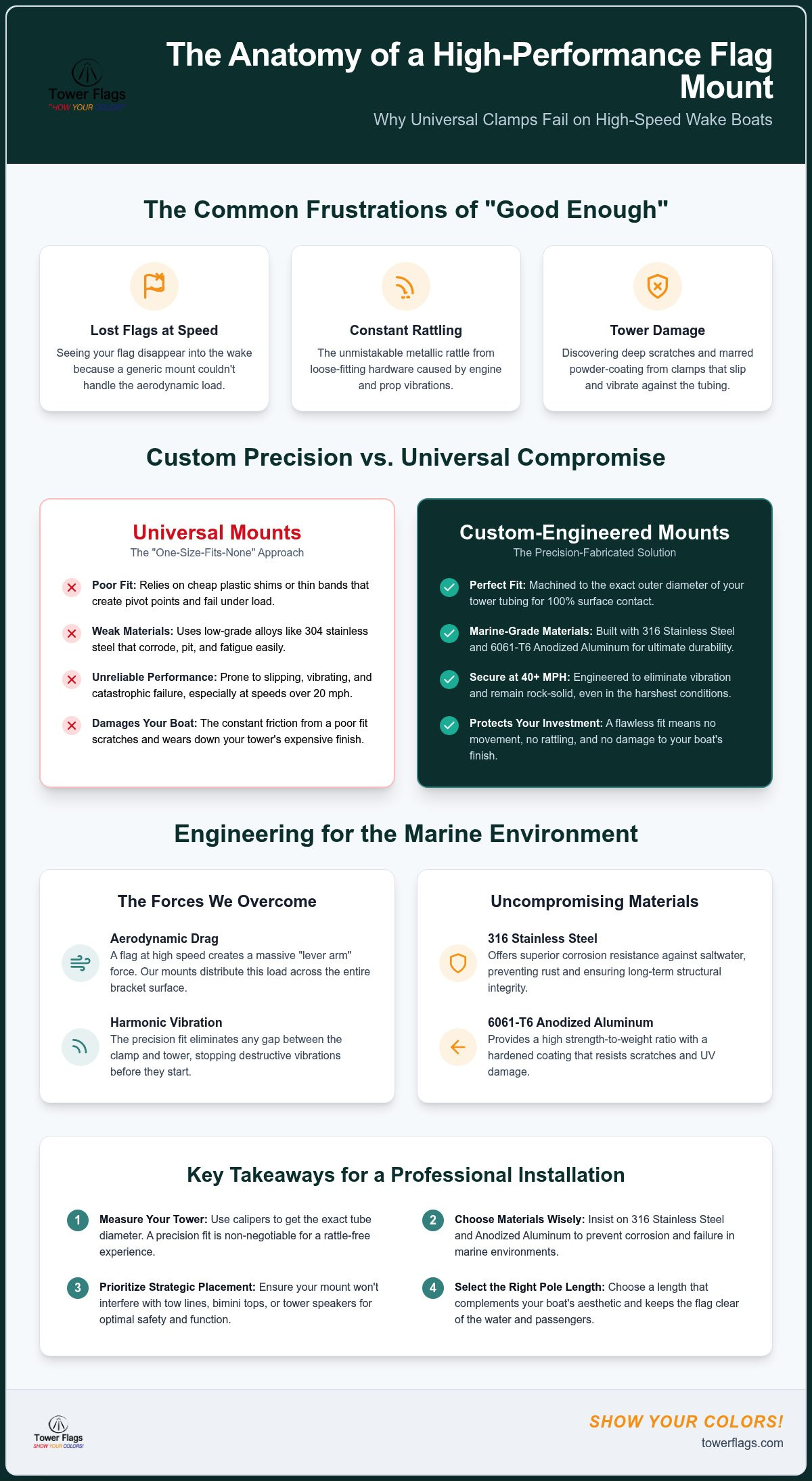
Standard boat flag mounts were never intended to survive the environment of a wakeboard tower. While a hull-mounted pole sits in relatively protected air, a tower mount is exposed to the full force of the wind and the amplified movements of the vessel. Most mass-market retailers sell universal kits that rely on plastic shims or thin metal bands. These components lack the structural rigidity to withstand the unique stresses of a high-profile marine application. Investing in a custom flag pole for boat tower use isn't about aesthetics alone; it's about mechanical integrity. Generic hardware often fails because it treats the tower as a static mounting point rather than a dynamic, vibrating structure.
The Physics of High-Speed Flag Display
A 3x5 flag flying at 30 knots acts like a small sail, creating substantial drag that increases exponentially as you accelerate. This drag exerts a constant "lever arm" force on the mounting bracket. If the bracket is not perfectly mated to the tower, this force creates a pivot point that stresses the hardware. Generic flag poles often utilize indexed adjustments or thin, feeble pins to hold the pole in place. These small contact points are the first to strip or shear under constant pressure. By applying fundamental marine engineering principles, it becomes clear that a mount must provide a 100% contact surface area to distribute this load effectively. Without a precision fit, the wind resistance will eventually cause the pole to slip or the bracket to fail entirely.
Vibration: The Silent Tower Killer
Harmonic vibration is the most common cause of hardware failure on the water. It originates from the engine and prop, traveling through the hull and up the tower. On a tower, these vibrations are magnified, leading to metal fatigue in low-grade aluminum components. A vibration resistant boat flag mount is the only way to prevent the constant rattling that leads to hardware degradation. Beyond the annoying noise, loose-fitting universal clamps will vibrate against your tower tubing. This constant friction will eventually scratch or mar the expensive powder-coated finish of your boat. A custom flag pole for boat tower applications is engineered to match the exact outer diameter of your tubing, creating a rock-solid connection that eliminates movement and protects your vessel's aesthetic value. This precision fit ensures that the hardware remains silent and secure, even when you're hitting the wake at full throttle.
The Engineering Behind a Custom Flag Pole for Boat Tower Use
Engineering a solution for a high-performance vessel requires a departure from "one-size-fits-all" manufacturing. A custom flag pole for boat tower setup relies on exact tolerances to manage the aerodynamic load. We treat every bracket as a critical component, focusing on the mechanical relationship between the hardware and the vessel's structure. This specialized approach ensures that the display remains stable even when the boat is subjected to heavy chop and high speeds.
Material Science in Marine Environments
Saltwater and high humidity are unforgiving environments that quickly expose the weaknesses of inferior alloys. While many mass-market retailers use 304 stainless steel to save on production costs, we prioritize 316 stainless steel and 6061-T6 anodized aluminum for their superior corrosion resistance. This level of durability is essential for marine flag poles that face constant salt spray, high-octane vibrations, and intense UV exposure. Adhering to high equipment standards, similar to the reliability expected in U.S. Coast Guard safety standards, ensures your hardware won't pit, rust, or seize over time. Heavy-duty fabrication isn't just about adding weight; it's about ensuring the alloy can handle the lateral stress of a 30-knot wind without losing its structural integrity.
Anatomy of a High-Performance Tower Clamp
A precision-fit bracket is designed with internal geometry that matches the specific radius of your tower's tubing. Unlike universal clamps that use cheap plastic shims to bridge gaps, a custom flag pole for boat tower bracket ensures a 100% contact surface area. This even distribution of pressure is vital for the longevity of your boat. It prevents the "point loading" that causes crimping, bending, or permanent structural damage to the tower tube. We utilize custom-fit inserts that act as a protective barrier between the bracket and the powder-coating, maintaining a rock-solid grip without compromising the finish.
The locking mechanism is where many generic mounts fail during a session. Thumbscrews are convenient for low-speed applications, but they often vibrate loose under the harmonic stress of a wake boat engine. We utilize precision-fit bolts that provide a mechanical lock, ensuring your display stays upright and secure. This streamlined profile also reduces wind drag, preventing the bracket from acting like a brake on your tower. If you're ready to upgrade your vessel's hardware, you can explore our precision-engineered flag poles to find the perfect fit for your specific tower model.
Custom Precision vs. Universal Clamps: Which Is Right for Your Vessel?
Universal clamps are often marketed as a convenient, budget-friendly fix for any vessel. However, the reality of high-speed marine environments quickly exposes the fundamental flaws of a "one-size-fits-all" approach. A custom flag pole for boat tower application is designed as a precision-fit component rather than a temporary accessory. While mass-market retailers prioritize inventory turnover with universal kits, we prioritize the mechanical bond between the hardware and your boat's structure.
The Myth of the "One-Size-Fits-All" Clamp
Universal hardware typically relies on rubber shims or plastic spacers to bridge the gap between a generic clamp and your specific tower tube. Over a single season, intense UV exposure causes these temporary spacers to dry, crack, and lose their elasticity. When the shim compresses, the clamp loses its torque. This loss of tension leads to the sagging and metallic rattling that ruins the experience of a quiet morning on the glass. Using a 2.5-inch clamp on a 2.375-inch tube, for example, creates a dangerous gap that no amount of rubber can safely fill. This is exactly why custom boat flag brackets are the preferred choice for owners of premium performance brands. Precision machining ensures that each bracket is engineered for specific tube diameters, such as 2-3/8", 2.5", or 3", providing a true mechanical lock that generic hardware simply can't replicate.
Protecting Your Tower Investment
Your boat tower is a significant part of your vessel's value and structural integrity. Ill-fitting universal clamps are notorious for causing permanent gouging and marring in the aluminum tubing. As your boat hits chop, the vibration causes an undersized or shimmed clamp to "walk" along the tube. This movement chews through the expensive powder-coating or anodized finish, leaving behind raw metal that is vulnerable to corrosion. The cost of tower repair or professional refinishing far exceeds the investment in precision-engineered hardware. By selecting a custom flag pole for boat tower use, you ensure the bracket acts as a seamless extension of the boat. This precision fit protects the resale value of your performance boat by keeping the tower pristine and the flag display secure, regardless of the conditions. Custom-fabricated hardware doesn't just look better; it functions as a permanent part of your marine equipment that won't need replacement after a single season of salt-spray and wind stress.
Strategic Placement: Optimizing Visibility and Safety on Your Tower
Strategic placement is the final step in achieving a professional marine setup that functions as well as it looks. When you install a custom flag pole for boat tower use, you must account for the dynamic environment of a wake boat. High-profile towers are crowded with speakers, lights, and bimini tops, all of which compete for space. Finding the right mounting point ensures your flag remains visible without creating a safety hazard or interfering with your vessel's existing equipment. We prioritize a placement strategy that balances aesthetic symmetry with mechanical clearance.
The Tow Line Clearance Test
The most critical safety consideration is the path of your tow line. A snagged rope during a wakeboard session can cause immediate hardware failure or, worse, snap the line back toward the rider. Mounting a high speed wakeboard tower flag mount too low on the tower leg is a common mistake that leads to line interference. To find the safest mounting point, you should perform a manual clearance test. Attach your tow line to the pylon and pull it taut to the furthest lateral extent on both the port and starboard sides. Mark the arc of the rope against the tower legs to identify the "no-mount" zone. Safe clearance is a minimum of 12 inches from any moving tow line. This buffer ensures that even during aggressive cuts or rider falls, the rope will never make contact with your flag pole hardware.
Aesthetic and Functional Mounting Points
For maximum visibility, we recommend the "golden triangle" of tower mounting. This area is located on the upper third of the rear tower legs, just behind the tow point. Placing your hardware here ensures the flag is elevated above the passengers and the bimini top, making it visible to other boaters from 360 degrees. If you intend to fly dual flags, offset the brackets by at least 18 inches vertically to prevent the flags from tangling during a shift in wind direction. You must also verify that the pole doesn't obstruct the driver’s rear-view mirror. A clear line of sight to the rider is a non-negotiable safety requirement. By choosing a custom flag pole for boat tower application, you can utilize a streamlined bracket that sits tight to the tower leg, preserving your field of vision while maintaining a high-end, OEM look. If you're ready to secure your display, shop our collection of precision-engineered brackets to find the ideal mounting solution for your vessel.
Choosing Your Custom Tower Mounting Solution
Selecting the right hardware is the final step in transitioning from a generic setup to a professional marine display. A custom flag pole for boat tower system is a precision-engineered assembly where every measurement matters. Unlike mass-market retailers that offer a limited range of "close enough" sizes, we focus on the exact tolerances required for your specific vessel. This ensures that your hardware doesn't just hold a flag; it becomes a permanent, vibration-free extension of your boat's structure.
The Precision Fit Checklist
Measuring your tower tubing is the foundation of a successful installation. You shouldn't rely on a standard tape measure or manufacturer spec sheets, as powder-coating thickness can vary. We recommend using a digital caliper to find the exact outer diameter of your tubing at the specific point where you intend to mount the bracket. While many towers use round tubing in standard sizes like 2.5 inches or 3 inches, modern performance boats often feature oval or custom-shaped extrusions. A round bracket will never provide a secure mechanical bond on an oval tube. You must also verify the pole socket depth. A precision-machined socket ensures the pole is seated deeply enough to resist the lateral leverage created by wind drag at 40 mph.
Once you have your measurements, you'll need to choose the appropriate pole length. This decision is usually dictated by your flag's dimensions and your tower's configuration. A 26-inch pole is typically sufficient for smaller burgees or when you're navigating areas with low bridge clearance. For a standard 3x5 flag, a 46-inch pole is necessary to ensure the flag clears your tower speakers and bimini top. To finish the installation, you should utilize high-quality wakeboard tower flag accessories. Using marine-grade clips and tensioners prevents the flag from wrapping around the pole or creating unnecessary noise during your session.
Investing in American-Made Quality
Purchasing from a specialized workshop ensures you're getting hardware designed by craftsmen who understand the marine environment. We prioritize American-made quality because it allows for tighter quality control and the use of superior alloys that mass-market importers often overlook. A custom flag pole for boat tower application demands a level of precision that generic factories simply can't provide. Before your first outing, perform a final inspection by applying firm pressure to the mount. It should feel rock-solid and fused to the tower leg. If there's any play or metallic clicking, the fit isn't precise enough for high-speed use. Investing in precision fabrication today means you won't be dealing with stripped bolts or scratched towers tomorrow. Ready to upgrade? Browse our precision-fit tower flag hardware today.
Elevate Your Vessel with Precision Marine Hardware
Settling for universal mounting hardware is a gamble that often results in damaged towers and lost flags. By choosing a custom flag pole for boat tower applications, you're investing in a solution specifically designed to handle the harmonic vibrations and aerodynamic loads of a performance wake boat. We've seen how precision machining and high-grade materials eliminate the metallic rattling and slipping common with mass-market alternatives. Protecting your vessel's aesthetic and structural integrity is simply a matter of selecting hardware that matches the caliber of your boat.
Our workshop focuses on American-made quality, producing hardware that is high-speed vibration tested and custom-fit for major tower brands. We utilize 316 marine-grade stainless steel to ensure your display remains rust-proof and secure for years to come. Stop fighting with shims and loose brackets that mar your finish. You can Shop Precision-Engineered Tower Flag Mounts today and experience the peace of mind that comes with specialized engineering. Get back to the wake with confidence, knowing your hardware is built to last as long as your boat.
Frequently Asked Questions
Will a universal flag holder damage my wakeboard tower?
Yes, universal holders often cause damage because they rely on shims or spacers that compress over time. This creates a gap that allows the metal bracket to vibrate against the tower's powder-coating. This movement leads to deep scratches and gouging. A custom flag pole for boat tower application avoids this by providing a 100% contact surface area, which distributes pressure evenly and prevents the hardware from "walking" along the tube.
How do I measure the diameter of my boat tower for a flag mount?
You should use a digital caliper to measure the outer diameter of your tower tubing at the exact mounting location. Tape measures are insufficient because they can't account for the precision required for a custom fit. Measure the tube in several spots to ensure it isn't slightly out-of-round. If your tower has an oval or non-standard shape, you'll need specialized hardware rather than a standard circular clamp to ensure a secure mechanical bond.
What is the best material for a high-speed boat flag pole?
The best materials for high-speed marine environments are 316 stainless steel and 6061-T6 anodized aluminum. These alloys provide the necessary tensile strength to resist the lateral force of wind drag while offering maximum corrosion resistance against salt spray. Inferior materials like 304 stainless or plastic will quickly fail under the stress of 40 mph speeds. Precision-engineered metals ensure the pole won't bend or snap when you're hitting the wake at full throttle.
Can I fly a 3x5 flag on a wakeboard tower at full speed?
You can fly a 3x5 flag at full speed only if you use a high-performance custom flag pole for boat tower use designed for high aerodynamic loads. A flag of this size acts like a sail, exerting significant leverage on the mounting bracket. You must ensure the bracket is machined for a precision fit and that the pole is seated deeply in its socket. We recommend checking the hardware torque regularly when flying large flags at high speeds.
How do I prevent my boat flag pole from vibrating or rattling?
Preventing vibration requires a mount that matches the exact radius of your tower tubing. Rattling occurs when there is a gap between the bracket and the tube, which is common with universal mounts that use rubber shims. By utilizing a precision-machined clamp, you eliminate the mechanical play that leads to noise. Additionally, ensure all bolts are tightened to the correct torque and that your flag clips are tensioned to prevent them from flapping against the pole.
Is it better to mount a flag pole on the tower or the hull?
Tower mounting is generally superior for visibility and safety because it keeps the flag above the passengers and the bimini top. Hull mounts often place the flag in the "dirty air" behind the boat, where it can tangle or obstruct the driver's rear-view mirror. While a tower mount experiences higher vibration, a custom-engineered bracket manages this stress effectively. This elevated position also makes your vessel more visible to other boaters from a distance.
How do I ensure my flag pole doesn’t interfere with my wakeboard rope?
You must perform a clearance test by pulling your tow line to its maximum lateral extent on both sides of the boat. Mark the arc of the rope against the tower legs and mount your hardware at least 12 inches away from this path. Placing the mount on the upper third of the rear tower leg usually provides the best clearance. This prevents the rope from snagging on the flag pole hardware during aggressive cuts or rider falls.
Do I need special tools to install a custom tower flag mount?
Most custom tower flag mounts only require basic hand tools like an Allen wrench set or a socket wrench. The focus isn't on complex installation but on the precision of the hardware itself. You won't need to drill into your tower or use temporary adhesives because the bracket is engineered to lock onto the tube through mechanical pressure. Always use a torque wrench if the manufacturer provides specific settings to ensure the bolts are seated correctly.


Comments