

Debunking the Myths: Choosing a Boat Flag Pole for High Speeds in 2026
Most "heavy duty" boat flag accessories are actually designed for the leisurely pace of a harbor crawl, not the 40 MPH reality of a modern wake boat. You've likely felt that sinking feeling when a gust of wind at cruising speed turns a proud flag into a projectile that snaps its pole and scars your gelcoat. It's a common frustration born from a market flooded with universal mounts that simply cannot handle the physics of high speed boat flag mount engineering.
We understand that your boat tower represents a significant investment, and you shouldn't have to choose between showing your pride and protecting your equipment. This article reveals the engineering truths behind high-speed flag mounting so you can maintain a clean, professional look at 40+ MPH without gear failure. We'll examine the critical differences between generic rubber shims and custom-machined brackets, the vibration-dampening properties of carbon fiber, and the performance standards required for the 2026 boating season. By understanding the mechanical forces at play, you can secure a setup that stays vertical, silent, and secure regardless of the throttle position.
Table of Contents
The 30 MPH Barrier: Why Most Marine Flag Poles Fail
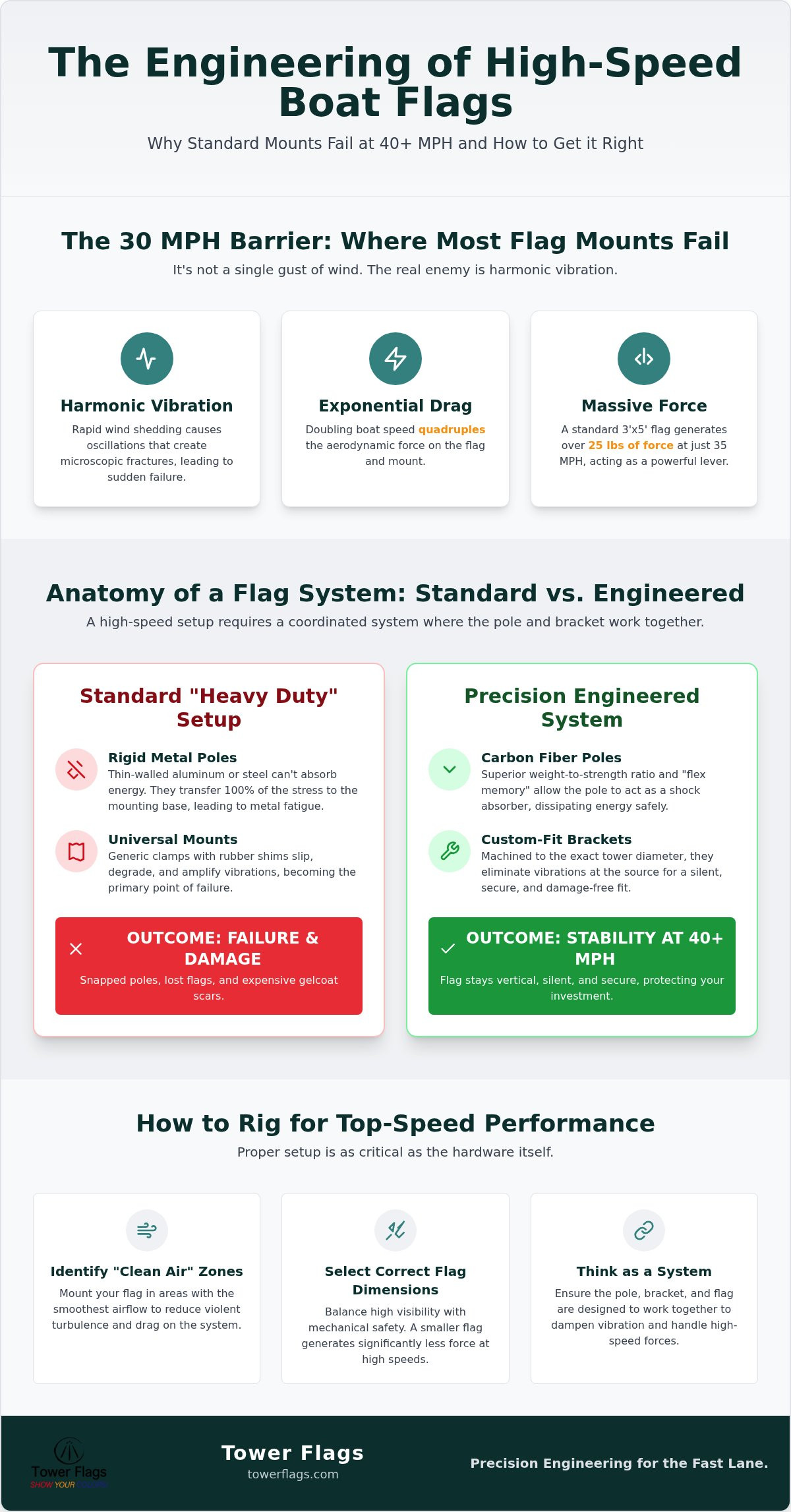
Most boaters assume a flag pole fails because of a single, powerful gust of wind. In reality, the culprit is almost always harmonic vibration. When your boat hits the 30 MPH threshold, the air moving around the flag doesn't flow smoothly. Instead, it creates a phenomenon known as wind shedding, where air pockets alternate sides rapidly. This causes the pole to whip back and forth with increasing intensity. Without the benefit of precision high speed boat flag mount engineering, this oscillation creates microscopic fractures in the hardware that eventually lead to a clean snap.
The physics of drag play a massive role here. Aerodynamic drag increases exponentially with speed; doubling your boat's velocity quadruples the force exerted on the flag. A standard 3x5 foot flag can generate approximately 25 lbs of wind force at just 35 MPH. This force acts like a massive lever, multiplying the stress at the point where the pole meets the bracket. While the study of flags often prioritizes symbolism and history, marine applications require us to prioritize the mechanical integrity of the mounting system above all else.
The Myth of 'Universal' Speed Ratings
Many retail flag poles carry "speed rated" labels that are fundamentally misleading. These ratings are often based on static wind loads in a controlled environment, which don't account for the dynamic, choppy air found behind a moving vessel. A "heavy duty" rating on a generic pole rarely considers the size of the flag being flown. A mount that survives 40 MPH with a small pennant will likely fail at 25 MPH with a full-sized ensign. Most off-the-shelf accessories simply aren't tested for the real-world conditions of a wake tower at cruising speed.
Drag, Vibration, and Harmonic Failure
Rigid materials like cheap, thin-walled aluminum are particularly susceptible to the "Snap Point." Because they can't absorb the energy of the wind, they transfer all that stress directly to the mounting base. This leads to metal fatigue, where the hardware becomes brittle and fails without warning. When a pole snaps at 40 MPH, the hardware doesn't just disappear into the lake. It often whips back toward the boat, causing expensive gelcoat damage or cracking the finish on your tower. True high speed boat flag mount engineering focuses on a coordinated system where the pole and bracket work together to dampen these vibrations before they reach the breaking point.
Material Science: Why Carbon Fiber Dominates High-Speed Boating
Choosing the right material is the foundation of high speed boat flag mount engineering. While stainless steel has long been a marine standard, it's often too heavy and rigid for high-speed applications. Carbon fiber has emerged as the superior alternative because it offers an exceptional weight-to-strength ratio. A lighter pole reduces the static and dynamic load on your tower bracket, preventing the mounting system from becoming a liability when you open the throttle. By reducing the mass at the end of the "lever arm," you minimize the stress that leads to hardware failure.
Carbon Fiber vs. Stainless Steel
High-performance marine flag poles made from carbon fiber provide significant advantages over traditional 316L stainless steel. Stainless steel is incredibly strong, but its weight creates a massive weight penalty that can fatigue even the best machined aluminum brackets over time. In saltwater environments, carbon fiber is naturally inert and thrives where metals struggle. It won't rust, pit, or corrode after multiple seasons of exposure. While stainless steel is prone to permanent bending once its yield point is exceeded, carbon fiber maintains its structural integrity and finish over years of high-speed runs.
Tensile Strength and Flex Memory
Flex memory is the material’s ability to absorb energy without permanent deformation. This property is critical for a boat flag pole for high speeds because aerodynamic forces on marine appendages turn a standard flag into a high-drag sail at 40 MPH. When a metal pole bends under these loads, it often stays deformed or develops stress cracks. Carbon fiber acts as a sophisticated shock absorber. It flexes to dissipate the energy from sudden wind gusts and then snaps back to its original vertical position. This "give" is vital because it protects your boat's permanent hardware by reducing the peak impact forces transferred to the tower.
The "whip" effect mentioned previously is magnified by rigid materials that resonate with engine vibration and wind shedding. Carbon fiber naturally dampens these high-frequency oscillations instead of magnifying them. Instead of vibrating like a tuning fork, a composite pole remains steady and silent. If you're looking for a setup that combines durability with technical superiority, it's time to consider a carbon fiber flag pole engineered for the fast lane. This material choice ensures your flag stays upright and your tower remains undamaged, even during the most aggressive transitions to plane.
Beyond the Pole: Why Brackets Are the Secret to Stability
A high-performance pole is only as effective as the anchor holding it to your vessel. If you pair a premium carbon fiber pole with a flimsy, mass-produced bracket, you're essentially building a high-speed system on a foundation of sand. True high speed boat flag mount engineering prioritizes the interface between the bracket and the boat tower. This ensures that every ounce of wind force is distributed safely across the structure rather than concentrated on a single point of failure. When you're cruising at 40 MPH, the bracket must act as a rigid, immovable extension of your boat's frame.
The Failure of Plastic and Cast Aluminum
In the harsh marine environment, materials like "heavy duty" plastic and cast aluminum quickly reveal their limitations. While plastic mounts might be labeled as "UV-stabilized," the reality is that constant exposure to sun and saltwater causes these polymers to become brittle within a single season. Under the dynamic load of a boat at cruising speed, these brackets can crack or shatter without warning. Cast aluminum alternatives often fare little better. The casting process can leave internal air pockets that compromise the metal's integrity. When combined with engine vibration, the soft threads in these mounts often strip, leading to a loose, rattling assembly that eventually fails and risks your equipment.
Precision Engineering for Custom Fits
The most common cause of bracket failure is a poor fit. Universal mounts attempt to solve this with rubber shims or oversized clamps, but these shortcuts create gaps that allow for movement. At high speeds, even a microscopic gap results in a "hammering" effect as the mount vibrates against the tower. This doesn't just destroy the bracket; it can also mar the expensive finish of your wake tower or cause structural stress to the tower itself.
Investing in custom boat flag brackets eliminates this risk entirely. These components are machined to within 1/100th of an inch of your specific tower's diameter. A zero-tolerance fit ensures that the bracket remains perfectly stationary regardless of wind resistance. When you utilize high-grade fasteners and precision-machined 6061-T6 aluminum, you create a mounting system that remains silent and secure at 50+ MPH. This level of exactness is the hallmark of professional high speed boat flag mount engineering, providing the peace of mind that your gear will stay exactly where you put it.
How to Rig Your Boat for Top-Speed Flag Performance
Rigging your vessel for high-performance runs requires more than just high-quality hardware. It demands a strategic approach to placement and flag selection. Even the most robust high speed boat flag mount engineering can be undermined by poor installation choices that expose the system to unnecessary turbulence. To ensure longevity, you must identify "clean air" zones where the wind flows steadily rather than swirling in chaotic patterns. Proper rigging reduces the mechanical stress on your tower and keeps your colors flying straight.
Optimal Mounting Locations for Airflow
Choosing a high-speed wakeboard tower flag mount is consistently superior to mounting on a side rail. Rails are positioned low, where they encounter "dirty air" coming off the bow and spray from the hull. This turbulence increases the erratic whipping motion of the flag. In contrast, the tower provides access to clean, laminar airflow. You should avoid the turbulence zone directly behind the windshield or helm, as the vacuum created by the boat's cockpit can cause the flag to snap violently. While angled mounts look aggressive, a vertical orientation generally handles high-speed drag more effectively by distributing force evenly along the pole's axis.
Flag Size and Material Selection
The size of your flag is the single most important factor in determining the load on your equipment. The math of drag is unforgiving. Doubling your boat's velocity quadruples the force on the flag. For context, a standard 3x5 foot flag generates approximately 25 lbs of wind force at 35 mph. If you push that same flag to 70 mph, the force jumps to 100 lbs. This is why selecting a smaller, specialized flag for high-speed runs is a fundamental principle of high speed boat flag mount engineering.
Material selection also dictates mechanical efficiency. You should avoid heavy cotton flags that hold water and become exponentially heavier when wet. Lightweight, high-tenacity polyester is the standard for 2026. These flags dry quickly and offer a lower drag coefficient. Look for flags with reinforced quad-stitching on the fly end to prevent fraying at 40+ MPH. Some performance boaters even opt for vented flags, which allow a portion of the air to pass through the fabric, significantly reducing the total load on the pole and bracket.
Before every outing, perform a quick pre-flight inspection. Ensure your fasteners are tight and the bracket hasn't shifted. A thirty-second check prevents a day of expensive repairs. If you're ready to upgrade your rigging with hardware designed for these forces, explore our precision-machined flag poles and brackets.
Tower Flags: Precision Engineering for the Fast Lane
Tower Flags exists because the marine industry lacked a solution for boaters who refuse to slow down. We don't believe in "good enough" when it comes to securing your colors. As specialists in high speed boat flag mounts, we have replaced the guesswork of retail accessories with the certainty of custom manufacturing. Our products are the result of a dedicated workshop obsessed with the fine details of fit and finish. We understand the physics of the water because we're boaters ourselves, and we've engineered every component to eliminate the snap, rattle, and roll that plagues inferior setups.
Our "No-Slip" guarantee is the cornerstone of our brand. While others rely on universal clamps that inevitably slide under pressure, our high speed boat flag mount engineering utilizes a coordinated system of precision-machined brackets and high-performance poles. This approach ensures that your hardware remains an immovable part of your vessel, even during aggressive acceleration and high-speed cruising. We take pride in providing a specialized solution that allows you to fly your flag with total confidence.
Custom-Fit Brackets for Major Boat Towers
We've spent years refining our engineering process to create brackets tailored to the specific geometry of the industry's leading towers. Whether you're running a Malibu with a G3 tower, a MasterCraft, or a Nautique, our hardware is designed to integrate seamlessly with your boat's existing aesthetics. We don't use rubber shims or generic spacers to bridge the gap. Instead, each bracket is machined to the exact diameter of your tower, providing a zero-tolerance fit that looks like a factory installation. This precision makes the installation process straightforward and ensures a professional, streamlined appearance that complements your boat's high-end design.
American-Made Quality You Can Trust
Reliability starts with where and how you source your materials. We prioritize American-made quality by controlling the entire manufacturing process within our own facilities. Sourcing durable boat flag hardware domestically allows us to maintain strict quality control standards that mass-produced imports simply cannot match. Our use of high-grade carbon fiber and 6061-T6 anodized aluminum ensures that our components outlast the competition, especially in corrosive saltwater environments. We don't cut corners with cast metals or cheap plastics. If you're ready to invest in hardware that performs as well as it looks, browse our collection of high-speed flag poles and brackets at Tower Flags.
Elevate Your Performance with Precision Marine Hardware
Flying your colors at cruising speed shouldn't be a gamble with your boat's gelcoat. Successful high-speed operation requires a move away from generic, mass-produced accessories toward specialized high speed boat flag mount engineering. By combining the vibration-dampening properties of carbon fiber with the rock-solid foundation of a custom-fit bracket, you eliminate the mechanical fatigue that leads to hardware failure. These components work together to absorb energy rather than fighting against it.
You now have the technical knowledge to choose a system that withstands harmonic vibration and exponential drag forces. Our American-made components are precision-machined to fit major wake tower brands, ensuring a seamless look and a secure grip at any throttle position. Don't settle for hardware that rattles or slips when you can have a setup designed specifically for the fast lane. It's time to stop worrying about your gear and start focusing on the wake.
Secure your flags with Tower Flags engineered mounting solutions and enjoy the peace of mind that comes with professional-grade marine hardware. See you on the water.
Frequently Asked Questions
What is the maximum speed I can fly a flag on my boat?
Most high-performance mounting systems are engineered to withstand speeds exceeding 45 MPH. While standard harbor poles often fail once you cross the 30 MPH threshold, precision hardware is designed for the dynamic loads of cruising. It's essential to match your hardware to your boat's capabilities to avoid mechanical failure during aggressive runs. Always check specific manufacturer ratings for your coordinated pole and bracket system.
Will a carbon fiber flag pole snap if I hit a big wave at speed?
Carbon fiber is highly unlikely to snap because it possesses superior flex memory. Unlike metal poles that can stay bent or develop stress fractures from sudden impacts, carbon fiber absorbs energy and returns to its original shape. This material is specifically chosen for high speed boat flag mount engineering because it dampens high-frequency vibrations rather than magnifying them. It provides a durable, shock-absorbing solution for rough water conditions.
Can I use a universal bracket on a wakeboard tower for high speeds?
You should not use universal brackets for high-speed applications because they rely on rubber shims that frequently slip. These "one size fits all" solutions cannot provide the zero-tolerance fit required to handle the 25 lbs of force generated by a standard flag at 35 MPH. We specialize in custom-fit brackets that match your tower's exact geometry to ensure the assembly remains immovable at cruising speeds.
Does the flag size affect the speed rating of the pole?
Flag size drastically impacts the load placed on your mounting hardware. Aerodynamic drag increases exponentially with speed; doubling your velocity quadruples the force on the fabric. A larger flag acts as a high-drag sail, which can overwhelm even the strongest poles. For high-speed runs, we recommend using smaller, reinforced flags to maintain a balance between visibility and mechanical safety for your specific tower geometry.
How do I prevent my flag pole from vibrating or rattling?
Preventing vibration requires a combination of precision-machined brackets and vibration-dampening poles. Rattling usually occurs because of gaps in universal mounts or the use of thin-walled metal poles that resonate with engine noise. By utilizing a custom-fit bracket that matches your tower's diameter to within 1/100th of an inch, you eliminate the movement that causes hardware to rattle and eventually fail under the stress of cruising.
What is the best material for a boat flag pole meant for 40+ MPH?
High-performance setups typically utilize carbon fiber poles and 6061-T6 anodized aluminum brackets. These materials thrive in saltwater environments and offer the structural integrity needed for 40+ MPH. This combination is a core component of modern high speed boat flag mount engineering, providing a lightweight yet rigid system that won't rust, pit, or permanently deform. It remains the gold standard for durability in the 2026 boating season.
Do I need to take my flag down when trailering my boat at highway speeds?
You should always remove your flag and pole before trailering your boat at highway speeds. Most marine hardware is rated for speeds up to 45 or 50 MPH, but highway travel often reaches 70 MPH or more. The sustained wind load and road vibrations can exceed the engineering limits of the mounting system. Taking thirty seconds to stow your gear prevents expensive damage to your tower and gelcoat.
Why are custom-fit brackets better than adjustable clamp-on mounts?
Custom-fit brackets are superior because they provide a seamless, metal-on-metal connection without the need for failing rubber inserts. Adjustable clamp-on mounts often lose their grip as the boat vibrates, leading to rotation or catastrophic hardware failure. A custom-machined bracket distributes the load evenly across the tower's surface; this protects your boat's finish and ensures your flag remains vertical regardless of how fast you're moving across the water.


Comments