

Heavy Duty Boat Flag Pole Mount: How to Choose a Quality Fit
A heavy duty boat flag pole mount can look robust in a product description and still be a poor fit for your boat. Bracket style, attachment point, available space, and pole compatibility all matter. A durability label alone can’t tell you whether the hardware matches your setup.
To choose with confidence, start with the details of your vessel and intended mounting location. This guide explains what to measure, what to compare in product descriptions, and how to spot missing fit information before you order. Tower Flags designs and manufactures custom boat flag brackets and poles for marine vessels, with fit at the center of the selection.
Table of Contents
What Makes a Heavy Duty Boat Flag Pole Mount a Worthwhile Investment?
A heavy-duty label sounds reassuring, but it doesn’t establish whether a mount suits your boat. Start with the actual setup: the vessel, mounting point, flag pole, and intended use. Construction matters, but appearance and broad durability claims can’t confirm that a fitting will work at your chosen location.
Treat “heavy duty” as a description to examine, not a complete specification. Look for information about how the mount attaches, the type of mounting point it is designed for, and the pole it accommodates. If a product description stays general, you have little basis for judging compatibility. A useful comparison connects these details instead of relying on one adjective.
What should heavy duty mean in a boat flag mount?
For a boat flag mount, heavy duty should relate to the intended marine use and the fit of the installation. Evaluate the bracket against the boat and mounting surface rather than assuming that a substantial-looking part is suitable. The same bracket style may not work for every vessel or mounting point.
Consider the whole arrangement: the surface where the bracket will attach, the space around it, and how the pole fits into the bracket. These details help you distinguish a suitable setup from one that only looks sturdy in a photo. Don’t treat phrases such as “built tough” as proof of fit, strength, lifespan, or performance under particular conditions unless the product information provides relevant specifics.
Flag display is another part of the intended use. Mounting location can affect how a flag is positioned and presented, so it helps to understand the traditions relevant to your flag. Understanding Flag Etiquette on Boats offers background on flag etiquette, including maritime traditions.
Why does mount fit affect the value of boat fittings?
Fit affects the experience from the start. A mismatch between bracket and mounting point can complicate installation, leave the pole sitting awkwardly, or require a change in placement. A heavy duty boat flag pole mount is a more considered investment when its design aligns with the boat, location, and pole you plan to use.
Before comparing options, write down what you know about your setup: the boat structure at the intended location, the available mounting surface, the pole’s relevant dimensions, and your intended use. Compare those details with each mount’s specifications. This shifts the decision from appearance to compatibility and makes missing information easier to spot.
A fit-first approach also helps you assess custom hardware. Vessel-specific bracket design takes the boat and mounting details into account, rather than relying on a broad label. The custom boat flag bracket guide explains how those considerations inform bracket selection. The principle is straightforward: A mount’s value comes from how well it fits the vessel and intended use, not from a heavy-duty label by itself.
How Boat, Mounting Point, and Flag Pole Shape the Right Fit
Start with the boat, not a bracket category. A rail mount, transom mount, or tower mount attaches to a different part of the vessel. The structure and available space at that location determine which fitting may work. Choosing a style before identifying the mounting point can lead to a mismatch, even when the product description sounds suitable.
Which boat and mounting details should buyers record?
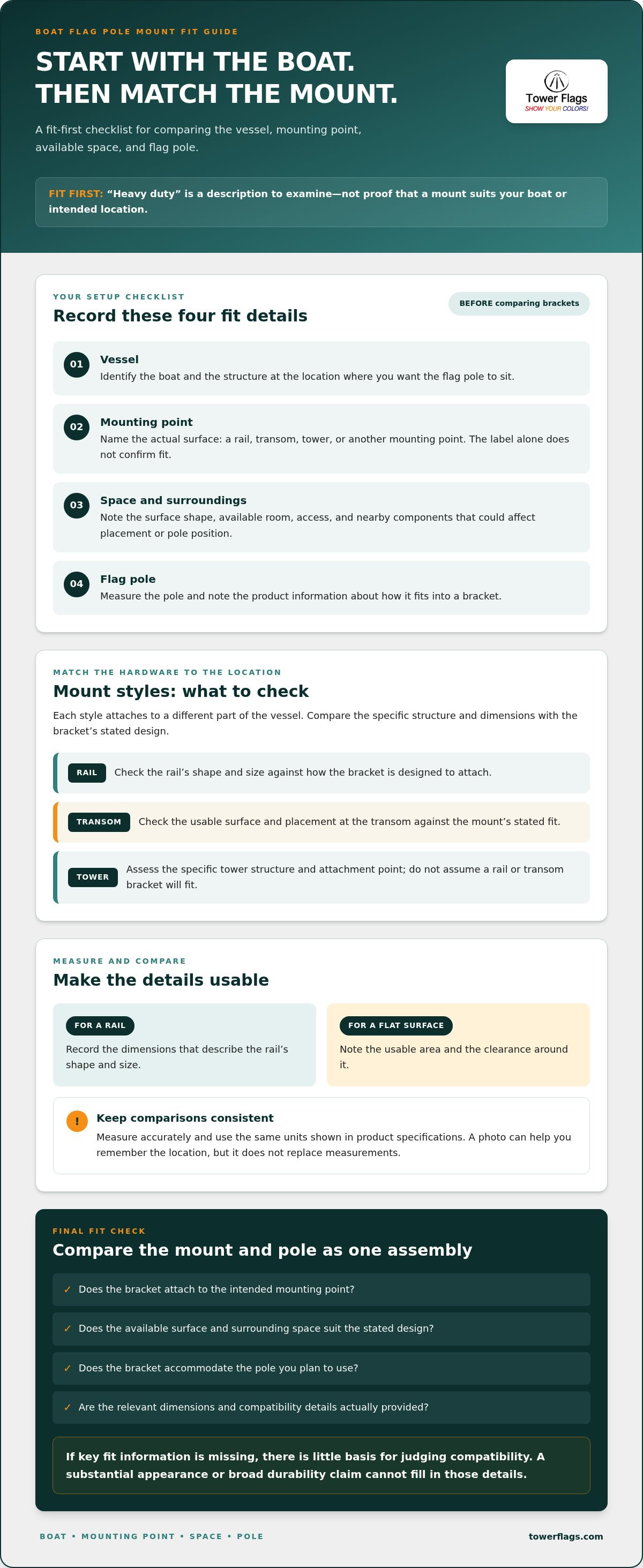
Record the vessel type and the exact location where you want the flag pole to sit. Examine the structure at that point. Note its shape, the room around it, and whether nearby components could restrict access or interfere with the pole’s position.
Measure the relevant surface and pole accurately, using the same units shown in product specifications. For a rail, record the dimensions that describe its shape and size. For a flat surface, note the usable area and surrounding clearance. A photo can help you keep track of the location, but it doesn’t replace measurements when you compare stated fit details.
Vessel: Identify the boat and the structure at the intended location.
Mounting point: Note whether you’re considering a rail, transom, tower, or another surface.
Available space: Record the shape, access, and nearby obstructions that may affect placement.
Pole: Measure the pole and note the information provided about how it fits a bracket.
How do mounting styles differ across boats?
A rail mount depends on the rail itself and how the bracket is designed to attach to it. A transom mount uses a different part of the boat, so the available surface and placement are central to the decision. Neither label confirms fit by itself. The dimensions and structure at your chosen point must correspond with the bracket’s stated design.
Tower mounting is a distinct setup, not an automatic extension of a rail or transom choice. Towers vary in form and attachment points, so assess the specific structure rather than assuming a bracket designed for another location will fit. For any style, consider the mount and pole as one assembly: the bracket must attach at the intended point and accommodate the pole you plan to use.
Keep your boat, mounting-point, and pole details together as you compare options. This makes missing compatibility information easier to spot and helps you distinguish a relevant product description from a general one. For more pole-specific context, consult the marine flag pole engineering guide.
Identify the vessel, mounting location, surface dimensions, and pole before narrowing the bracket options. That information gives a custom-fit solution a practical starting point. Tower Flags designs and manufactures custom boat flag brackets and poles for marine vessels. Explore its custom boat flag hardware to see options for a setup shaped around your boat’s details.
How to Compare Heavy Duty Boat Flag Pole Mount Options
A useful comparison goes beyond product names and durability language. For a heavy duty boat flag pole mount, assess whether the available information lets you compare the bracket with your boat, mounting point, and intended pole. Compare like with like, and treat missing information as unknown rather than filling gaps with assumptions.
What does a useful mount comparison include?
Review each option against the same criteria: where it mounts, how it attaches, what fit information is provided, and which pole dimensions or configurations it lists as compatible. Note stated limits as well. Separate measurable details from promotional wording. “Heavy duty” may describe the product’s positioning, but without relevant specifications it doesn’t show whether the fitting suits your setup.
Material names are useful data, but they don’t establish suitability on their own. A material description can’t tell you whether the bracket’s dimensions, attachment approach, and intended application match your boat. Review construction information in context, and don’t infer an unstated rating or performance limit from a material label.
When is a custom-fit bracket worth considering?
Consider a custom-fit bracket when your boat’s mounting point or pole requirements don’t align with the fit information provided for general options. Comparing broadly available hardware can be convenient, but it doesn’t resolve a mismatch. A specialized design makes the vessel’s mounting details central to the decision. Tower Flags designs and manufactures custom boat flag brackets and poles for marine vessels.
Use your comparison notes to identify the specific requirements a bracket must meet, then compare them with the details each option provides. For broader context on evaluating marine fittings, the durable boat flag hardware guide explores related considerations. If vessel-specific fit is a priority, include custom boat flag brackets in your comparison.
A Practical Checklist Before Choosing a Boat Flag Pole Mount
A few deliberate checks can prevent a mismatch from becoming an installation headache. Before selecting a heavy duty boat flag pole mount, gather details about your setup and compare them with the specifications provided. A familiar bracket style or confident durability language is no substitute for fit information.
What should you measure and match before ordering?
Work through these steps in order. Keep your measurements and product details together so you can compare them directly instead of relying on memory or a listing photo.
Identify the boat and intended use. Note the vessel type and how you plan to use the flag and pole. This provides context without assuming every boat has the same requirements.
Pinpoint the mounting location. Record the structure where the bracket will attach, such as a rail, transom, or tower. Include nearby obstructions and access limitations that may affect placement.
Measure the mounting point. Follow the measurement method stated in the product information. If a listing explains how to measure a rail, use that reference rather than estimating from its appearance.
Record the pole details. Note the pole’s relevant dimensions and any stated bracket compatibility. Evaluate the pole and bracket as one setup.
Compare stated fit and limits. Match your notes against the product’s dimensions, intended mounting location, compatibility details, and explicitly stated limits. Don’t fill missing information with assumptions.
Don’t assume a clamp or bracket that suits one rail, tower, or vessel will fit another. Differences in shape, dimensions, or available space can affect whether an attachment is appropriate. If a listing doesn’t provide enough information to compare your setup, pause before choosing rather than guessing.
How can buyers assess quality claims without guessing?
Separate verifiable details from promotional language. Specific construction information, stated dimensions, mounting approach, and clearly described compatibility all help you evaluate a product. A broad claim such as “built for durability” doesn’t explain how the fitting attaches or whether it matches your boat. Material names also need context; don’t infer suitability, lifespan, or performance from a material label alone.
Use the specifications actually provided. If a limit or application isn’t described, treat it as unknown rather than assuming the product meets a particular need. Documented fit details show how a mount relates to your setup; generic quality claims don’t.
Once you’ve identified your boat’s requirements, compare them with custom-designed hardware for marine vessels. Explore custom boat flag brackets from Tower Flags as one option for matching the bracket to your setup.
Choosing a Tower Flags Mount for a More Considered Investment
A considered purchase starts with the vessel, not the phrase “heavy duty.” Connect the boat’s mounting structure and intended use with the flag pole and bracket details provided. That approach keeps the comparison focused on relevant information instead of assuming a broad strength label guarantees a suitable match.
Use your notes as a concise project brief: identify the boat, mounting location, available structure, pole, and intended use. Then compare those details with the product information. If an essential detail is missing from a description, treat it as unanswered rather than filling the gap yourself.
How does custom-engineered hardware address fit?
Vessels have different mounting requirements, so a general label may not capture the details that matter for your setup. Custom-engineered hardware puts vessel-specific considerations at the center of the design. Tower Flags designs and manufactures custom boat flag brackets and poles for marine vessels, giving boat owners a specialized option when mounting details matter.
Your measurements and intended use provide a clearer basis for evaluating the hardware. They help define what a bracket needs to accommodate without assuming compatibility or a particular performance outcome. Focus on the documented information for the specific product and how it relates to your setup.
What is the next step toward a suitable mount?
Review your boat and pole details alongside the available bracket and pole information. Prioritize a fitting that aligns with the stated mounting location and relevant specifications. Don’t let broad durability wording outweigh practical fit. Tower Flags makes custom-engineered marine flag accessories available to order directly through its online store, including flag brackets and poles for boat owners.
Explore Tower Flags boat flag mounting hardware and compare the options with your vessel details. A heavy duty boat flag pole mount is a more considered investment when the choice reflects your boat and intended use, not just a general claim.
Choose Your Boat Flag Hardware With Confidence
A considered purchase is more than a quick match between a product label and a search. Choose hardware that answers a real need on your vessel, and use relevant product details to guide the decision. This keeps the focus on a suitable setup instead of letting broad claims set your expectations.
Tower Flags specializes in marine flag mounting solutions, with custom-engineered accessories available through its online store. A heavy duty boat flag pole mount is a more confident choice when it reflects your vessel’s requirements. Explore Tower Flags boat flag mounting hardware to find a bracket or pole for your boat.
Frequently Asked Questions
What makes a boat flag pole mount heavy duty?
The label alone doesn’t establish suitability. Evaluate a heavy duty boat flag pole mount using the available details about its construction, attachment, and fit. If a product description names a mounting surface and gives relevant dimensions, compare those with your boat’s setup. General terms such as “rugged” or “strong” provide less concrete guidance.
Will a heavy duty boat flag pole mount fit any boat?
No. Boats differ in structure and in the space available for attaching hardware. A bracket described for a rail shouldn’t be assumed to suit a transom or tower. Compare the stated mounting location and measurements with the specific place you plan to use. If the description leaves out a detail that affects your setup, don’t treat that omission as proof of compatibility.
Is a custom boat flag mount better than a universal mount?
Neither category is automatically better for every boat. A broadly marketed mount may suit a setup that matches its documented specifications. A custom-engineered bracket may be worth considering when your mounting location has a shape or configuration that common options don’t address. Focus on fit: an unusual attachment point calls for closer comparison than a location with clearly matching specifications.
How do I choose between a rail and transom flag mount?
Choose based on the available location and how the fitting is designed to attach there. A rail mount and a transom mount address different surfaces, so let the boat’s structure guide the comparison. Consider nearby equipment, usable space, and where the pole would sit. A mount suited to a rail’s shape may not be appropriate for a flat transom, even if both descriptions mention boat use.
Does a heavier flag pole mount automatically mean it is stronger?
No. Weight alone doesn’t show how a mount is constructed or whether it’s appropriate for your boat. Different weights don’t establish which fitting is better for a particular setup. Review the listed construction details, dimensions, fit information, and any stated limitations. Treat each as one piece of evidence, not a shortcut to judging overall suitability or performance.
What information should I have before ordering a boat flag pole mount?
Have the boat type, intended mounting location, relevant surface measurements, and flag pole details ready. Note anything that could affect placement, such as limited access or nearby equipment. For example, a crowded mounting area may make clearance important alongside basic dimensions. Use the product’s measurement method when comparing specifications, and keep your notes handy as you review bracket styles.
Can I use a wakeboard tower mount on a rail or transom?
Don’t assume a tower mount can attach to a rail or transom. Each mounting point has its own structure and geometry, and a bracket designed for one location may not match another. A tower with a distinctive shape, for example, presents different fit considerations from a rail or flat surface. Use the product’s stated mounting application to guide your assessment rather than relying on a general “boat mount” description.
Comments