

Heavy Duty Boat Flag Pole: The Engineering Reference for High-Speed Marine Use
In the marine world, "heavy duty" is not a marketing buzzword; it is a measurable standard of material integrity and aerodynamic resistance. You've likely experienced the frustration of watching a generic flag pole bend or snap the moment you open the throttle, or worse, seeing a custom flag shred because the hardware couldn't handle the drag. It's a common headache for boaters who prioritize performance but find themselves stuck with universal mounts that rattle, corrode, and eventually fail in harsh saltwater environments.
We believe your boat is a precision machine, and every accessory should reflect that same level of engineering. This guide will help you master the technical requirements of a heavy duty boat flag pole to ensure your display remains secure at top speeds. We'll analyze the material science behind 316L stainless steel and 6061-T6 anodized aluminum, explain the physics of drag forces, and demonstrate why custom-engineered fabrication is the only permanent solution for high-speed marine use. By understanding these mechanical standards, you can finally display your flags with pride and zero anxiety.
Table of Contents
Defining the Heavy Duty Boat Flag Pole: More Than Just Metal
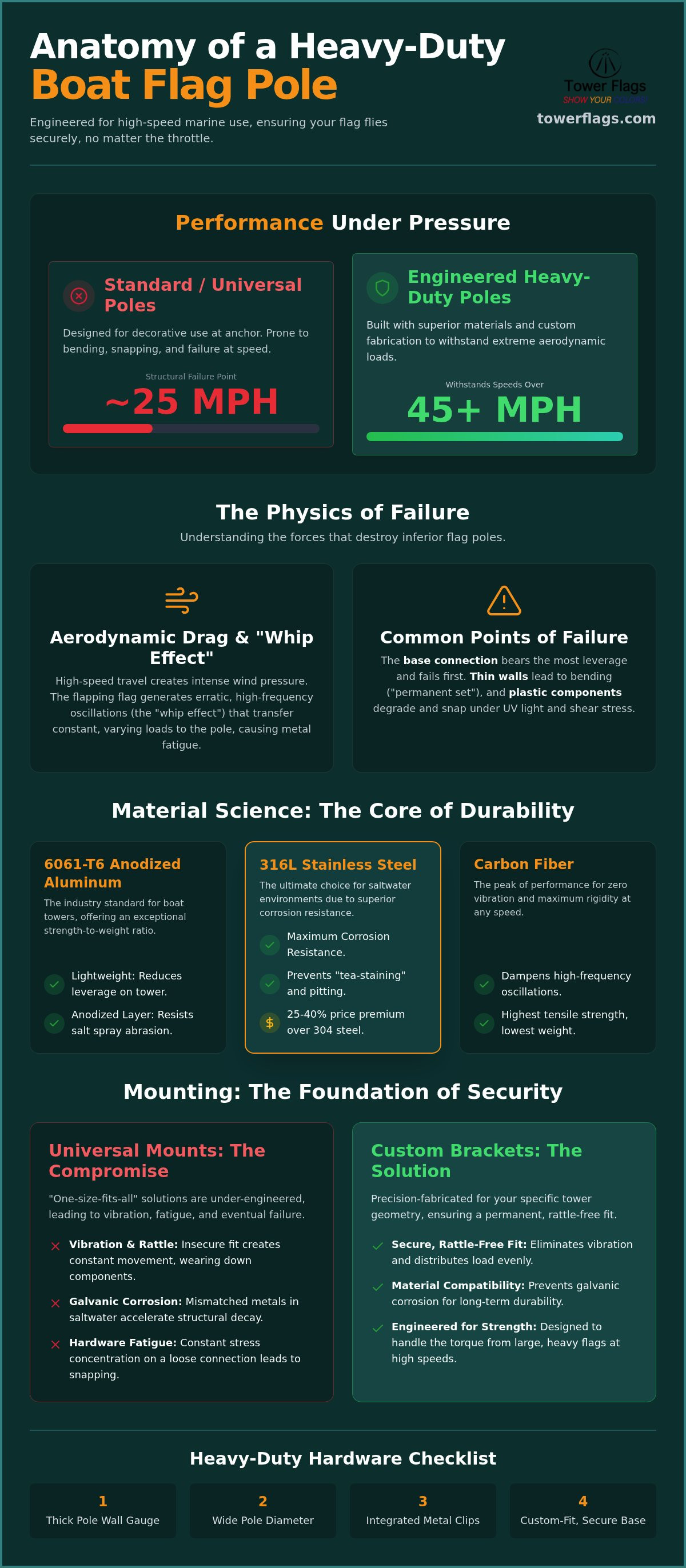
In the marine industry, a heavy duty boat flag pole is defined by its ability to maintain structural integrity under extreme aerodynamic loads. While standard "harbor poles" are designed for decorative use at anchor, performance-grade hardware must withstand drag forces exceeding 45 mph. This distinction is critical for owners of modern wakeboard and surf boats who don't want to lose their investment the moment they hit the throttle. A pole that isn't engineered for these velocities isn't just a nuisance; it's a potential safety hazard if it snaps under tension.
Wall thickness is the primary defense against pole deformation. Under high load, inferior poles often exhibit "permanent set," a condition where the metal bends and fails to return to its original shape. According to foundational flagpole design and engineering principles, material density and wall gauge must be calculated to resist the specific torque generated by the surface area of the flag. This is especially true for custom boat flags. These flags often use heavier, double-sided fabrics that create significantly more drag than thin, single-stitch alternatives, requiring specialized tensioning systems to remain secure.
The Anatomy of High-Performance Flag Hardware
Pole diameter plays a vital role in distributing lateral stress across the entire length of the hardware. A wider diameter increases the moment of inertia, making the pole significantly more rigid. However, even the strongest pole is only as good as its anchor. The base connection remains the most common point of failure because it bears the brunt of the leverage created by the flag's drag. We prioritize integrated metal clips over cheap plastic grommet sliders. Plastic components degrade quickly in UV light and lack the shear strength to hold a flag during high-speed maneuvers or sharp turns.
Performance Standards for 2026 Marine Use
Current benchmarks for 2026 emphasize the use of 6061-T6 anodized aluminum or 316L stainless steel. These materials provide the necessary yield strength for high-speed performance vessels. Many "universal" brackets are under-engineered because they attempt to fit too many different tower geometries, leading to vibration and eventual hardware fatigue. For a deeper dive into the specific material requirements for high-velocity environments, you can explore our technical guide on marine flag poles. This focus on custom fabrication ensures that your hardware doesn't just look the part but performs under pressure.
Material Science: Why Engineering Matters at Sea
Selecting a heavy duty boat flag pole requires more than a visual inspection of the finish. In marine environments, the interaction between different metals can lead to rapid structural failure. Galvanic corrosion occurs when two dissimilar metals, such as a stainless steel bolt and an aluminum tower, are joined in the presence of salt water. This electrochemical reaction can compromise the mount before you even notice the surface pitting. We prioritize material compatibility and precision fabrication to ensure that every component of our custom marine flag accessories functions as a single, durable unit.
Anodized Aluminum vs. Stainless Steel
6061-T6 anodized aluminum is the industry standard for high-performance boat towers because of its exceptional weight-to-strength ratio. It's significantly lighter than steel, which reduces the leverage force applied to your tower during high-speed maneuvers. Conversely, 316L stainless steel offers superior corrosion resistance. As of 2026, 316L stainless steel carries a 25% to 40% price premium over 304 stainless steel, but the investment is necessary to prevent the tea-staining and deep corrosion common in saltwater. Anodizing provides an additional layer of protection by creating a hard, non-reactive surface that resists the abrasive nature of salt spray, ensuring the metal remains structurally sound over years of use.
The Rise of Carbon Fiber in Marine Flag Poles
Carbon fiber is becoming the preferred material for boaters who demand zero vibration at high RPMs. Unlike metal poles that can resonate and amplify the "whip effect," carbon fiber's inherent properties dampen high-frequency oscillations. This material science is crucial when you consider the physics of how flags flap, as the erratic movement of the fabric creates constant, varying loads on the pole. Carbon fiber's high tensile strength allows it to remain rigid under drag while being significantly lighter than metallic alternatives. Carbon fiber outperforms aluminum in high-speed drag scenarios because it maintains its structural shape without the fatigue risks associated with repetitive metal flexing.
If you're ready to upgrade to a mounting system that respects these engineering principles, explore our selection of custom-fit flag poles designed for the modern mariner.
The Physics of High-Speed Flag Display
Physics doesn't care about marketing claims; it only cares about force and resistance. When you're running at 40 mph, a standard 2x3 flag is no longer a soft piece of fabric. It becomes a high-drag aerodynamic surface that generates massive lateral pressure. This force is transferred directly to your heavy duty boat flag pole, creating a lever effect that can exert hundreds of pounds of torque on your mounting point. Without secure boat flag mounting, you aren't just risking a lost flag; you're risking the structural integrity of your wakeboard tower or gunwale.
Calculating Drag and Torque on Marine Hardware
Aerodynamic drag increases exponentially with speed. If you double your boat's velocity, the force acting on your flag quadruples. Most "harbor poles" are designed for speeds under 20 mph. Once you cross the 30 mph threshold, the drag forces often exceed the yield strength of thin-walled aluminum or plastic mounts. Precision engineered boat flag mounts are designed to handle this non-linear increase in pressure. These systems prioritize a rigid connection to the boat, ensuring that the force is distributed across the mounting bracket rather than concentrating at a single stress point that could lead to a snap.
Preventing Hardware Failure at Top Speeds
The "Whip Effect" is the silent killer of marine hardware. As your boat moves through choppy water or catches wind gusts, the flag pole begins to oscillate. This high-frequency vibration creates repetitive stress cycles that lead to metal fatigue. Inferior poles often fail not because the wind was too strong, but because the constant whipping caused the material to crystallize and crack. High-quality marine hardware standards dictate that equipment must be able to withstand these dynamic loads without failure. Custom-fit clamps are essential here; they eliminate the small gaps found in universal mounts that allow for rattling. By removing the "play" in the system, you significantly reduce the shock loads transferred to your hardware. For a technical breakdown of how these forces interact specifically with wakeboard towers, see our guide on Mastering Flags with Towers.
Custom vs. Universal Mounting Solutions
Universal brackets are built for the shelf; custom brackets are built for the boat. This distinction is vital when choosing a heavy duty boat flag pole. While a one-size-fits-most clamp might seem convenient, it relies on generic rubber shims and friction to stay in place. Under the high-drag conditions described in previous sections, these shims compress and shift, leading to hardware failure. Precision-fabricated custom brackets eliminate this movement by matching the specific geometry of your tower, ensuring the hardware stays exactly where you installed it.
Custom fabricated boat flag mounts distribute load across a greater surface area. Instead of concentrating torque on a small contact patch, a custom mount envelopes the tower tube. This design utilizes the structural integrity of the boat itself to counteract wind resistance. By spreading the force, you prevent the "lever effect" from focusing stress on a single bolt or weld, which is the primary cause of bracket snapping in inferior systems.
The Hidden Cost of Universal Brackets
Low-cost plastic or thin-wall metal mounts often require frequent replacement because they can't handle constant marine vibration. The real cost, however, is the damage they do to your vessel. Generic clamps often slip, grinding through expensive tower powder coating and exposing the underlying metal to corrosion. There's also a significant safety risk to consider. If a bracket fails at 40 mph, your heavy duty boat flag pole becomes a dangerous projectile, risking injury to passengers or other boaters on the water.
Engineering for Specific Boat Towers
Modern towers, like the Malibu G3, aren't simple cylinders; they feature complex tapers and unique cross-sections. A custom-fit bracket is engineered to match these exact dimensions, providing a seamless, rattle-free connection. This precision ensures the hardware looks like an integrated part of the boat rather than an aftermarket afterthought. For performance enthusiasts who push their vessels to the limit, we recommend our high-speed wakeboard tower flag mount for maximum security.
If you want a mounting solution that respects your boat's finish and your family's safety, view our custom marine flag accessories to find the perfect fit for your specific tower model.
Selecting and Maintaining Your Marine Hardware
Choosing the right heavy duty boat flag pole is a technical decision that directly impacts the safety and aesthetics of your vessel. You must align your hardware selection with the specific operational profile of your boat rather than relying on generic retail descriptions. A pole engineered for a slow-moving pontoon will fail on a high-performance surf boat. By following a methodical selection and maintenance routine, you ensure your investment remains secure regardless of the conditions on the water.
The 3-Step Selection Process
Precision is the foundation of a secure mount. Start by measuring your tower or rail diameter with precision calipers. Even a fraction of a millimeter difference can lead to the vibration issues discussed in previous sections. Next, determine your maximum cruising speed. If your boat regularly exceeds 35 mph, you must prioritize 6061-T6 aluminum or carbon fiber to handle the exponential increase in drag. Finally, choose a pole length that provides sufficient clearance for your bimini top and tower speakers. A pole that is too long creates unnecessary leverage, while one that is too short may cause the flag to tangle in other gear.
Before every departure, perform a quick security check of your hardware. Verify that the mounting bracket is torqued correctly and that the pole is fully seated in the socket. This pre-departure checklist prevents the most common cause of hardware loss: human error during installation. Ensure your custom boat flags are attached with high-tension clips that show no signs of spring fatigue or corrosion.
Long-Term Maintenance for Heavy Duty Gear
Saltwater is relentless and can seize even the highest quality hardware if left unchecked. Your cleaning protocol should involve more than a surface rinse. Use a soft brush to remove salt deposits from within locking mechanisms and quick-release sockets. These deposits act as an abrasive, wearing down the internal tolerances of your mount over time. You should perform a comprehensive safety inspection of all marine flag hardware every 30 days or after any high-speed run in rough water conditions.
During these inspections, look closely for stress fractures in the mounting bracket, particularly around the bolt holes and weld points. These micro-cracks are early indicators of metal fatigue caused by the "Whip Effect." Additionally, apply a thin layer of marine-grade lubricant to quick-release pins and sockets to ensure smooth operation and prevent galvanic bonding. Replace your flag clips at the first sign of oxidation or reduced tension. This proactive approach protects your custom boat flags and ensures your mounting system remains a permanent, reliable fixture on your boat.
Securing Your Marine Legacy at Speed
High-performance boating demands hardware that respects the laws of physics and the harsh realities of the saltwater environment. You now understand that a true heavy duty boat flag pole is defined by its material yield strength and its ability to dissipate the massive drag forces generated at cruising speeds. By prioritizing custom-fabricated brackets over universal alternatives, you eliminate the vibrations that lead to metal fatigue and protect your vessel's finish from unnecessary damage. Consistent maintenance and a focus on high-grade alloys ensure your mounting system remains a permanent, reliable fixture on your tower.
Don't settle for mass-produced compromises that rattle or fail when you open the throttle. Instead, choose a specialized solution that matches the craftsmanship and performance standards of your boat. Upgrade to a Custom Engineered Tower Flag Mount Today to experience the relief of American-made marine hardware designed for high-speed durability and a precision fit. We take pride in the fine details of fit and finish so you can fly your colors with absolute confidence on every run. Enjoy the water knowing your gear is built to last.
Frequently Asked Questions
Can I use a standard home flag pole on my boat?
No, you shouldn't use residential hardware for marine applications. Home poles are designed for vertical loads and relatively low wind speeds. They lack the wall thickness and high-grade alloys required to survive the lateral drag forces and constant vibrations of a moving vessel. Using a standard pole on the water risks the hardware snapping and becoming a dangerous projectile at high speeds.
What is the best material for a boat flag pole used in saltwater?
316L stainless steel and 6061-T6 anodized aluminum are the industry standards for saltwater durability. 316L offers superior corrosion resistance compared to lower 304 grades, while anodized aluminum provides an excellent weight-to-strength ratio. Carbon fiber is also a premium choice because it's entirely immune to corrosion and excels at dampening high-frequency vibrations that occur during high-speed runs.
How fast can I drive with a heavy duty boat flag pole attached?
A high-quality heavy duty boat flag pole is typically engineered to withstand speeds exceeding 45 mph. However, the safe speed depends on your flag's surface area and the integrity of your mounting bracket. We design our hardware to handle these high-drag environments, but you should always perform a quick physical inspection of the mount if you plan on sustained high-speed cruising.
Do I need a custom bracket for my wakeboard tower?
Yes, a custom bracket is the only way to ensure a secure, rattle-free fit on complex tower geometries like the Malibu G3. Universal brackets rely on generic rubber shims that compress and slip under load. This movement doesn't just loosen the flag; it can permanently grind through your tower's expensive powder coating. Custom brackets are precision-fabricated to match the exact diameter of your tower.
Why do my flag poles keep bending at high speeds?
Bending occurs when the aerodynamic drag exceeds the material's yield strength. If a pole has thin walls or uses low-grade aluminum, it will experience "permanent set," meaning it won't return to its original shape. This is a common failure point for decorative harbor poles. Drag forces increase exponentially with speed, so hardware that works at 20 mph often fails once you cross the 30 mph threshold.
Is carbon fiber better than stainless steel for marine flag poles?
Carbon fiber is often the superior choice for high-performance vessels because it's lighter and dampens vibrations more effectively than metal. While 316L stainless steel is incredibly strong, its weight creates more leverage force on your tower. Carbon fiber reduces this stress while preventing the "whip effect" that causes hardware fatigue. It provides the rigidity needed for high-speed drag without the risk of repetitive metal flexing.
How do I prevent my boat flag pole from rattling?
Eliminating rattle requires a mounting system with zero internal play. You should avoid universal mounts that use generic spacers or shims. A custom-fit bracket grips the tower or rail with total precision, removing the gaps that allow for vibration. You should also ensure your quick-release pins are clean and that the pole is fully seated in the socket before you leave the dock.
What size flag is safe to fly on a performance boat?
A 2x3 foot flag is the standard recommendation for most performance boats. Larger flags increase drag forces exponentially, which can overwhelm even a heavy duty boat flag pole at top speeds. If you decide to fly a larger flag, you must ensure your mounting hardware is specifically engineered to handle the additional torque. Always prioritize a secure mount over flag size to maintain safety.


Comments