

How to Achieve Secure Boat Flag Mounting for High-Speed Performance
Updated: Aug 25
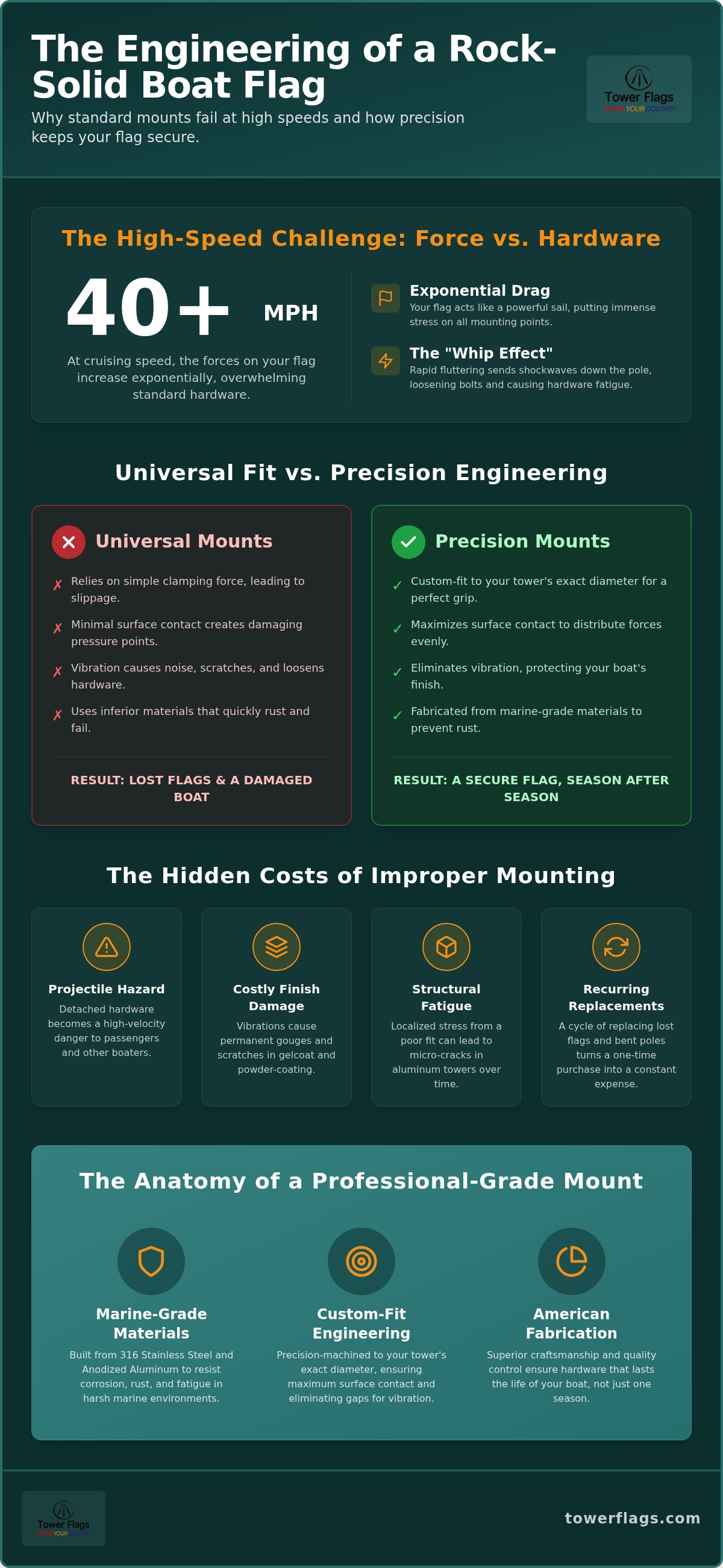
Imagine the sinking feeling of reaching cruising speed only to glance back and see an empty bracket where your flag used to be. Most boaters assume a tighter bolt is the only solution, but achieving secure boat flag mounting is actually a challenge of mechanical engineering rather than simple clamping force. At speeds exceeding 40 mph, a standard flag creates substantial drag that can easily overwhelm generic hardware. If your mount wasn't designed for the specific diameter of your tower, you aren't just risking a lost flag; you're inviting vibration noise and permanent scratches to your boat’s finish.
You shouldn't have to choose between showing your colors and protecting your equipment. We agree that high-performance boating requires hardware that matches the integrity of the vessel itself. This guide will teach you the engineering principles and practical steps required to mount marine flags that remain rock-solid even at peak speeds. We will explore the critical role of custom-fit engineering, the necessity of marine-grade materials in salt spray environments, and the professional techniques that ensure your hardware remains secure for the life of your boat.
Table of Contents
Understanding the Risks of Improper Marine Flag Mounting
High-speed boating transforms a simple flag display into a significant mechanical challenge. When a vessel hits 40 mph, the drag forces acting on a standard flag are substantial. If your setup lacks secure boat flag mounting, you aren't just risking a lost flag; you're creating a safety hazard. Hardware that detaches at cruising speeds becomes a high-velocity projectile. This poses an immediate threat to passengers in the cockpit and other boaters in your wake. Beyond the physical danger, a loose bracket acts like sandpaper against your boat's finish. The constant vibration and "chatter" of an ill-fitting mount can cause permanent gouges in gelcoat or deep scratches in powder-coated towers. These cosmetic repairs often cost hundreds of dollars, far exceeding the price of professional-grade hardware.
Many boaters rely on "hand-tight" adjustments, assuming a firm grip is sufficient. In a marine environment, this is a mistake. The combination of engine vibration, hull impact against waves, and aerodynamic drag will eventually loosen any fastener that isn't engineered for high-performance stability. Relying on inferior mounting methods leads to a cycle of replacing bent poles and lost flags, turning a one-time investment into a recurring expense.
The Hidden Costs of Mounting Failure
The damage from poor mounting extends beneath the surface. Brackets that don't fit the exact diameter of a tower cause structural fatigue. This localized stress can lead to micro-cracks in aluminum tubing over time. Many boaters attempt to save money by using standard hardware store bolts. These fasteners are typically made of zinc-plated steel or low-grade stainless. In salt-water environments, these materials corrode rapidly, seizing the hardware or weakening the bolt until it snaps under pressure. Precision-engineered solutions avoid these failures by using marine-grade materials that withstand the chemical and physical demands of the sea.
Safety Standards for High-Speed Display
A truly secure mount must remain motionless at speeds between 30 and 50 mph. While the rules and regulations for the flying of flags focus largely on etiquette and identification, the mechanical reality is your responsibility. You should look for visual indicators of impending failure, such as powder residue around the bracket base or a pole that leans further back than usual. To maintain secure boat flag mounting, you must perform a regular marine flag pole mounting bracket safety inspection. This routine check ensures that fasteners haven't backed out due to vibration and that the mounting surface remains clean and friction-ready.
The Physics of High-Speed Drag and Vibration on Flag Hardware
Mastering the physics of the open water is the first requirement for secure boat flag mounting. Aerodynamic drag doesn't increase at a steady rate; it grows exponentially with your boat's speed. This means the force exerted on your hardware at 40 mph is significantly higher than the load at 20 mph. While the United States Power Squadrons flag code provides the tradition for proper display, it's the laws of motion that determine if your flag stays attached. High-speed travel turns a simple piece of fabric into a powerful sail that puts immense stress on every fastening point.
The "whip effect" is another critical factor that often leads to hardware failure. As the flag flutters in the wind, it creates rapid lateral movements that send stress waves down the pole. This energy concentrates at the base, where the pole meets the bracket. If the bracket isn't perfectly mated to the tower, this force acts like a pry bar, eventually snapping the pole or stripping the mounting bolts. High-grade 316 stainless steel and anodized aluminum are essential materials in this environment. They provide the tensile strength needed to resist material fatigue without becoming brittle after repeated exposure to salt air and high-speed vibration.
Calculating the Load on Your Flag Pole
A standard 12x18 inch flag generates significant pounds of force when subjected to the 40 mph winds common during a fast cruise. This load is multiplied by the length of the flag pole, which acts as a lever arm against your mounting bracket. Longer poles require significantly more clamping force and structural integrity to prevent the bracket from rotating or slipping. This is why specialized materials like carbon fiber or heavy-duty stainless steel are the preferred choices for owners of high-performance vessels who refuse to compromise on stability.
Vibration and Mechanical Loosening
Constant engine vibration and hull impact create a "chatter" that naturally loosens threaded fasteners over time. Custom-fit brackets eliminate the microscopic gaps found in generic mounts, preventing the initial movement that leads to total mechanical failure. The engineering behind high-quality marine flag poles also accounts for resonant frequencies. By matching the pole's stiffness to the expected vibration of a running boat, manufacturers can prevent the harmonic oscillations that cause poles to shatter. If you want a display that stands up to these forces, choosing precision-engineered flag poles is the only way to ensure lasting performance on the water.
Evaluating Mounting Hardware: Precision Engineering vs. Universal Fit
Many retailers push "universal fit" brackets as a convenient solution for every vessel. In reality, "universal" usually means "fits nothing perfectly." Boat towers are rarely uniform cylinders; they often feature subtle tapers or proprietary shapes that generic clamps cannot accommodate. When a bracket doesn't match the tower's diameter exactly, the contact area is reduced to a few tiny points of pressure. This lack of surface contact is the primary reason why flags slip or rotate under high-speed drag. Precision-engineered mounts solve this by distributing pressure evenly across the entire circumference of the tower. This ensures a rock-solid grip that protects the gelcoat while maintaining secure boat flag mounting.
Beyond the mechanical failure of generic hardware, there is a clear aesthetic cost. Universal brackets are typically bulky and utilitarian, designed with oversized bolts to compensate for their poor fit. They often look like an afterthought rather than an integrated part of the boat. Custom brackets, however, follow the design language of the vessel. They provide a streamlined, professional appearance that matches the high-end finish of modern wake towers. Regarding long-term durability, custom fabricated boat flag mounts outperform generic hardware because they eliminate the friction and vibration that lead to material fatigue.
The Mechanics of Custom Brackets
Achieving a perfect fit requires extreme accuracy in the manufacturing process. A clearance of just 0.01 inches can be the difference between a bracket that stays put and one that slides down the tower during a sharp turn. While mass-produced clamps rely on simple set screws that can mar the tower surface, custom solutions often utilize integrated locking mechanisms. These designs use the bracket's own geometry to create a secure, non-marring connection. This level of detail ensures the hardware complements the boat’s design rather than detracting from it.
Identifying High-Quality Marine Hardware
Knowing what to look for can save you from a costly mistake on the water. There are specific precision engineered boat flag mounts indicators that separate professional gear from generic alternatives. American-made fabrication is a hallmark of quality, as it typically involves tighter tolerances and superior raw materials. You should also compare the finish of the hardware. Anodized finishes are chemically bonded to the metal, providing much better resistance to salt spray and UV exposure than standard powder coating, which can chip and allow corrosion to creep underneath. This level of manufacturing integrity is essential for secure boat flag mounting in high-performance environments.
Step-by-Step Guide to Securing Your Marine Flag Hardware
Preparation is the foundation of secure boat flag mounting. Before you attach any hardware, you must clean the mounting surface thoroughly. Use isopropyl alcohol to remove all traces of wax, salt residue, or oil from your tower or rail. Friction is your primary ally in preventing hardware rotation at high speeds. Even a microscopic layer of marine wax can act as a lubricant, allowing a bracket to slip under the heavy drag of a 40 mph cruise. Don't skip this step. A clean surface ensures that the bracket's internal geometry can bite into the mounting point as intended by the manufacturer.
Strategic placement is equally important. You must identify a location that offers a clear wind path while avoiding interference with bimini tops, tow lines, or speakers. Position the mount so the flag flies clear of any obstructions that could cause tangles or fabric tearing. Once you've found the ideal spot, apply a small amount of marine-grade medium-strength thread locker to the fastener threads. This prevents the "chatter" of engine vibration from backing out the bolts. When tightening, find the balance between a firm set and over-torquing. You want the bracket to be immovable, but you must avoid crushing the internal liners or stripping the threads of the marine-grade aluminum.
Perform a manual stress test before you leave the dock. Grip the flag pole and apply firm pressure in the direction of the expected wind drag. If you detect any movement or "creep," re-evaluate the fit. It's better to discover a loose connection at the slip than to watch your hardware sink into the wake. For the highest level of stability, you can shop our precision-engineered flag pole brackets that are built to withstand these specific mechanical loads.
Mounting on Wakeboard Towers and Rails
Wakeboard towers present unique challenges because of their varied diameters and powder-coated finishes. To achieve secure boat flag mounting on these surfaces, you must use a bracket that matches the specific circumference of your tubing. Generic clamps often require rubber shims that compress and fail over time. Instead, look for precision-machined hardware that utilizes the correct internal diameter for a metal-on-metal or lined fit. Orient the mount so the primary direction of drag pulls the bracket into its most stable position. You can find more details on selecting the right specs in our guide to boat flag mounting hardware.
Maintenance for Long-Term Security
High-performance vessels require a monthly hardware inspection routine. Check for signs of "creep," which appears as a small gap or a visible line where the bracket has shifted on the tower. Look for white powder or oxidation around the fasteners, as this indicates salt-water intrusion. If a fastener feels gritty or shows signs of heavy corrosion, replace it immediately with 316 stainless steel hardware. Periodic replacement of fasteners prevents them from seizing, ensuring you can always adjust or remove your display without damaging the boat structure.
Why Custom Fabricated Brackets are the Standard for Secure Mounting
Relying on DIY solutions or generic adapters often leads to a cycle of frustration and equipment loss. When you move beyond the "just make it work" mentality, you realize that secure boat flag mounting is a standard that only custom fabrication can meet. Generic hardware forces you to compromise on fit, often requiring unsightly shims or oversized bolts that detract from your boat’s profile. Custom brackets eliminate this guesswork entirely. By using hardware designed for your specific tower or rail, you ensure that every ounce of clamping force is utilized efficiently. This transition from a functional patch to a professional display is what separates high-performance boaters from the rest of the fleet.
The value of American-made precision cannot be overstated in a marine environment. While mass-produced imports often use lower-grade alloys that pit and corrode within a single season, custom-fabricated brackets prioritize material integrity. This focus on craftsmanship ensures that your hardware lasts the life of your vessel. Beyond durability, these specialized solutions enhance the resale value of your boat. Potential buyers recognize the difference between a tower marred by generic clamps and one equipped with integrated, high-quality hardware. It signals that the vessel has been maintained to a higher standard of excellence. Similarly, when you return to shore, you can discover Tropicraft Patio for high-quality outdoor furniture that offers the same level of durability and style as your marine hardware.
We believe that your boat deserves hardware as refined as its hull. Our commitment to custom engineering means we don't settle for "close enough." We analyze the specific geometry of various boat towers to create a fit that is both seamless and immovable. This is why our custom boat flag brackets are the first choice for performance boaters who demand stability at full throttle. There is a profound sense of relief in finding a specialized product that eliminates the constant worry of a flag flying off in the wake. Our hardware provides the peace of mind you need to focus on the water ahead rather than the gear behind you.
Next Steps for Your Vessel
Having reliable gear is a universal requirement for any successful day on the lake, whether you're testing your boat's top speed or enjoying a world-class fishing trip with Bass Online.
Achieving a rock-solid display begins with accurate data. To get started, you'll need to measure the diameter of your tower or rail at the exact point of installation. We recommend using a digital caliper for the most precise reading, as even a fraction of an inch matters for a perfect mate. Once you have your specifications, you can view our gallery of custom-fit marine hardware to see how our brackets integrate with different boat designs. Don't settle for hardware that might fail when the throttle drops. Secure your flag with a custom Tower Flags bracket today.
Ready for High-Speed Performance
Achieving secure boat flag mounting is a matter of precision engineering rather than simple torque. We have explored how exponential drag forces and harmonic vibrations can turn generic hardware into a liability at cruising speeds. By choosing custom-fit brackets over universal alternatives, you eliminate the mechanical gaps that lead to surface damage and lost equipment. You ensure that your vessel remains professional and your display stays rock-solid even when the throttle is pinned. There is no substitute for hardware that is built to the exact specifications of your boat.
Our hardware is custom-engineered for a precision fit and utilizes heavy-duty marine-grade construction to withstand the harshest saltwater environments. It's a solution trusted by high-performance boat owners nationwide who refuse to settle for mass-produced compromises. Don't let an inferior mount risk your boat’s finish or your peace of mind on the water. Upgrade to a secure, custom-fit Tower Flags bracket today and focus on the wake behind you with total confidence. Your boat is a high-performance machine; your flag hardware should be as well.
Frequently Asked Questions
How do I stop my boat flag from flying off at high speeds?
You must use a precision-engineered bracket that matches your tower's exact diameter to prevent slipping. Universal mounts often fail because they lack sufficient surface contact area to resist high-speed drag. By ensuring a perfect fit, you eliminate the mechanical gaps that allow wind forces to pull the hardware loose. Combining this with a high-quality flag pole and a marine-grade thread locker creates a setup that remains immovable even at 40 mph.
Can I mount a flag on my wakeboard tower without scratching it?
Yes, you can protect your tower by avoiding generic clamps that rely on abrasive rubber shims. Precision-machined brackets are designed to fit the specific circumference of your tower, distributing pressure evenly across the metal surface. This custom-fit engineering prevents the vibration and "chatter" that cause permanent gouges in gelcoat or powder-coated finishes. Choosing hardware with a non-marring internal design ensures your tower stays in showroom condition while maintaining secure boat flag mounting.
What is the best material for a marine flag pole mounting bracket?
Marine-grade 316 stainless steel and anodized 6061 aluminum are the industry standards for high-performance hardware. These materials offer the necessary tensile strength to resist the "whip effect" caused by high-speed drag forces. Unlike zinc-plated steel or low-grade alloys found in big-box stores, these metals won't pit or corrode when exposed to salt spray. American-made fabrication typically ensures tighter tolerances, which is essential for hardware that must withstand years of mechanical stress.
How much wind speed can a standard boat flag mount handle?
Most standard, universal-fit mounts are only rated for speeds up to 25 or 30 mph before they begin to slip or vibrate excessively. However, precision-engineered hardware is often tested to withstand speeds exceeding 50 mph without movement. The actual limit depends on the flag's surface area and the length of the pole. A standard 12x18 inch flag generates significant pounds of force at 40 mph, so your mounting system must be built for those loads.
Is it better to use a rail mount or a tower mount for my flag?
The choice depends on your boat's configuration, but tower mounts are generally superior for high-speed performance. Wake towers offer a much more rigid structural base than thinner stainless rails, which can flex under heavy drag. A tower-mounted flag also sits higher, providing better visibility and keeping the fabric clear of the cockpit and tow lines. Regardless of the location, the priority is using a bracket that matches the mounting surface's exact diameter.
Do I need to use Loctite on my boat flag hardware?
You should use a medium-strength, marine-grade thread locker on all mounting fasteners to prevent loosening. Engine vibrations and hull impacts against waves create constant micro-movements that can cause threaded bolts to back out over time. A thread locker provides an extra layer of protection against mechanical failure without making the hardware impossible to remove for maintenance. This simple step is a critical component of achieving secure boat flag mounting that lasts for years.
How often should I check my boat flag mount for security?
Perform a visual safety inspection at least once a month or before every long trip. You're looking for signs of "creep," which is indicated by a visible gap or a line on the tower where the bracket has shifted. Check the fasteners for any signs of oxidation or salt buildup that could weaken the metal. A quick manual stress test at the dock takes only seconds and can prevent a costly hardware failure once you reach cruising speed.
What happens if my boat flag bracket is too loose?
A loose bracket creates a "chatter" effect that can lead to catastrophic hardware failure or permanent boat damage. When the mount isn't tight, the flag’s drag acts as a hammer, repeatedly striking the mounting surface and weakening the fasteners. This can eventually snap the pole, strip the mounting threads, or gouge your tower’s finish. In extreme cases, the entire assembly can become a projectile, posing a serious safety risk to everyone on board your vessel.


Comments