

How to Choose the Right Boat Flag Mounting Hardware: A 2026 Checklist
- ianmackinnon4
- Aug 13
- 13 min read
Updated: Aug 14
A "universal fit" is often just a polite way of saying a bracket wasn't actually designed for your boat. In the high-stakes environment of open water, generic components are the first to fail when the throttle opens up. Most captains have experienced the frustration of a bracket snapping under wind load or watching a once-shiny mount succumb to salt spray corrosion within a single season. It's a common struggle that ruins the aesthetic of a high-end vessel and puts your gear at risk of being lost to the wake.
Selecting the right boat flag mounting hardware shouldn't be a matter of trial and error. You deserve a secure, vibration-proof solution that matches the precision engineering of your tower. This 2026 checklist provides the technical roadmap to identify marine-grade hardware that survives high speeds and harsh salt spray without failing. We will examine the critical differences between mass-produced alloys and custom-engineered fabrication. You'll learn how to verify material integrity, ensure long-term UV resistance, and find the exact fit for custom wakeboard towers that generic mounts simply can't accommodate.
Table of Contents
Why Generic Boat Flag Mounting Hardware Fails at Speed
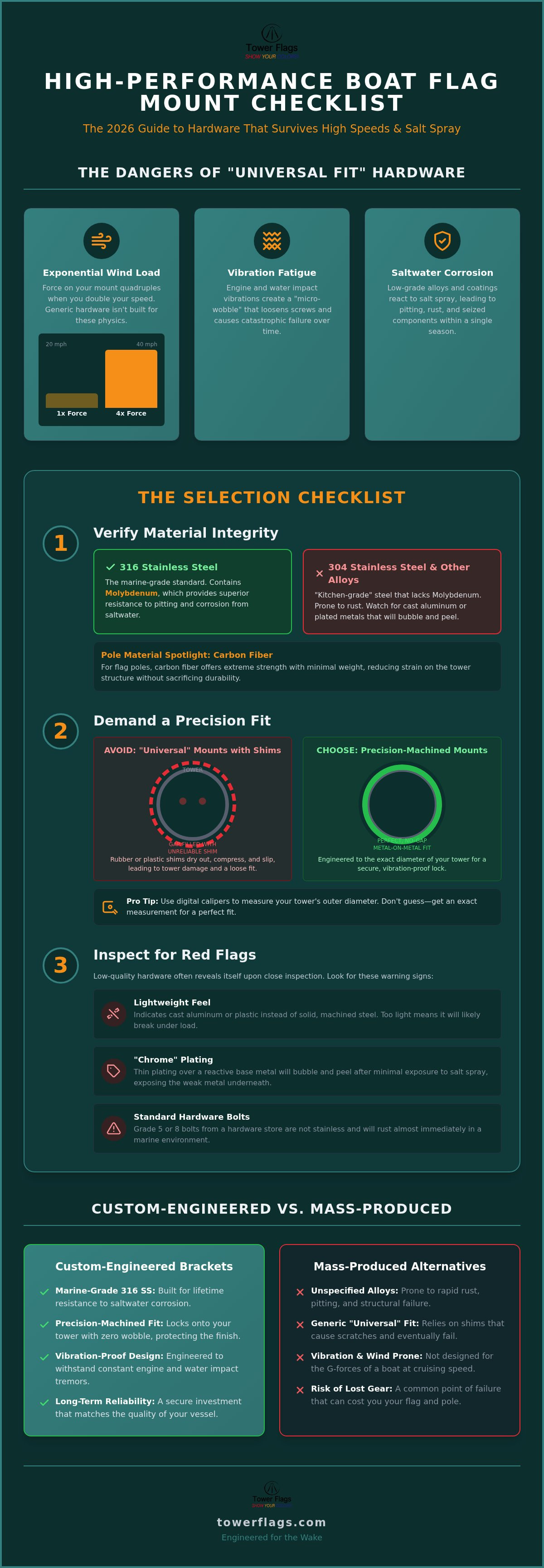
Speed changes everything on the water. At 40 mph, a flag isn't just a piece of fabric; it's a sail generating significant drag. The wind load on your boat flag mounting hardware increases exponentially, not linearly. If you double your speed, the force exerted on the bracket quadruples. Generic mounts designed for stationary docks or slow-moving pontoon boats simply lack the structural integrity to withstand these G-forces. They are built for aesthetics, not the mechanical realities of a performance vessel.
Constant vibration is the silent killer of inferior mounts. Marine engines and hull-to-water impacts create high-frequency tremors that travel directly through the wake tower. On mass-produced hardware, standard set screws eventually vibrate loose because they rely on friction alone. Without a precision-machined fit, the hardware begins a "micro-wobble" that slowly eats away at the mounting surface. This leads to the hardware snapping or, worse, the entire assembly flying off into the water. Proper adherence to maritime flag regulations requires your ensign to be displayed clearly and securely, which is impossible if your hardware is sitting at the bottom of the lake.
Material degradation also plays a massive role in hardware failure. Many generic brands use low-grade alloys that look like stainless steel but lack the necessary molybdenum content to resist pitting. When salt spray meets these reactive metals, it triggers rapid galvanic corrosion. Within a single season, the internal threads of a cheap bracket can seize or crumble, making it impossible to adjust or remove your pole. Choosing high-performance hardware isn't just about strength; it's about long-term chemical resistance.
The Myth of One-Size-Fits-All Brackets
Most "universal" brackets rely on rubber shims or plastic spacers to bridge the gap between a generic clamp and your specific tower diameter. In the high-heat environment of a summer afternoon, these shims compress, dry out, or slip. When the shim fails, the metal bracket makes direct contact with your tower. This causes permanent scratches and gouges in your expensive powder-coated or anodized finish. Precision-machined tolerances are the only way to achieve a true lock that doesn't rely on temporary fillers. If the bracket wasn't cut for your specific tower, it won't stay secure at high speeds.
Identifying Low-Quality Hardware Components
You can often spot inferior boat flag mounting hardware by its weight and finish. Many retailers sell cast aluminum or plastic components that feel light in the hand. While they might look shiny in the box, that "chrome" is often a thin plating over reactive base metals that will bubble and peel after the first exposure to salt spray. Standard hardware store bolts are another red flag. These are typically Grade 5 or 8 steel, which will rust almost instantly in a marine setting. True marine-grade hardware uses specialized alloys that resist both physical stress and galvanic corrosion, ensuring your flag stays exactly where you mounted it.
Essential Materials for Durable Marine Flag Brackets
Marine hardware faces two relentless enemies: galvanic corrosion and mechanical stress. Standard metals that survive on land quickly disintegrate when exposed to salt-laden air and high-velocity water impacts. High-performance boat flag mounting hardware must be engineered from materials that maintain structural integrity while resisting the chemical reactions inherent in saltwater environments. If the alloy is incorrect, the hardware becomes the weakest link in your tower assembly.
316 Stainless Steel vs. 304 Stainless
Many retailers label their products as "stainless steel" without specifying the grade. This distinction is critical for boaters. While 304 stainless is common in kitchen appliances, it lacks the chemical resilience needed for the ocean. 316 stainless steel is the primary choice for marine hardware. This alloy contains approximately 2% to 3% molybdenum, which significantly increases resistance to pitting and crevice corrosion in chloride environments. Without molybdenum, hardware develops small, dark spots that eventually compromise the metal's strength. Using 316 ensures your brackets remain functional and visually pristine for years.
The Rise of Carbon Fiber in Marine Engineering
Weight management is a priority when mounting accessories to wakeboard towers. Adding heavy hardware high above the waterline can affect the boat's center of gravity and increase the strain on tower joints during rough water crossings. Carbon fiber has emerged as a superior alternative for poles and components. It combines extreme lightweight properties with a tensile strength that exceeds traditional fiberglass. Unlike fiberglass, carbon fiber doesn't splinter under high wind loads or degrade quickly from UV exposure. It also possesses a low coefficient of thermal expansion, meaning the hardware won't expand and contract enough to loosen its grip on the tower.
Aluminum is another popular choice due to its strength-to-weight ratio, but the raw metal is highly reactive. The durability of an aluminum bracket depends entirely on the anodizing process. This electrochemical procedure thickens the natural oxide layer on the metal surface, creating a hard, non-reactive shell. If the anodizing is thin or poorly applied, the metal underneath will oxidize, leading to "white rust" that flakes off. When selecting aluminum components, prioritize those with Type II or Type III hard-coat anodizing for maximum longevity.
Maintaining your vessel's appearance involves more than just selecting the right metals. It also requires following flag etiquette for recreational boats to ensure your ensign is positioned correctly. Investing in premium materials prevents the common cycle of replacing rusted brackets every two seasons. If you're tired of generic components that fail, consider upgrading to engineered flag pole brackets that are built to withstand the elements.
The 2026 Selection Checklist for Marine Flag Hardware
Choosing the right boat flag mounting hardware requires more than a casual glance at a product description. It demands a systematic evaluation of your vessel's specific configuration to ensure the safety of your gear and the integrity of your boat. Before making a purchase, you must identify your primary mounting surface. A bracket designed for a flat gunwale will not function on a round wakeboard tower, and a rail mount requires different geometry than a permanent deck mount. Each surface presents unique challenges for stability and weight distribution.
Surface Identification: Match the bracket base to your specific mounting area (tower, rail, or deck).
Precise Dimensioning: Verify the exact diameter of your mounting point to avoid loose fits.
Locking Mechanism Integrity: Prioritize dual-bolt designs over single-point friction clamps.
Flag Pole Compatibility: Ensure the pole diameter and grommet spacing match your specific flag.
Rapid Removal Capability: Evaluate how quickly the assembly can be stowed for trailering or high-speed transit.
Measuring Your Tower for a Custom Fit
Boat owners often fall into the trap of using nominal pipe sizes. A "2-inch" tower rarely measures exactly 2.00 inches; manufacturing tolerances, powder coating, and paint thickness alter the actual outside diameter. Using digital calipers is the only way to guarantee a perfect match. Measure the diameter at the exact point where you intend to install the bracket. Check for tapers or subtle curves, as mounting a flat bracket on a curved section leads to uneven pressure and inevitable hardware failure. A precise fit eliminates the need for messy rubber shims that eventually rot and slip.
Evaluating the Clamping Force
Generic boat flag mounting hardware often relies on a simple friction fit. This design uses a single bolt to squeeze the bracket against the tower, which is insufficient for the vibrations of a performance boat. Precision-engineered brackets utilize a mechanical lock, featuring dual-bolt designs that distribute clamping pressure evenly around the circumference of the tube. This prevents "tower crushing," a common issue where thin-walled aluminum towers are deformed by over-tightened, poorly designed clamps. High-quality hardware also incorporates vibration-dampening internal surfaces to protect your boat's finish while maintaining a rock-solid grip.
Finally, consider the logistics of trailering. You need a system that allows for rapid removal. If you have to spend ten minutes with a wrench every time you pull the boat out of the water, you will eventually stop flying your flag. Look for hardware that balances permanent mounting security with a quick-release pole mechanism, ensuring you can stow your flag in seconds before hitting the highway.
Strategic Placement: Where to Mount Your Boat Flag Pole
Strategic placement of your flag is as critical as the quality of the hardware itself. A poorly positioned mount can obstruct the captain's line of sight, interfere with tow lines, or lead to "flag fouling" caused by the turbulent air behind the windshield. You must follow the Viewpoint Rule: ensure that neither the pole nor the flag's arc of movement blocks the 360-degree horizon or the rearview mirror. Safety on the water depends on an unobstructed field of vision, and your boat flag mounting hardware should never compromise this priority.
Wakeboard towers are often the preferred mounting location because they provide access to "clean air." When a flag is mounted low on the gunwale, it often sits in a pocket of low-pressure, turbulent air created by the boat's cockpit. This causes the flag to wrap around the pole or snap violently in unpredictable patterns. Mounting higher on the tower ensures the flag flies in a steady stream of air, which reduces mechanical stress on the bracket and extends the life of the fabric. However, you must keep the pole clear of tower speakers, light bars, and passenger grab handles to prevent accidental injury or equipment damage during high-speed maneuvers.
Wakeboard Tower vs. Gunwale Mounting
Mounting at the highest point of the vessel offers maximum visibility, but it also introduces the challenge of increased leverage. A long flag pole attached to the top of a tower acts as a lever arm, multiplying the force exerted on the base during a sudden gust or sharp turn. If you choose a tower mount, you must use precision-engineered brackets that can handle this torque without slipping. Conversely, a thru-hull gunwale mount offers a lower center of gravity and superior stability for larger, heavier flags. While gunwale mounts are more permanent, they are less likely to suffer from the vibration fatigue common in elevated tower accessories.
Flag Etiquette and Legal Positioning
Proper positioning also involves adhering to maritime traditions and legal standards. The national ensign should ideally be flown from the stern, while courtesy or club flags are typically reserved for the starboard spreader or a forward mount. Your hardware must allow the flag to fly freely without touching the water or becoming entangled in the boat's rigging. The flag should be mounted high enough so that it remains visible above the heads of passengers and does not touch the deck even when the wind dies down. If you're ready to secure your flag in the optimal position, explore our selection of custom-fit flag poles designed for performance boats.
Finally, consider the "Propeller Wash" effect. Mounting too low on the transom can subject the flag to a constant mist of water and exhaust from the engine. This leads to rapid staining and weighted fabric that is more prone to tangling. By elevating the mount, you keep the gear dry and ensure your flag remains a clean, proud representation of your vessel.
Custom Fabrication: The Tower Flags Advantage
Generic boat flag mounting hardware is often a compromise. Mass-produced aluminum mounts rely on generic sizing that forces boat owners to use rubber shims or plastic adapters to achieve a snug fit. These temporary fixes fail under the stress of high-speed runs and eventually mar the finish of your wakeboard tower. Custom fabrication eliminates these weak points by engineering brackets to the exact specifications of your vessel. Whether you operate a Malibu, MasterCraft, or another performance tower, a custom-machined bracket provides a seamless, metal-to-metal lock that universal alternatives simply cannot match.
American-made precision is a core tenet of the Tower Flags philosophy. We reject the "good enough" standard of overseas manufacturing in favor of specialized marine hardware that prioritizes mechanical efficiency. By controlling every step of the fabrication process, we ensure that every component meets rigorous standards for tensile strength and corrosion resistance. This craftsman-like approach, mirroring the attention to detail found at Iron Guys, results in hardware that matches the aesthetic and performance of a high-end vessel. When you choose custom-engineered solutions, you eliminate the frustration of brackets that vibrate loose or fail after a single season of salt spray exposure.
The Process of Custom Engineering
Every product begins as a digital design precisely tuned to modern tower geometries. We translate these designs into marine-grade reality using high-performance alloys and advanced machining techniques. Our durability testing simulates the extreme conditions of open-water transit, ensuring that every bracket and pole can withstand significant wind loads and constant vibration. We focus on the fine details of fit and finish so you can enjoy a seamless experience on the water. This rigorous engineering makes our hardware a "buy it once" investment for serious boaters who value reliability over temporary, mass-produced savings.
Next Steps for Your Vessel
Securing your gear starts with identifying your specific tower model. You can easily order a custom-fit bracket through our online store, where we list configurations for the most popular performance towers on the market. If you have a unique or vintage tower setup, our team is available to consult on specialized solutions tailored to your boat's specific needs. We pride ourselves on being a high-integrity partner for boaters who demand technical superiority. Don't settle for boat flag mounting hardware that puts your equipment at risk. Upgrade your vessel with Tower Flags custom hardware today to experience the difference that precision engineering makes on the water.
Secure Your Vessel's Performance and Style
The integrity of your vessel depends on the quality of every component you attach to it. Selecting 316 marine-grade stainless steel is the only way to resist the relentless chemical attack of salt spray while maintaining structural strength. Moving beyond the "universal" compromise ensures your hardware provides high-speed stability without the need for unreliable shims. By prioritizing precision-engineered solutions, you protect your tower's finish and ensure your flag remains a proud, secure fixture even at full throttle.
Investing in professional-grade boat flag mounting hardware is a "buy it once" decision that pays off in peace of mind and long-term performance. Our custom-fit brackets are specifically designed for high-end tower models, ensuring a mechanical lock that generic alternatives simply can't achieve. When your gear is built to the same standards as your boat, you can focus on the water instead of worrying about your hardware.
Browse Custom-Engineered Boat Flag Brackets to find the perfect match for your specific tower model today. Enjoy the confidence that comes with American-made precision and elite marine engineering.
Frequently Asked Questions
What is the best material for boat flag mounting hardware?
316 stainless steel is the superior material for marine hardware because its high molybdenum content provides essential resistance to saltwater corrosion. This specific alloy prevents the pitting and crevice decay that quickly destroys inferior metals. While hard-coat anodized aluminum is a viable lightweight alternative, it requires a thick oxide layer to survive the elements. Choosing these materials ensures your hardware maintains its structural integrity and visual appeal through years of heavy use.
How do I measure my wakeboard tower for a flag bracket?
You should use digital calipers to measure the outside diameter of your tower at the specific point where you intend to install the bracket. Nominal pipe sizes are often inaccurate because powder coating or paint adds thickness to the raw metal. Measuring the exact circumference ensures your boat flag mounting hardware achieves a perfect, metal-to-metal lock. This precision prevents the bracket from slipping or damaging your boat's finish under high wind loads.
Can I use a residential flag pole bracket on my boat?
You should never use residential flag pole brackets on a boat because they aren't engineered for high-speed wind loads or corrosive environments. Residential hardware is typically made from cast aluminum or thin steel that will snap under the exponential drag created at 40 mph. Additionally, the mounting screws used in homes lack the vibration resistance needed to stay secure on a moving hull. Marine-grade hardware is a specialized requirement for safety and longevity.
How do I keep my boat flag pole from vibrating loose?
To prevent a pole from vibrating loose, you must choose a bracket that utilizes a dual-bolt mechanical lock rather than a simple friction fit. High-frequency vibration from the engine and water impacts travels through the tower, slowly backing out single set screws. A precision-engineered clamp distributes pressure evenly around the tower, creating a rock-solid connection. This design ensures your boat flag mounting hardware remains secure regardless of how rough the water conditions become.
What is the difference between 304 and 316 stainless steel for boats?
The primary difference is that 316 stainless steel contains molybdenum, while 304 does not. This addition makes 316 significantly more resistant to chloride-induced corrosion and pitting. While 304 is suitable for freshwater applications, it'll develop "tea staining" and rust spots quickly when exposed to salt spray. For long-term durability on any coastal vessel, 316 is the mandatory standard for all mounting components, ensuring they don't seize or crumble over time.
Do I need a special mount for high-speed performance boats?
High-speed performance boats require specialized brackets capable of withstanding quadrupled wind resistance. When you double your speed, the drag force increases fourfold, which can easily shear generic "universal" mounts. Precision-engineered hardware is designed to handle these specific G-forces without deforming or slipping. If your boat regularly exceeds 30 mph, a custom-fabricated mount is the only reliable way to keep your flag and pole from being lost to the wake during a run.
How do I prevent my flag from tangling around the pole at sea?
Mounting your flag in a location with "clean air," such as high on a wakeboard tower, is the best way to prevent tangling. Flags mounted low near the gunwale often sit in turbulent air pockets created by the windshield and cockpit. This turbulence causes the fabric to wrap tightly around the pole. Elevating the mount allows the wind to flow steadily across the flag, keeping it extended and clearly visible while you're navigating at sea.
Is it better to mount a flag on the tower or the stern?
Mounting on the tower is better for visibility and air quality, while the stern is preferred for traditional etiquette and lower leverage. Tower mounts provide an unobstructed view for other boaters and keep the flag away from propeller wash and exhaust. However, stern mounts offer a more stable base for very large flags that might exert too much torque on an elevated tower. Your choice should depend on your specific vessel's configuration and flag size.


Comments