

Marine Flag Pole Mounting Bracket Safety Inspection: A Complete Guide
- ianmackinnon4
- Aug 14
- 12 min read
What if your marine flag pole mounting bracket isn't just a simple accessory, but a critical mechanical component currently under hundreds of pounds of stress? Most boaters treat their flag hardware as a "set it and forget it" item, but at 40 knots, that assumption can lead to a costly disaster. You've likely felt that flash of anxiety when you hear an unfamiliar rattle at high speeds or notice a faint trail of corrosion weeping from a mounting bolt. It's a valid concern; losing a custom flag or damaging an expensive boat tower because of hardware fatigue is a frustration no captain wants to deal with.
We understand that your equipment should be as reliable as your vessel's engine. This guide provides a professional framework for inspecting your mounting hardware to identify wear before it becomes a failure. You'll learn how to spot early warning signs of metal fatigue, how to secure your gear for high-speed runs, and why precision-engineered mounts are the only way to ensure total peace of mind. We'll walk you through a comprehensive safety checklist that moves from basic bolt inspections to the technical advantages of custom-fit fabrication. By the end of this article, you'll have the confidence to know your flag is secure through every season.
Table of Contents
Why Marine Flag Pole Mounting Bracket Safety Matters
A boat tower is a high-vibration environment where every bolt and clamp is tested by the relentless movement of the hull through the water. While many owners view a marine flag pole mounting bracket as a simple cosmetic addition, it's actually a critical mechanical interface. At speeds exceeding 30 knots, the wind resistance against a standard flag generates significant drag forces that transfer directly into the bracket. If the hardware isn't engineered for these specific loads, the bracket becomes a fuse that's waiting to blow.
Proper mounting is essential for more than just aesthetics. Every maritime flag serves as a functional signal or a point of pride; losing one at sea is a preventable loss. The hidden cost of a failed bracket isn't just the price of the flag itself. When a low-quality mount snaps or vibrates loose, it can gouge the gelcoat of your hull or cause structural scarring on your expensive powder-coated tower. Transitioning from a decorative mindset to an engineered security approach ensures your hardware matches the performance of your boat.
Understanding Mechanical Stress on Towers
Engine vibration is a constant force that travels from the transom through the entire frame of the boat tower. This high-frequency oscillation works against mounting hardware, slowly backing out screws that haven't been properly torqued or secured. At high speeds, wind resistance creates a "lever effect." A three-foot flag pole acts as a lever arm, multiplying the force applied to the base of the socket. Without a precision-engineered marine flag pole mounting bracket, this leverage creates micro-movements that eventually lead to metal fatigue and hardware failure.
The Risk of Generic Plastic Mounts
Generic "universal" plastic brackets are often the primary point of failure in marine applications. UV radiation from constant sun exposure breaks down the chemical bonds in polymer mounts, making them brittle and prone to shattering under load. These materials also suffer from thermal expansion and contraction. As temperatures fluctuate between the midday sun and cool water, plastic mounts can lose their grip on the tower. Professional standards demand metal-on-metal custom brackets. These precision-fabricated components provide the rigidity needed to withstand the harsh marine environment without degrading over time.
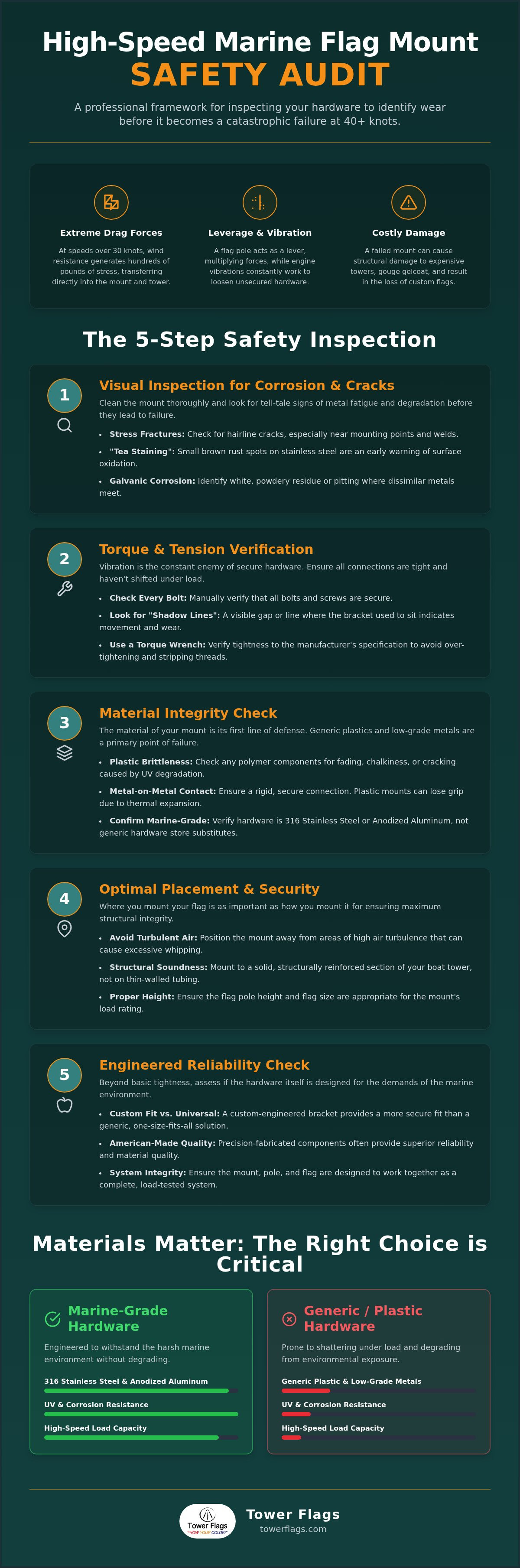
The 5-Step Safety Inspection Checklist
Maintaining a high-performance vessel requires more than just checking the engine oil. Your safety audit should include every external attachment on the boat. A systematic approach to your marine flag pole mounting bracket ensures that your hardware remains reliable under the stress of open-water transit. Skipping these checks often leads to hardware failure at the worst possible moment, such as during a high-speed run or in heavy chop.
You don't need a professional shop to perform this audit. A set of high-quality Allen wrenches, a small torque wrench, and a bright flashlight are usually sufficient. Conduct a deep inspection during your pre-season commissioning and follow up with a quick monthly check throughout the boating season. For those running high-performance vessels, keeping a simple hardware log helps track when bolts were last torqued or when specialized components were replaced. Documentation creates a history of reliability that's invaluable for long-term maintenance.
Visual Inspection for Corrosion and Cracks
Start by wiping down the bracket to remove dried salt spray and grime. Look closely for stress fractures in the bracket housing, especially near the primary mounting points. If you see "tea staining", which appears as small brown spots on stainless steel, it's a sign of surface oxidation that requires immediate cleaning. More importantly, watch for galvanic corrosion. This occurs when dissimilar metals meet without a proper barrier. If you notice a white, powdery residue or pitting in the metal, the structural integrity of the mount is compromised. Ensuring your mount is secure is even more critical when carrying safety gear that meets U.S. Coast Guard visual distress signal requirements, such as a mandatory orange distress flag.
Torque and Tension Verification
Vibration is the constant enemy of tight hardware. Check every bolt to ensure the clamp remains flush against the boat tower. If you see a "shadow line" or a gap where the bracket used to sit, the hardware has "walked" or shifted position. This movement causes friction that wears down expensive tower finishes. Use a torque wrench to verify tightness without over-tightening. Stripped threads are just as dangerous as loose ones because they provide a false sense of security. If your current hardware frequently shifts, it might be time to upgrade to a custom-engineered flag pole bracket designed for your specific tower diameter.
Flag Pole Socket Stability Test
Perform a manual "shake test" by grasping the pole near the base and applying firm pressure in multiple directions. There should be zero play between the marine flag pole mounting bracket and the tower. Examine the internal walls of the socket for signs of wallowing or ovaling, which indicates the pole has been rattling during transit. Finally, verify that the locking mechanism or set screw is fully functional. A seized set screw prevents you from removing the pole in heavy weather, while a loose one risks losing your flag at speed.
Marine Grade vs. Generic Hardware Materials
Choosing a marine flag pole mounting bracket involves more than matching the color of your tower. It's a choice between long-term reliability and inevitable material failure. Generic hardware often utilizes 304 stainless steel, which lacks the molybdenum found in 316-grade stainless. While 304 is fine for freshwater, it quickly succumbs to pitting and crevice corrosion in salt air. 316 stainless steel provides the superior chemical resistance needed to survive seasons of salt spray without losing structural integrity or aesthetic appeal.
Anodized aluminum is the preferred choice for custom boat tower brackets due to its high strength-to-weight ratio. Unlike painted or powder-coated generic parts that can flake and peel, anodized finishes create a protective oxide layer that is chemically bonded to the metal. To protect your vessel's investment, high-quality mounts incorporate nylon spacers. These act as a sacrificial barrier, preventing the metal bracket from scratching or marring the powder-coated finish of your boat tower. Without these spacers, constant vibration leads to metal-on-metal grinding that exposes raw aluminum to the elements.
The Science of Salt Water Resistance
Salt water acts as a powerful electrolyte that accelerates oxidation in low-quality alloys. When hardware is exposed to constant moisture and salt, the chemical reaction can turn a generic bracket into a brittle safety hazard in just one season. Tower Flags prioritizes high-durability marine finishes specifically to combat this silent degradation. Using rust-proof hardware isn't just about safety; it's about maintaining your boat's resale value. Potential buyers notice rust streaks bleeding from hardware, as it suggests a lack of overall maintenance and attention to detail.
Vibration Dampening in Precision Mounts
Custom-fabricated mounts absorb engine and water vibration far better than universal-fit alternatives. Universal mounts rely on "one size fits most" clamps that inevitably leave micro-gaps between the bracket and the tower. These gaps are where hardware rattle begins. Precision tolerances in a dedicated marine flag pole mounting bracket ensure a flush, secure fit that eliminates noise and reduces mechanical wear. Our engineering approach focuses on high-speed stability, ensuring the mount remains silent and stationary even when the boat is running through heavy chop. High-grade fasteners with locking features provide the final layer of stability, ensuring that once you torque the hardware, it stays put through every wake and turn.
Optimizing Placement for Maximum Security
Placement is a strategic decision that impacts the longevity of your hardware. While it's tempting to mount a flag where it looks best, you must consider the aerodynamics of your vessel. Windshields and bimini tops create pockets of "dirty air" or turbulence. When a flag sits in these zones, it doesn't fly smoothly; it snaps and whips, which creates irregular, high-frequency loading on the marine flag pole mounting bracket. This buffeting accelerates hardware fatigue and can lead to the set screws backing out over time.
Height is the next consideration. You want the flag high enough for visibility but not so high that it creates excessive leverage on the tower's thinnest tubing. Structural support is strongest near the tower's base or main cross-members. Additionally, consider the surface area of your flag. A standard 3x5 foot flag generates significantly more drag than a smaller pennant. If you're planning on running a large custom flag at high speeds, ensure your bracket is positioned on the most rigid part of the tower to distribute that load effectively.
Clearance is a safety requirement that boaters often overlook. A flag pole should never interfere with tow ropes, wakeboard racks, or tower speakers. More importantly, ensure it's clear of passenger movement. A whipping flag or a rigid pole shouldn't be a hazard during docking or when someone is moving through the cockpit. Precise positioning ensures that your flag remains an asset to your boat's profile rather than a liability to its occupants.
Tower Mounting Best Practices
Always place your bracket where the tower is most rigid. Avoid mounting on curved sections of the tubing. Clamps are designed for straight runs; placing them on a curve results in uneven pressure distribution, which causes the bracket to slip or "walk" under load. A custom flag pole for boat tower installations should provide a clear line of sight for other boaters without obstructing your view from the helm. If you're struggling with a universal mount that won't stay put, it's time to upgrade to a precision-engineered flag pole bracket that matches your tower's exact specifications.
Securing the Flag to the Pole
The connection between the flag and the pole is a common failure point. Use marine-grade stainless steel clips that won't rattle or corrode. For high-wind conditions, anti-wrap sleeves are essential. These allow the flag to rotate freely around the pole, preventing it from tangling and creating a "sail effect" that puts unnecessary strain on the marine flag pole mounting bracket. Before heading out, perform a 360-degree rotation test. Spin the flag around the pole manually to ensure it doesn't catch on any hardware or nearby tower accessories. If the rotation isn't smooth, adjust your clips or sleeves to prevent mechanical binding during transit.
Choosing Tower Flags for Engineered Reliability
A thorough inspection often reveals the inherent limitations of mass-market hardware. While a universal marine flag pole mounting bracket might seem convenient, it's engineered to fit everything and nothing simultaneously. These generic components rely on rubber shims and oversized clamps to bridge the gap between their loose design and your boat's specific tower geometry. This compromise is where the "rattle and snap" begins. In contrast, custom-fit engineering treats the mounting point as a precision interface. By matching the exact diameter of your tower, we eliminate the mechanical play that leads to hardware fatigue and failure at high speeds.
American-made quality is essential for high-performance marine hardware. Our workshop prioritizes structural integrity over high-volume production. When you're running at 40 knots, you need the confidence that your bracket was fabricated by specialists who understand the physics of drag and vibration. Investing in precision-fabricated boat flag brackets offers long-term value by protecting your tower's finish and ensuring you never lose an expensive custom flag to a snapped mount. It's the difference between a temporary accessory and a permanent piece of vessel equipment.
Custom Solutions for Specialized Towers
We don't believe in "one size fits all." Our design process accounts for the unique profiles of specific tower models, such as the Malibu G3 or MasterCraft series. Each bracket is manufactured using CNC technology to ensure tolerances that mass-produced accessories can't match. This level of exactness ensures the clamp applies uniform pressure around the entire circumference of the tubing, preventing the slipping that occurs with generic mounts. Custom fabrication stands as the gold standard for marine safety in 2026, providing the only reliable way to secure heavy loads on modern boat towers.
The Tower Flags Guarantee of Durability
Our commitment to excellence starts with the highest-grade marine materials available. We select alloys and finishes that withstand the harshest environments without losing their mechanical properties or aesthetic appeal. Despite the technical sophistication of the build, we prioritize a streamlined installation process. The modern boater doesn't want to spend hours in the garage; they want hardware that fits perfectly the first time and requires minimal maintenance throughout the season. If your current setup feels like a liability, it's time to make a change. Upgrade to a secure, custom Tower Flags bracket today and experience the difference that precision engineering makes on the water.
Elevate Your Standards for High-Speed Performance
Maintaining your vessel is a matter of mechanical integrity; your flag hardware is no exception. We've explored how high-speed drag forces and salt-air corrosion can compromise even the most durable gear. By following a consistent inspection schedule and understanding the material science behind your equipment, you eliminate the risk of hardware failure. A generic marine flag pole mounting bracket simply isn't designed to handle the precision requirements of a high-performance boat tower. It lacks the exactness needed for a rattle-free experience and long-term stability.
True reliability comes from hardware built for your specific vessel. Tower Flags provides the specialized solutions needed to end the frustration of vibrating mounts and loose bolts. Our products feature a precision custom-fit for major boat tower brands and are manufactured from high-performance marine alloys. Every bracket we build is engineered for high-speed stability and durability. Don't let inferior hardware compromise your time on the water. Secure your flag with Tower Flags custom-engineered brackets and enjoy the peace of mind that comes with specialized craftsmanship. Your flag represents your pride; make sure it stays exactly where it belongs.
Frequently Asked Questions
How often should I inspect my marine flag pole mounting bracket?
You should perform a deep inspection of your marine flag pole mounting bracket every three to six months, ideally coinciding with your pre-season commissioning and mid-season maintenance. In high-performance environments where vibration and salt exposure are constant, a quick monthly check of bolt torque is recommended. Regular audits identify micro-fractures and hardware shift before they escalate into structural failure. Consistent maintenance ensures the bracket remains secure during high-speed runs and heavy weather.
Can I use a universal flag mount on a wakeboard tower?
While universal mounts are widely available, they are generally unsuitable for the high-speed requirements of wakeboard towers. These "one size fits most" accessories rely on rubber shims and generic clamps that lack the mechanical surface area to grip the tower tubing effectively. At 30 knots, the wind load on the flag can cause universal brackets to slip, rattle, or even snap. Precision-engineered, custom-fit brackets provide a superior, direct connection that ensures total security.
What is the best material for a rust-proof boat flag bracket?
316-grade stainless steel and anodized aluminum are the industry standards for rust-proof performance. Unlike 304 stainless, 316 contains molybdenum, which specifically resists the pitting and crevice corrosion caused by salt spray. Anodized aluminum offers a high strength-to-weight ratio and a chemically bonded protective layer that won't flake like powder coating. Using these high-durability materials prevents structural degradation and maintains your vessel's resale value over years of exposure to harsh marine environments.
How do I know if my flag pole bracket is about to fail?
Visible warning signs include shadow lines where the bracket has shifted position, brown tea staining on the metal, or a white powdery residue indicating galvanic corrosion. You should also listen for unfamiliar rattles or vibrations at cruising speeds, as these suggest the hardware has lost its tension. If you notice any play during a manual shake test or see micro-cracks in the housing, the bracket requires immediate replacement to prevent a total mechanical failure.
Do I need special tools to install a custom boat tower flag mount?
Most custom-fit installations require only basic hand tools, such as a high-quality Allen wrench set and a small torque wrench. Using a torque wrench is critical to ensure fasteners are tightened to manufacturer specifications without stripping the threads or crushing the tower finish. Unlike generic mounts that might require complex shimming or modifications, precision-fabricated brackets are designed for a streamlined, bolt-on installation that respects the mechanical integrity of your boat tower.
What should I do if I see tea staining on my stainless steel bracket?
Tea staining is a surface oxidation that you should clean immediately with a specialized marine stainless steel cleaner and a non-abrasive pad. While it's primarily an aesthetic issue, ignoring it allows salt and contaminants to penetrate deeper into the metal over time. After cleaning, applying a high-quality marine wax or protectant creates a barrier against future salt spray. Regular cleaning ensures your marine flag pole mounting bracket remains structurally sound and visually pristine.
How does high speed affect flag pole mounting hardware?
High speeds create intense aerodynamic drag and mechanical vibration that test the limits of your hardware. A flag acting as a lever arm multiplies the force applied to the bracket base, which can back out set screws that aren't properly secured. Constant oscillation at 40 knots leads to metal fatigue in low-quality alloys and generic plastic mounts. Engineering for high-speed stability requires precision tolerances and high-grade fasteners that maintain their grip despite these relentless forces.
Why is custom-fabricated hardware safer than mass-produced options?
Custom-fabricated hardware is safer because it distributes mechanical loads evenly across the tower tubing through an exact-match fit. Mass-produced options utilize generic clamps that create stress points, which can lead to tower scarring and bracket failure. Custom engineering eliminates the need for unstable shims and provides a flush, metal-on-metal connection designed for specific boat models. This tailored approach ensures the hardware functions as a permanent, reliable component of your vessel's structure rather than a loose accessory.


Comments