

Marine Grade 316 Stainless Steel Hardware: Boater's Guide
A mirror-polished finish won't protect your vessel from catastrophic mechanical failure when you're pounding through heavy saltwater chop. Every boater knows the sheer frustration of watching shiny new deck fittings corrode, pit, and freeze up before their first season even ends. Marketing labels often disguise basic utility alloys under the vague banner of "stainless," but out on open water under intense dynamic loads, specifying genuine marine grade stainless steel 316 for hardware isn't just an upgrade; it's vital insurance against lost gear and structural damage.
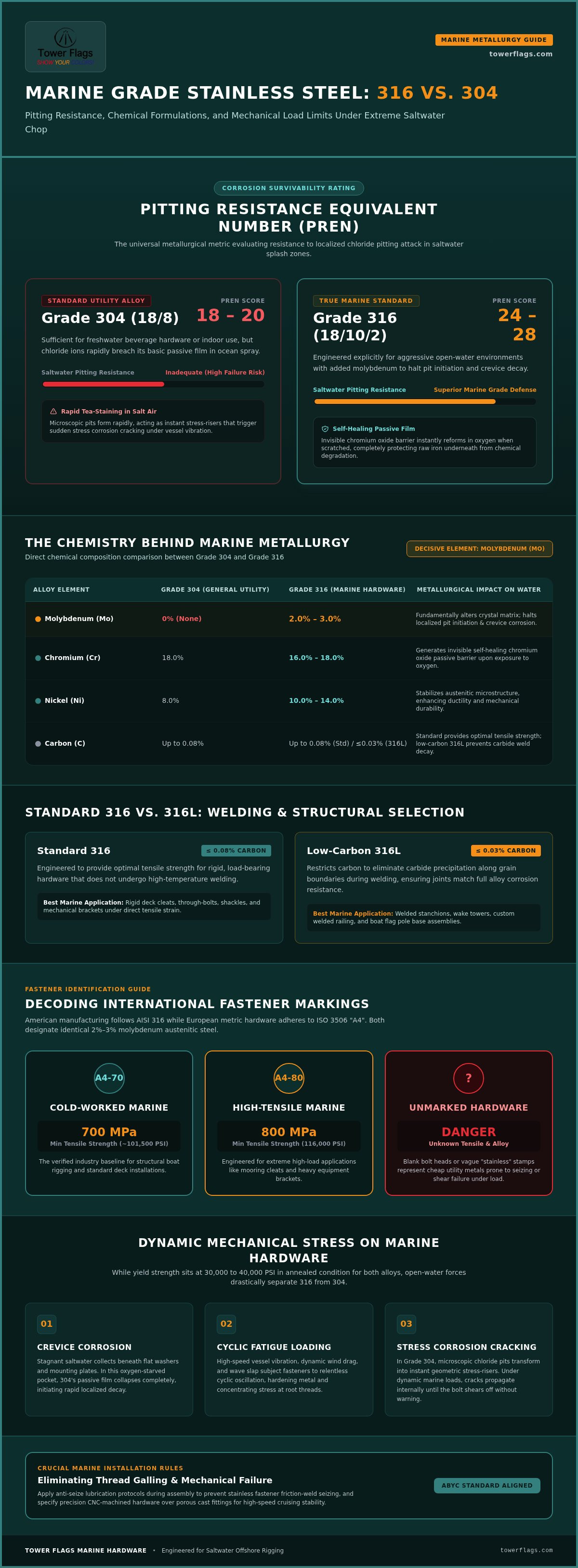
In this guide, you'll discover the exact metallurgical advantages that make 316 the non-negotiable standard for marine hardware, including how its 2% to 3% molybdenum content delivers a Pitting Resistance Equivalent Number (PREN) between 24 and 28. We'll evaluate when you can get away with 304 versus when 316 is mandatory, and reveal the field-tested practices you need to stop thread galling and galvanic corrosion permanently.
Table of Contents
What Is Marine Grade Stainless Steel 316?
Walk down any marina dock, and you'll spot fittings covered in reddish-brown tea staining after just a few months in the salt air. That happens when hardware uses general-purpose stainless steel rather than true marine-rated alloys. At its core, marine grade stainless 316 is an austenitic chromium-nickel alloy specifically modified to survive aggressive chloride environments. While ordinary steels oxidize rapidly when exposed to saltwater spray, 316 relies on chromium to generate an invisible, self-healing chromium oxide passive film across its exterior. When scratched or mechanically stressed, this microscopic barrier instantly reforms in the presence of oxygen, shielding the raw iron underneath from chemical degradation.
The Chemistry Behind Marine Grade Metallurgy
The decisive differentiator in marine grade stainless steel 316 for hardware is the addition of 2% to 3% molybdenum. Standard stainless formulations contain iron, 16% to 18% chromium, and 10% to 14% nickel, but chloride ions in seawater readily penetrate basic chromium oxide barriers. Molybdenum fundamentally alters the alloy's crystalline structure, halting localized pit initiation and preventing crevice corrosion under mounting surfaces.
Standard 316: Contains up to 0.08% carbon, offering optimal tensile strength for rigid load-bearing hardware.
316L Variant: Restricts carbon to a maximum of 0.03%, preventing carbide precipitation during welding and ensuring welded joints maintain identical corrosion resistance to the surrounding metal.
A4 vs 316: Decoding International Fastener Markings
Hardware sourcing frequently creates confusion because American manufacturing adheres to AISI 316 standards, while metric fasteners follow the European ISO 3506 designation of "A4." Both specify the exact same metallurgical formulation: austenitic steel with 2% to 3% molybdenum. The critical details lie in the headstamp markings stamped directly onto the bolt:
A4-70: Cold-worked marine grade steel delivering a minimum tensile strength of 700 MPa (roughly 101,500 PSI). This serves as the industry baseline for structural boat rigging.
A4-80: High-tensile marine grade steel offering 800 MPa (116,000 PSI), engineered for high-load applications like deck cleats and heavy equipment brackets.
Unmarked fasteners represent a serious gamble on the water. If a bolt head is blank, lacks an alloy stamp, or vaguely claims "stainless" without an explicit 316 or A4 designation, you're likely holding cheap utility-grade metal that will seize or fracture under heavy offshore load.
Marine Grade Stainless Steel 316 vs 304: The Critical Comparison
Big-box retailers routinely stock 304 stainless hardware right next to marine components, tempting boaters with lower upfront prices. Grade 304, known metallurgically as 18/8 for its 18% chromium and 8% nickel content, works adequately for freshwater beverage fittings or indoor fasteners. However, outfitting an ocean-going boat with 304 is a false economy. Grade 316, often classified as 18/10/2, adds that vital 2% molybdenum buffer while boosting nickel to roughly 10% to 14%. The chemical difference shows up immediately in the Pitting Resistance Equivalent Number (PREN). Standard 304 lands at a meager 18 to 20, whereas 316 achieves a rating of 24 to 28, representing a massive leap in chloride survivability.
Corrosion Resistance in Saltwater Splash Zones
Chloride ions in marine spray ruthlessly attack weak passive films. Grade 304 quickly exhibits tea-staining, followed by localized pitting that chews microscopic cavities deep into the metal. The real danger, though, is crevice corrosion. Under flat washers, fasteners, and mounting plates where stagnant saltwater collects and oxygen cannot enter, the passive film of 304 collapses entirely. Relying on durable boat flag hardware engineered from true marine alloys eliminates this vulnerability beneath critical deck interfaces.
Mechanical Strength and Tensile Performance Under Load
Tensile ratings look comparable on paper, with both alloys providing yield strengths around 30,000 to 40,000 PSI in annealed condition. The practical difference emerges under dynamic fatigue. When high-speed vessel vibration and heavy seas apply continuous cyclic loading, cold-worked hardware hardens and concentrates stress at thread roots. In an aggressive salt fog, microscopic pits on 304 act as instant stress-risers, accelerating stress corrosion cracking until the fastener suddenly shears off under load.
Adhering to rigorous design baselines like the American Boat & Yacht Council (ABYC) standards means selecting materials that withstand both physical loads and environmental chemistry simultaneously. When outfitting your vessel, choosing precision components made from marine grade stainless steel 316 for hardware provides the baseline reliability needed to safeguard expensive equipment against unnecessary loss.
Dynamic Mechanical Stress on Marine Hardware
Static loads rarely break boat hardware; violent dynamic forces do. When running through open water, deck fittings endure corrosive salt spray, high-frequency engine vibration, and punishing wave impacts all at once. Generic stamped brackets use thin, cold-formed sheet metal filled with micro-fissures. Under continuous cyclic fatigue, these tiny stress fractures widen rapidly, resulting in sudden mechanical failure. Choosing robust, custom-engineered marine grade stainless steel 316 for hardware ensures your deck fixtures absorb relentless torsional forces without work-hardening to the point of brittle fracture.
High-Speed Wind Resistance and Flag Drag Dynamics
Aerodynamic forces multiply rapidly on the water. A vessel cruising at 30 knots directly into a 15-knot headwind generates 45 knots of apparent wind against your accessories. A flying flag acts as a dynamic sail, exerting severe cantilevered leverage against its base. Wake towers magnify this issue because tower tubing vibrates at harmonic frequencies that rattle standard fittings loose. Purpose-built high speed boat flag mount engineering counters this leverage using solid, precision-machined clamp profiles rather than flimsy universal bands that warp under sudden wind shear.
Galvanic Compatibility with Aluminum Hulls and Boat Towers
Fastening 316 stainless hardware to aluminum wakeboard towers or radar arches introduces an electrochemical risk: galvanic corrosion. In the galvanic series, marine aluminum alloys are significantly more anodic (active) than passivated 316 stainless steel (cathodic). If raw stainless directly contacts bare aluminum in the presence of an electrolyte like salt spray, the aluminum sacrifices itself, pitting and oxidizing rapidly around the bolt holes.
To maintain the metal on your boat and preserve expensive structural aluminum, never bolt dissimilar metals together without physical isolation. High-end marine assemblies integrate non-conductive Delrin or nylon barrier bushings and synthetic washers. This barrier breaks electrical conductivity, allowing you to harness the structural strength of 316 stainless without compromising your aluminum tower.
How to Inspect, Install, and Maintain 316 Marine Hardware
Even premium alloys can fail prematurely if they're mishandled during installation or neglected at the slip. Setting up marine grade stainless steel 316 for hardware demands specific mechanical precautions that utility hardware never requires. Surface tea-staining often looks alarming, but it usually represents cosmetic discoloration from trapped iron dust rather than genuine alloy breakdown. Structural failure, by contrast, begins silently as microscopic pitting or thread shearing hidden deep within the assembly.
Preventing Thread Galling and Cold Welding
Thread galling, or cold welding, is the quickest way to ruin a marine hardware installation. Austenitic stainless alloys generate intense friction when threads mesh together under tension. That friction strips away the protective oxide layer, causing microscopic high spots on the opposing threads to fuse together instantly. Once a stainless bolt galls, backing it out is virtually impossible; the fastener will snap off before it turns.
Use Dedicated Marine Lubricants: Coat all external threads thoroughly with a PTFE-based paste like Tef-Gel or a marine-rated anti-seize lubricant before assembly.
Avoid Impact Drivers: High-speed power tools generate instantaneous heat that triggers galling within seconds. Always run stainless fasteners down slowly using manual hand ratchets.
Ensure Clean Threads: Keep salt crystals and sand out of threads, as foreign particles dramatically increase galling risks.
Routine Saltwater Rinsing and Passivation Care
A freshwater rinse down after every ocean outing removes dried salt crusts that deplete localized oxygen around mounting surfaces. During your pre-season inspection, back off high-load fittings to check for hidden crevice attack under flat washers, and inspect high-stress bend radii for hairline fractures. If you notice light surface staining, clean the component using a mild citric acid solution to dissolve free iron contaminants and accelerate natural chemical passivation.
When fittings show pitting deep enough to catch a fingernail or exhibit cracks across thread roots, immediate replacement is mandatory. To eliminate weak links in your deck setup, shop precision-machined flag brackets and poles crafted from true marine alloys engineered to survive extreme offshore conditions.
Selecting Premium 316 Stainless Hardware for Your Vessel
Outfitting a performance boat requires hardware that matches the physical demands of high-speed navigation. While mass-produced deck fittings often use porous die-cast pot metals or stamped sheet alloys, true structural survivability demands solid billets. Precision CNC-machining carves components from continuous-grain alloy stock, eliminating the internal air pockets, microscopic voids, and thin walls that plague molded alternatives. Specifying genuine marine grade stainless steel 316 for hardware ensures that every bracket, fastener, and receiver provides unwavering dimensional stability under relentless offshore vibration.
Custom Engineering vs Generic Universal Mounts
Universal-fit clamps rely on rubber shims and slotted brackets to accommodate a broad range of tubing sizes. That compromise proves costly out on open water. Under sustained heavy chop, dynamic leverage breaks friction against round wakeboard towers and radar arches, allowing the bracket to twist, slip, and scratch expensive powder coating or anodized finishes. Precision-machined flag pole brackets eliminate this movement by matching your tower's exact outer diameter with zero tolerance for play. Pairing a tailor-made clamp with dedicated marine flag poles ensures that wind drag transfers cleanly into the boat's primary frame without rattling or loosening.
The Long-Term Value of Specialized Marine Fabrication
Budget hardware carries hidden ongoing expenses. Swapping out corroded brackets every other season, repairing gouged tower tubing, and fishing lost flags out of the wake costs far more than doing the job right the first time. Purpose-built marine components deliver long-term value through single-purchase durability:
Total Structural Confidence: Cruise at full throttle without worrying about brackets shearing off in rough water.
Damage Prevention: Rigid, custom-milled interfaces protect boat towers, bimini frames, and fiberglass coamings from dynamic fatigue.
Craftsman-Grade Aesthetics: Mirror-smooth, passivated surfaces resist oxidation and complement high-end vessel finishes for years.
Investing in custom-engineered marine hardware protects your vessel, your equipment, and everyone onboard. When you demand uncompromising quality on the water, exploring specialized boat flag brackets and accessories engineered specifically for harsh marine use provides permanent peace of mind.
Equip Your Vessel for High-Speed Offshore Reliability
Surviving the harsh marine environment isn't a matter of luck; it's the direct result of sound metallurgy and exact engineering. Specifying genuine marine grade stainless steel 316 for hardware gives your boat the chemical defense needed to defeat chloride pitting, crevice corrosion, and cyclic fatigue. When paired with meticulous installation techniques and dielectric isolation, high-grade marine alloys ensure your deck gear holds firm through punishing chop and high-speed wind drag.
Don't risk equipment loss or tower damage with generic stamped brackets or sloppy universal clamps that slip under dynamic load. Demand custom-engineered mounting brackets designed specifically for marine environments, built with zero universal-fit compromises to deliver rock-solid stability at speed. Ready to protect your setup permanently? Upgrade to precision-engineered marine hardware at Tower Flags and enjoy complete peace of mind on every voyage.
Frequently Asked Questions
What is the main difference between 304 and 316 stainless steel for boat hardware?
The primary difference is the addition of 2% to 3% molybdenum in 316 stainless steel, which dramatically boosts resistance to saltwater pitting and crevice corrosion. While 304 works well in freshwater, marine environments quickly break down its passive oxide layer. Using marine grade stainless steel 316 for hardware provides a higher Pitting Resistance Equivalent Number, protecting critical deck fittings and brackets from catastrophic failure under dynamic offshore conditions.
Can 316 marine grade stainless steel rust in saltwater conditions?
Yes, 316 stainless steel can develop surface rust or tea-staining if it's starved of oxygen or contaminated with surface iron particles. The alloy requires ambient oxygen to maintain its protective chromium oxide film. When stagnant saltwater sits in tight gaps or under unsealed washers without oxygen flow, crevice corrosion can occur. Fortunately, regular freshwater wash-downs and proper ventilation prevent this surface staining from progressing into structural damage.
Why do stainless steel bolts seize or gall when installing boat hardware?
Stainless steel bolts seize due to friction-induced cold welding, where microscopic surface ridges fuse together under tightening pressure. Austenitic stainless alloys naturally shed their protective oxide barrier under high friction and heat. Driving bolts too quickly with high-speed impact tools exacerbates this heat buildup, locking threads instantly. To prevent galling during marine installations, apply a dedicated anti-seize paste or PTFE lubricant and hand-tighten every fastener slowly.
Is 316 stainless steel magnetic when checked with a magnet?
Genuine 316 stainless steel is virtually non-magnetic in its raw, fully annealed state. It possesses an austenitic crystalline structure that does not attract standard magnets. However, heavy cold-working processes like thread rolling, head forming, or intense CNC machining can induce a slight magnetic pull along working edges. A weak magnetic attraction at the threads doesn't mean your hardware is inferior, but strong magnetic attraction indicates a non-marine grade alloy.
How do I prevent galvanic corrosion between 316 stainless hardware and an aluminum tower?
You prevent galvanic corrosion by completely isolating the stainless fastener from direct contact with the aluminum structure. Because 316 stainless is cathodic relative to anodic aluminum, salt spray creates an active electrochemical circuit that pits the aluminum. Installing non-conductive nylon or Delrin shoulder washers, isolation bushings, and marine barrier compounds breaks electrical conductivity, allowing you to secure heavy-duty brackets without degrading your boat's wake tower or radar arch.
What does A4-70 mean on marine stainless steel bolts?
A4-70 indicates a metric marine-grade 316 stainless fastener with a minimum tensile strength of 700 megapascals (approximately 101,500 PSI). In this European metric designation, "A4" identifies the austenitic 316 alloy containing molybdenum, while "70" represents the cold-worked tensile strength class. Seeing A4-70 stamped clearly on bolt headstamps confirms the fastener meets rigorous international metallurgical specifications rather than generic utility-grade standards.
How often should I clean and inspect 316 marine hardware on my boat?
You should rinse your marine hardware with fresh water after every saltwater trip and conduct a thorough mechanical inspection twice a year. Post-trip wash-downs strip away dried salt deposits that inhibit the alloy's natural self-passivating film. During pre-season and mid-season inspections, check high-load mountings for hairline cracks, verify proper torque, and examine hidden interfaces beneath washers. Choosing custom-machined marine grade stainless steel 316 for hardware makes long-term maintenance straightforward and predictable.


Comments