

Marine Tower Flag Pole Mounts: The 2026 Reference Guide to Precision Engineering
A universal mount is often the fastest way to ruin a custom powder-coated wakeboard tower. While generic, mass-produced clamps promise convenience, they frequently result in vibration-induced noise and permanent structural scratches that compromise your boat's premium aesthetic. You shouldn't have to choose between flying your colors and protecting your investment. Finding a specialized marine tower flag pole mount that actually stays vertical at 40 mph requires a shift from generic hardware to precision-engineered solutions.
We understand the frustration of watching a flag lean or fall because a clamp couldn't handle the drag force of open water. This 2026 reference guide masters the technical requirements for high-speed stability and structural integrity. You'll learn how to select hardware that eliminates mechanical failure and matches the high-end performance of your vessel. We'll cover everything from the importance of 316-grade stainless steel to the specific fitment needs of modern tower models, providing a clear path to a rock-solid display with zero damage to your tower's finish.
Table of Contents
The Physics of Marine Tower Flag Pole Mounts
A marine tower flag pole mount is a high-performance hardware assembly designed to secure flag poles to the specific geometry of wakeboard tower tubing. Unlike rail or hull mounts that sit low to the water, tower mounts are exposed to significantly higher wind velocities. When your boat reaches cruising speeds of 40 mph, a standard 3x5 flag transforms into a powerful aerodynamic brake. This creates immense drag that tests every component of the mounting system, from the fasteners to the clamp itself.
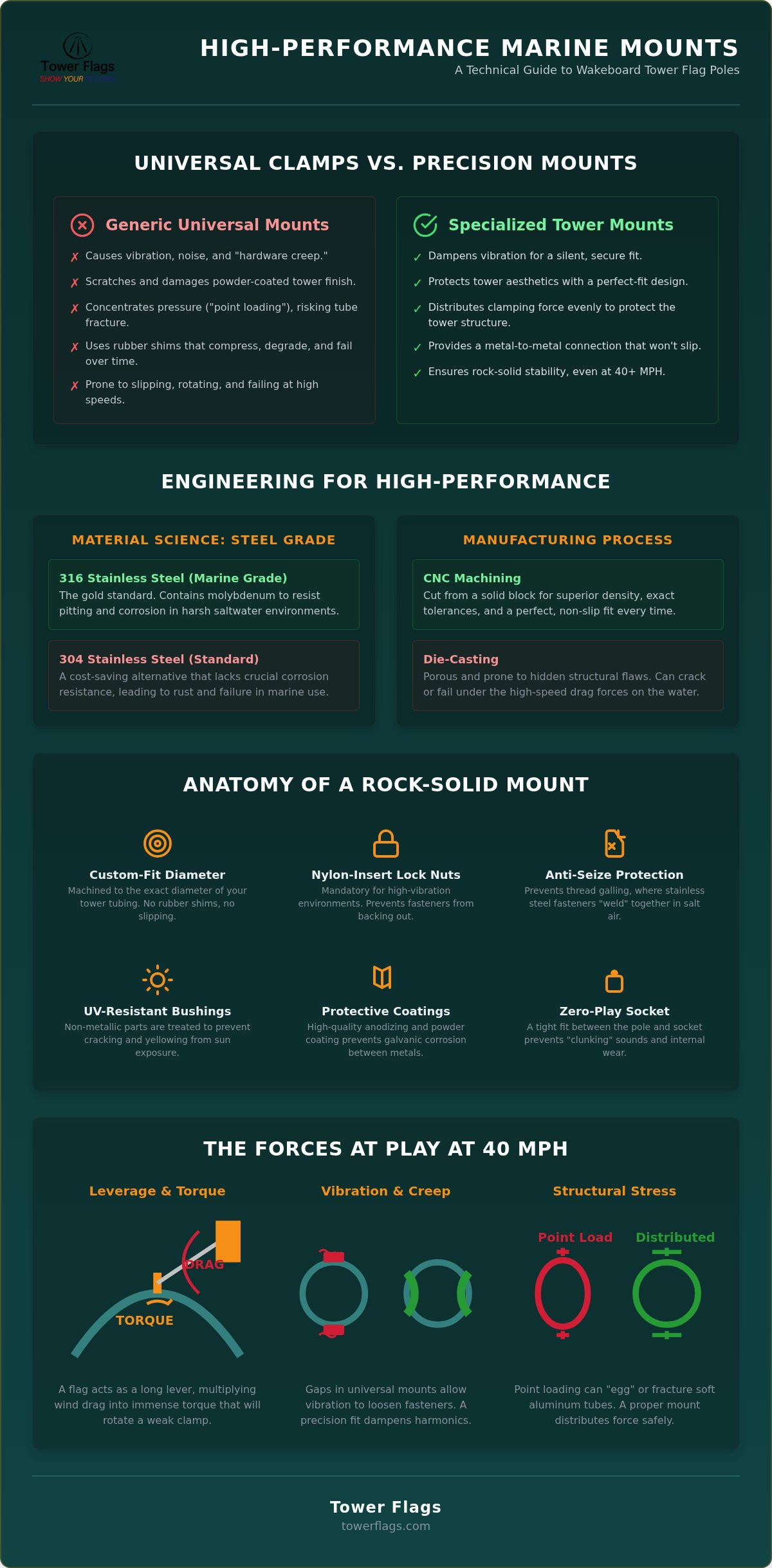
The primary engineering hurdle involves the physics of leverage. Because the flag sits at the end of a long pole, it acts as a lever arm that multiplies the force applied to the bracket. This mechanical advantage means that even moderate wind resistance generates substantial torque at the base. Foundational principles of flagpole design suggest that without a high-integrity connection, this leverage will eventually cause generic clamps to slip or rotate around the tower tubing. Precision engineering ensures the bracket can counteract this torque without shifting or stripping.
Vibration and Harmonic Oscillation at Sea
Marine hardware must contend with constant engine frequencies and repetitive hull impacts. These forces lead to "hardware creep," a phenomenon where generic mounts gradually vibrate loose during a single day on the water. Harmonic oscillation in the context of marine towers is the rhythmic vibration caused when the tower's natural movement frequency aligns with engine RPMs or wave patterns. Precision-fit hardware is essential because it dampens these vibrations by eliminating the microscopic gaps found in mass-produced parts. This tight tolerance prevents screws from backing out and keeps the display secure during long runs.
Structural Stress on Wakeboard Towers
Wakeboard towers are typically fabricated from hollow aluminum tubing, which has specific load limits. Low-quality, universal clamps often cause "point loading," where the clamping pressure is concentrated on a small area of the tube. This localized stress can result in hairline fractures or permanent "egging" of the tower's circular profile. A superior mounting solution distributes this clamping force across the maximum possible surface area. This distribution protects the soft aluminum while ensuring the mount remains immovable even under the heavy drag of a large flag at high speeds.
Engineering Standards for High-Performance Tower Hardware
316 stainless steel is the gold standard for any high-end marine tower flag pole mount. While many manufacturers use 304-grade steel to save costs, it lacks the molybdenum required to resist pitting and crevice corrosion in saltwater environments. Precision-engineered hardware relies on CNC machining rather than die-casting. Die-cast parts are often porous and prone to structural failure under the high-speed drag forces discussed previously. In contrast, CNC-cut components offer superior density and exact tolerances that ensure a perfect fit every time.
Custom-fit internal diameters are a critical engineering requirement. Most generic mounts use rubber shims to adapt to different tower sizes, but these shims compress and degrade over time. A dedicated bracket machined to the exact diameter of your tower tubing provides a metal-to-metal connection that won't slip. This approach also mitigates galvanic corrosion. By utilizing high-quality anodizing and powder coating, we create a protective barrier between the aluminum tower and the stainless steel hardware, preventing the chemical reaction that ruins finishes.
Marine-Grade Hardware Specifications
The small details of the assembly determine the long-term reliability of the system. We prioritize hardware with anti-seize properties to prevent thread galling, a common issue where stainless steel fasteners "weld" together in salt air. Every marine tower flag pole mount should utilize nylon-insert lock nuts. These fasteners are mandatory for vibration resistance because they won't back off during high-RPM wakeboarding runs. Don't settle for decorative chrome finishes that flake off; functional marine-grade finishes are designed for chemical stability and impact resistance.
Durability in Extreme Environments
Marine environments are brutal on non-metallic components. We ensure all bushings and caps are treated for UV resistance to prevent the cracking and yellowing caused by constant sun exposure. A high-integrity design also ensures there is zero-play in the marine flag pole socket. This lack of movement prevents the "clunking" sound often heard with loose-fitting poles and stops the internal wear that leads to failure. Investing in premium flag pole brackets eliminates the unsightly rust-bleed that cheaper mounts leave on your boat's deck and tower.
Custom-Fit Brackets vs. Universal Mounting Solutions
The "one-size-fits-all" claim is a marketing myth that compromises the integrity of your wakeboard tower. While universal mounts are sold as convenient solutions for tubing ranging from 1.5 to 3 inches, they rely on a mechanical compromise that precision engineering rejects. A high-quality marine tower flag pole mount should function as a permanent extension of the boat's structure. It shouldn't be a temporary clamp held together by friction and luck.
The Problem with Universal Shimming
Universal mounts typically utilize rubber or plastic shims to fill the gap between the bracket and the tower tubing. This design is fundamentally flawed for high-speed marine applications. Under the intense heat of a summer sun and the constant aerodynamic drag of a flag, these shims compress and lose their grip. Once the material loses tension, the mount begins to slip around the tower.
This slippage creates a "rocking" effect. Even a single millimeter of play generates significant structural fatigue over time. Every time the boat hits a wake, the mount jerks against the tower's surface. This concentrated impact is what causes the powder coating to chip and the aluminum to mar. While a universal bracket often only makes contact at three or four pressure points, a custom-machined bracket provides 360 degrees of contact area, distributing the load evenly across the entire circumference of the tube.
The Benefits of Custom Marine Flag Accessories
Opting for custom-fit hardware ensures your flag display matches the premium look of your factory tower. There are no bulky, unsightly shims sticking out from the sides of the clamp. The result is a seamless visual integration that looks like it was installed at the factory. It respects the lines of your boat rather than cluttering them with generic hardware.
Beyond aesthetics, the primary benefit is reliability. You won't have to spend your time on the water with a hex key, constantly re-tightening hardware that has vibrated loose. Precision engineering removes the guesswork. For a more detailed breakdown of how specific measurements impact your setup, see our guide on custom boat flag brackets. This focus on the exact outer diameter of your tower is the only way to ensure total stability during high-speed runs.
Strategic Placement and Installation for Marine Towers
Properly positioning a marine tower flag pole mount involves more than just finding an open spot on the tubing. It requires a calculated approach to visibility, nautical etiquette, and mechanical balance. For optimal stability, the mount should be placed as close to a structural junction as possible. This minimizes the "whip" effect caused by tower flex during high-speed transit. While etiquette suggests flying the ensign from the highest practical point, you must balance this with the physical limitations of your boat's center of gravity and low-hanging bridge clearances.
Stability is compromised when a mount is placed on a long, unsupported stretch of aluminum tubing. The leverage from a large flag at 40 mph can cause the tower to vibrate if the mount isn't anchored near a reinforced corner or cross-member. Before you commit to a location, follow the established protocols for securing your boat tower flag attachment. This ensures the hardware works with the tower's geometry rather than fighting against it.
Avoiding Common Obstructions
The most frequent installation error is failing to account for the flag's "kill zone." This is the circular arc the flag occupies when flapping at high speeds or swirling in a light breeze. You must ensure the flag won't tangle with tower speakers, bimini tops, or wakeboard racks. A tangled flag doesn't just look poor; it creates erratic drag that can jerk the mount and damage the fabric. Measure the full rotational clearance of the flag at rest and under tension before performing the final bolt tightening. Additionally, verify that the placement doesn't obstruct the driver’s rearward line of sight or interfere with navigation lights.
Torque and Tightening Protocols
Installing hardware on hollow aluminum requires precision. Over-tightening can crush thin-walled tubing, leading to permanent structural damage or even hairline fractures in the tower. Conversely, under-tightening allows the mount to rotate, which chips the powder coating. Use a torque wrench to meet the manufacturer's specific inch-pound requirements. This is the only way to achieve a uniform clamp load without risking the integrity of the tower.
Once the hardware is torqued, perform the "hand-shake test" to verify the stability of your vibration resistant boat flag mount. If there is even a hint of movement when you firmly grasp the pole, the fit is insufficient. Our precision-engineered flag pole brackets are built to these exact tolerances, providing a rock-solid connection that generic clamps simply cannot match.
The Tower Flags Standard: Precision-Engineered Mounts
Tower Flags operates on a simple principle: your boat deserves hardware that matches its engineering. We reject the "close enough" approach of mass-produced alternatives that compromise your tower's structural integrity. A premium marine tower flag pole mount isn't just a bracket; it's a specialized component designed to withstand the rigors of high-performance boating. By focusing on American-made quality and custom fabrication, we provide a level of reliability that generic, imported hardware cannot replicate.
Bespoke Manufacturing Process
Our workflow begins with the specific geometry of your tower. We don't use rubber shims to bridge the gap because we know that a precision fit is the only way to prevent structural damage and vibration. Every piece of wakeboard tower flag accessories we produce undergoes rigorous testing to ensure it handles the harmonic oscillations and drag forces discussed in this guide. This commitment to functional elegance means our hardware looks like a factory-installed component, maintaining the clean lines of your vessel while offering mechanical superiority.
The system is designed for total integration. Our brackets are engineered to work in tandem with our heavy-duty poles, creating a unified assembly that eliminates the "play" found in mixed-brand setups. Choosing our custom flag pole for boat tower ensures that the socket tolerances are exact, preventing the rattling and wear that eventually lead to hardware failure. We prioritize the fine details of fit and finish so the customer can enjoy a seamless experience on the water.
Investing in Long-Term Reliability
High-performance boating requires equipment that you can trust without constant supervision or maintenance. Precision hardware is a one-time investment for your vessel. Instead of replacing cheap, corroded clamps every two seasons, you install a solution that lasts for the life of the boat. This reliability provides the peace of mind necessary to enjoy high-speed runs without worrying about your flag leaning, falling, or scratching your powder coating.
We take pride in identifying the gaps in the marine market and filling them with specialized, engineered solutions. Our workshop focuses on the technical specifications of the build so you can focus on the destination. When you choose quality over convenience, you protect your tower's finish and ensure a rock-solid display at any speed. Explore our precision engineered boat flag mounts to find the exact match for your specific boat model and tower diameter.
Mastering Your High-Speed Flag Display
Flying a flag on a wakeboard tower shouldn't be a gamble with your boat's finish or the security of your hardware. You've learned that precision engineering is the only effective defense against the intense drag forces and harmonic oscillations found at cruising speeds. By choosing custom-fit hardware over generic shims, you eliminate the vibration-induced noise and powder coating damage that plague inferior mounting systems. It's a shift from temporary clamps to permanent structural solutions.
The right marine tower flag pole mount transforms your tower into a rock-solid platform for your colors. It's about more than just aesthetics; it's about the mechanical confidence that comes from 316-grade stainless steel and CNC-machined tolerances. Don't settle for mass-produced compromises that require constant re-tightening or risk falling at 40 mph. You've invested in a high-performance vessel, and your hardware should reflect that same standard of excellence.
Secure your flag with a precision-engineered mount from Tower Flags. Our hardware provides the custom-fit engineering, high-speed stability, and saltwater resistant durability your vessel demands. Take pride in a display that matches the performance and look of your boat. Enjoy the peace of mind that comes with a display built to last.
Frequently Asked Questions
Will a marine tower flag pole mount damage my tower's powder coating?
A precision-fit marine tower flag pole mount won't damage your powder coating because it eliminates the movement that causes friction. Damage usually occurs with universal clamps that rely on rubber shims. These shims compress over time, allowing the metal bracket to vibrate against the tower's surface. Our custom-machined brackets provide a perfect metal-to-metal contact area that distributes pressure evenly. This engineering approach prevents the chipping and marring commonly seen with generic hardware.
What is the maximum speed I can go with a tower-mounted flag?
Most precision-engineered mounts are tested for stability at cruising speeds up to 40 mph. The drag force on a standard 3x5 flag increases exponentially as speed rises, putting immense torque on the bracket. While generic mounts often fail or lean at 25 mph, high-integrity hardware remains vertical and secure. Always verify your specific setup's stability with a low-speed trial before reaching maximum throttle to ensure the tower tubing can handle the aerodynamic load.
Do I need to drill into my wakeboard tower to install a flag mount?
You don't need to drill into your wakeboard tower when using a high-quality clamp-on system. Precision-engineered brackets utilize a two-piece clamping design that secures the mount using high-tensile fasteners. This method provides a rock-solid connection without compromising the structural integrity of the hollow aluminum tubing. Drilling creates permanent weak points and entry spots for corrosion. A properly machined bracket stays in place through exact tolerances and uniform clamping force rather than invasive modifications.
How do I measure my tower tubing for a custom-fit bracket?
The most accurate way to measure your tower is using a set of digital calipers to find the exact outer diameter (O.D.). Measure the tubing at the specific location where you intend to install the mount. Don't rely on generic model specifications, as tubing sizes can vary even within the same boat brand. If you don't have calipers, wrap a piece of string around the tube, measure the circumference, and divide by 3.14 to find the diameter.
What is the difference between a rail mount and a tower mount?
The primary difference lies in the tubing diameter and the engineering required for high-speed drag. Rail mounts are designed for thin 7/8-inch or 1-inch bow rails and aren't built for the leverage of a flag at height. A marine tower flag pole mount is built for tubing up to 3 inches and features reinforced sockets to handle the increased wind resistance. Tower mounts must also account for the unique angles and vibration patterns of a wakeboard tower.
Can I mount two flags on a single wakeboard tower?
You can mount two flags on a single tower provided you place them symmetrically to balance the aerodynamic load. Mounting multiple flags on one side can create uneven torque that stresses the tower's mounting points. Ensure there is enough clearance between the flags and other accessories like speakers or board racks. Using precision brackets is critical in dual-flag setups because the combined drag force significantly increases the vibration and potential for hardware creep during high-speed runs.
Why do universal flag mounts rattle so much at high speeds?
Rattling occurs because universal mounts rely on multi-piece shims that leave microscopic gaps between the bracket and the tower. At high speeds, harmonic oscillations cause these gaps to expand and contract, creating the clunking or rattling sound. Precision engineering eliminates this by machining the bracket to the exact outer diameter of your tubing. This metal-to-metal contact dampens vibrations and ensures the assembly stays silent even when the boat hits heavy wake or experiences engine drone.
Is stainless steel or aluminum better for tower flag hardware?
316-grade stainless steel is superior for the fasteners and the flag pole socket due to its saltwater resistance. However, high-quality brackets are often machined from 6061-T6 anodized aluminum to match the material and finish of the wakeboard tower. This combination provides the best balance of strength and corrosion protection. Avoid die-cast aluminum, which is porous and prone to cracking. Our hardware utilizes CNC-machined components to ensure the highest possible integrity in harsh marine environments.


Comments