

Perfect Boat Flag Pole for Wake Towers: 2026 Guide
A "universal" fit is often the worst thing you can buy for your wake tower. While generic clamps promise versatility, they frequently fail to account for the specific diameter of your tubing, leading to hardware that slips or vibrates at high speeds. You've likely felt that spike of anxiety when a mount begins to mar your tower’s expensive powder-coated finish or when a flimsy pole starts to bow under the intense wind load at ten feet above the waterline. It's frustrating to settle for mass-produced gear that doesn't respect the engineering of a high-end boat.
We understand that your boat is a significant investment, and every piece of hardware should reflect that quality. This 2026 guide helps you find the ideal boat flag pole for wake towers by focusing on technical requirements and precision engineering. You'll learn how to achieve a secure, rattle-free mount that stands up to the physics of high-speed marine environments without causing structural damage. We will break down the essential differences between mass-produced alternatives and custom-engineered brackets, ensuring your skier-down flag remains visible and your tower remains pristine.
Table of Contents
Understanding the Unique Dynamics of Wake Tower Flag Mounting
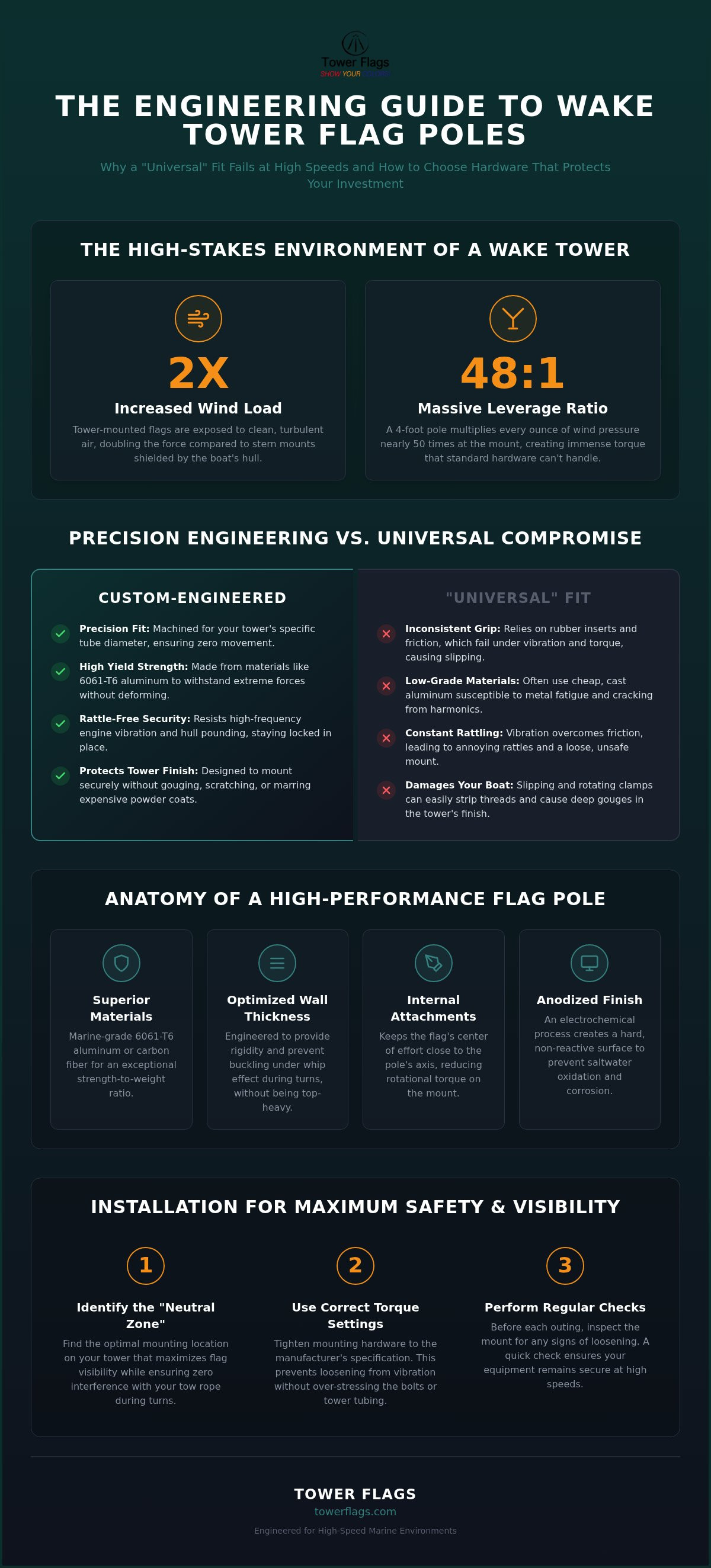
Mounting a flag to a wake tower is fundamentally different from attaching one to a stern rail or a gunwale. A wake tower acts as a high-leverage mast that experiences intense structural stress. When you install a boat flag pole for wake towers, you're placing hardware in a zone of high vibration and unshielded wind. While a stern-mounted flag sits in the slipstream created by the boat's windshield and hull, a tower-mounted flag is exposed to clean, turbulent air. This exposure often results in nearly double the wind load compared to lower mounting points. Aerodynamics play a vital role here. At wakeboarding speeds, the flag isn't just fluttering; it's a drag-inducing sail. If the pole isn't rigid, it begins to oscillate, which increases the load on the bracket exponentially. A wake tower flag mount is a specialized mechanical interface between the marine vessel and the flag pole.
The Leverage Factor: Why Height Matters
Physics dictates that the longer the pole, the greater the force exerted on the base. If you use a 4-foot flag pole with a bracket that has a 1-inch footprint, you've created a 48:1 leverage ratio. Every ounce of wind pressure on the fabric is multiplied nearly fifty times at the mounting bolts. During sudden turns or power turns to retrieve a fallen rider, the tower flexes and the pole whips. This lateral force can easily strip the threads of low-quality mounting hardware or cause a bracket to rotate around the tower tubing, potentially gouging the finish. It's not just about holding the pole; it's about resisting the massive torque generated at the end of that 4-foot lever arm.
Vibration and Harmonics at High Speeds
Wake towers are subject to constant engine resonance and hull pounding that travels upward through the aluminum frame. These high-frequency vibrations create harmonics that can lead to metal fatigue in generic, cast-aluminum brackets. While some manufacturers mention 6061-T6 aluminum as a buzzword, the real value lies in how that material handles these cycles of stress without cracking. Many universal clamps rely on thin rubber inserts and friction alone, but vibration eventually overcomes that friction, leading to the dreaded tower rattle. Beyond the annoyance, a loose mount is a safety hazard. Proper adherence to maritime flag regulations requires your signal to be visible and secure; a snapped pole or a failed bracket at 30 knots is a projectile risk. Using precision-machined Flag Pole Brackets ensures the hardware remains seated even when the boat hits heavy chop. A secure fit prevents the microscopic movements that eventually turn into structural failures.
The Engineering Behind High-Speed Wake Tower Flag Poles
Selecting a boat flag pole for wake towers requires looking past the polished finish and into the metallurgical properties of the hardware. Marine-grade 6061-T6 aluminum remains the industry standard for its exceptional strength-to-weight ratio. While stainless steel offers high corrosion resistance, its density adds unnecessary weight to the upper structure of the tower, potentially affecting the boat's center of gravity during sharp maneuvers. Carbon fiber is a modern alternative that provides extreme rigidity and weight savings, though it requires precision-engineered mounting to prevent the material from splintering under shear stress. Engineering high-performance marine flag poles involves a deep understanding of these materials and how they respond to the relentless pressure of high-speed transit.
Yield strength is the most critical metric for any tower-mounted hardware. This is the maximum stress a material can withstand before it permanently deforms. At speeds exceeding 40mph, the combined force of boat velocity and wind gusts creates a massive bending moment on the pole. We prioritize internal flag attachment points over external clips. This design choice keeps the flag's center of effort closer to the pole's vertical axis, which significantly reduces the rotational torque that often causes generic brackets to slip or rotate on the tower tubing.
Wall Thickness and Structural Integrity
Hollow poles are not all created equal. A thin-walled pole might look sleek, but it is highly susceptible to buckling under the whip effect during a power turn. We utilize specific wall-thickness ratios to ensure the pole remains rigid without becoming top-heavy. To protect this structural integrity, a high-quality anodized finish is essential. This electrochemical process creates a hard, non-reactive surface layer that prevents the saltwater oxidation that turns cheap hardware into brittle junk. You can explore our range of precision-machined Flag Poles to see how these engineering principles translate into durable hardware.
Aerodynamic Drag on Marine Flags
The flag itself is the primary source of mechanical stress on your setup. Upgrading from a 2x3 foot flag to a 3x5 foot flag does more than just increase visibility; it nearly triples the drag load on the mounting hardware. This load increases further when the fabric becomes saturated with water, which raises the drag coefficient significantly. At 30 knots, a standard 3x5 flag can exert over 50 lbs of force on the mount. This constant, rhythmic tugging acts like a slide-hammer on your mounting bolts, making precision fitment a requirement for any long-term installation.
Custom Brackets vs. Universal Clamps: Why Precision Fit Matters
Choosing a boat flag pole for wake towers often leads to a fork in the road: the convenience of a universal clamp or the integrity of a custom-fit bracket. Universal clamps, frequently found on mass-market platforms, prioritize a wide fitment range over mechanical excellence. These components rely on friction to stay in place, requiring excessive tightening that can crush or deform the tower tubing. In contrast, custom-machined brackets utilize form, where the internal radius of the mount matches the external radius of the tower tube perfectly. This metal-on-metal precision eliminates the need for excessive torque and provides a rock-solid foundation that won't budge during high-speed transit.
Surface Protection and Finish Integrity
Many boat owners don't realize that a poorly fitted mount is the fastest way to ruin a tower’s aesthetic. Generic clamps often include rubber shims to bridge the gap between the bracket and the tube. While these shims seem protective initially, they are prone to UV degradation and structural softening in the marine environment. As the rubber breaks down, the mount begins to wobble, allowing grit and salt to get trapped between the shim and the tower. This creates an abrasive paste that quickly sands through powder coating or anodized finishes. By using custom boat flag brackets, you ensure that pressure is distributed evenly across the entire surface area. This prevents localized stress points and preserves the resale value of your boat by keeping the tower's finish factory-fresh.
The Problem with "Universal" Hardware
The "one-size-fits-all" approach usually results in hardware that fits poorly across its entire range. Universal mounts often feature multi-piece adjustable hinges or pivoting arms to accommodate different angles. Every hinge point is a mechanical weakness and a potential source of bracket creep, where the mount slowly rotates under the 50-lb drag force generated at wakeboarding speeds. Precision engineering demands a specific diameter. A 2.375-inch Malibu G5 tower requires a different bracket than a 2.5-inch MasterCraft or a specialized Nautique profile. When you match the hardware to the specific brand and model, you eliminate the vibration and rattle that characterize cheap aftermarket accessories. Investing in exact-fit Flag Pole Brackets is the only way to ensure the hardware remains a permanent, silent part of your tower's architecture.
Installation and Placement Strategies for Maximum Visibility
A successful installation of a boat flag pole for wake towers depends on strategic placement rather than simply finding an open spot on the tube. The first step involves identifying the "Neutral Zone." This is the specific area on your tower legs where the flag will not interfere with the tow rope during wide cuts or rider transitions. If you mount the pole too close to the tow pylon or spool, you risk a high-speed rope snag that can damage both your flag and your tower. Position the bracket on the vertical or slightly angled side supports to keep the flag clear of the central towing path.
Once you've identified the location, follow these technical steps for a professional-grade setup:
Verify Torque Specifications: Use a torque wrench to secure the marine-grade 316 stainless steel bolts. While precision-fit brackets require less pressure than universal clamps to stay seated, they must be tightened to factory specs to account for the vibration forces discussed in previous sections.
Check Driver Line-of-Sight: Sit in the captain’s chair and move through your full range of motion. A flag that looks perfect from the swim platform might create a dangerous blind spot or block your rearview mirror while the boat is on plane.
Deploy High-Tension Clips: Use stainless steel swivel clips to attach the flag. These allow the fabric to rotate freely around the pole, preventing "flag wrap" and reducing the rhythmic tugging that can loosen mounting hardware over time.
Optimizing for Safety and Visibility
The highest point on the tower isn't always the best location. Mounting at the absolute peak exposes the flag to the most turbulent air, which increases wear on the grommets and the pole. Instead, look for a position that balances height with structural support. This placement ensures your skier-down signal is visible to surrounding vessels while minimizing the whip effect during power turns. Always test the mount position with the tower bimini both open and closed to ensure the flag doesn't tangle with the canvas or support arms.
Long-Term Maintenance of Tower Hardware
Marine environments are brutal on mechanical connections. Thermal expansion and constant engine resonance can cause even the best bolts to settle over time. We recommend checking the tension of your mounting hardware every 20 hours of operation to ensure a zero-rattle experience. Saltwater users must be especially diligent. Rinse your durable boat flag hardware with fresh water after every outing to prevent galvanic corrosion between different metal types. If you're ready to upgrade your setup, explore our precision-engineered Flag Pole Brackets designed for permanent, high-speed reliability.
Securing Your Setup: The Tower Flags Approach
At Tower Flags, we reject the compromise of universal hardware. Our philosophy centers on precision engineering rather than mass production. When you choose a boat flag pole for wake towers from our workshop, you're investing in hardware designed specifically for the unique geometry of your vessel. We recognize that high-speed wakeboarding and surfing boats aren't just recreational tools; they are high-performance machines that demand matching accessories. By focusing on a "form over friction" design, we ensure our mounts become a permanent, rattle-free extension of your tower. Our commitment to durability is evident in our high speed boat flag mount designs, which utilize the highest grade 6061-T6 aluminum to withstand the extreme leverage forces found at the top of a tower.
Custom Fabrication for Performance Boats
We don't just sell parts; we engineer solutions for the most demanding marine environments. Working with a specialist manufacturer means your hardware is machined to the exact thousandth of an inch. While general retailers offer plastic-heavy components that look out of place on a premium vessel, our American-made hardware maintains a seamless, high-end aesthetic. We match the finish and the profile of your specific tower, ensuring the installation looks like a factory-installed feature rather than an aftermarket afterthought. This level of detail is the only way to eliminate the structural vibration and "bracket creep" that plagues generic alternatives. Every Flag Pole Bracket we produce is a testament to our quality-first mindset and craftsman-like approach to fabrication.
Ready for High Speeds
The transition from "standard" to "heavy-duty" is a requirement for modern wake towers. As boat engine performance and tower heights have increased, the margin for error in mounting hardware has disappeared. Before you hit the water, use this final checklist to ensure your setup is secure and high-speed ready:
Fitment: Confirm the bracket is machined for your specific tower diameter with no rubber shims.
Hardware: Verify all 316 stainless steel bolts are seated and torqued to spec.
Positioning: Ensure the pole is seated in a reinforced mount that accounts for the 48:1 leverage ratio.
Rotation: Check that the flag swivel clips allow for 360-degree rotation to prevent wrapping.
High-performance boating requires high-performance gear. Don't let a failed universal clamp ruin your tower finish or your day on the lake. You deserve hardware that is as bold and reliable as the boat you drive. Explore Custom Flag Pole Brackets at Tower Flags to find the precision-engineered solution your vessel deserves.
Elevate Your Marine Hardware for High-Speed Performance
A high-performance boat deserves accessories that mirror its engineering. Settling for a generic, one-size-fits-all mount is a liability when you're traveling at 30 knots. We've detailed how precision-machined brackets prevent permanent tower damage and why material science is the deciding factor in hardware longevity. Moving away from unstable rubber shims and shifting universal clamps is the only way to achieve a permanent, silent installation that preserves your vessel's resale value. It's about finding a solution that stands up to the intense leverage forces found at tower height.
Selecting the ideal boat flag pole for wake towers means choosing hardware that respects the physics of your specific boat. Our American-made Flag Pole Brackets and Flag Poles are crafted from marine-grade materials to handle high-speed drag without the risk of buckling or vibration. You don't have to tolerate the rattle and slip of mass-produced gear any longer. It's time to invest in the craftsman-level quality your wake tower requires. Upgrade to a Precision-Engineered Tower Flag Mount today and enjoy the confidence of a secure, professional setup on every outing.
Frequently Asked Questions
Is it safe to fly a flag from a wake tower at high speeds?
Yes, provided you use hardware designed for high-velocity drag. Tower-mounted flags face significantly higher wind loads than stern mounts due to unshielded air exposure. Using a precision-engineered boat flag pole for wake towers ensures the assembly can withstand the leverage generated at 30 knots. Standard poles often buckle under these conditions. Structural integrity and yield strength are mandatory requirements for safe high-speed operation and preventing equipment failure.
Will a universal flag mount scratch my wakeboard tower?
Universal mounts frequently cause surface damage because they rely on rubber shims and friction to stay in place. These shims degrade under UV exposure, allowing grit to enter the interface and sand away the powder coating. Custom-fit brackets eliminate this risk by matching the exact diameter of your tower tubing. This metal-on-metal precision distributes pressure evenly. It prevents the localized stress points that lead to scratches and permanent finish failure.
What is the best material for a boat flag pole for wake towers?
Marine-grade 6061-T6 aluminum is the superior choice for most wake tower applications. It offers a high strength-to-weight ratio and excellent resistance to saltwater corrosion when properly anodized. While carbon fiber provides extreme rigidity for high-speed drag, aluminum remains the industry standard for durability and mechanical stability. We prioritize these high-performance materials to ensure our flag poles don't bend or snap under the intense wind loads found at tower height.
How do I know what size bracket I need for my wake tower?
You must measure the outside diameter of your tower tubing using a set of digital calipers for total accuracy. Many popular towers from brands like Malibu, MasterCraft, or Nautique have specific diameters ranging from 1.5 to 3 inches. Avoid guessing or relying on universal ranges. A precision-engineered bracket is machined to the thousandth of an inch. This ensures a zero-rattle fit that preserves the structural integrity of your boat's tower.
Can I mount two flags on one wake tower?
You can mount multiple flags as long as you identify separate Neutral Zones to avoid rope interference. Each flag adds significant drag, so ensure your mounting points are structurally sound and spaced to prevent the fabric from tangling. Placing one flag on the port leg and another on the starboard leg is a common strategy. This symmetrical placement maintains visibility while balancing the aerodynamic load across the tower frame.
How do I prevent my flag from wrapping around the tower?
Use high-tension swivel clips that allow the flag to rotate 360 degrees around the pole. This mechanical rotation prevents the fabric from binding or wrapping during sudden turns or changes in wind direction. Without these swivels, the flag acts as a fixed sail. This increases the rhythmic tugging on your mounting bolts. Swivel clips reduce this stress and keep your skier-down signal clearly visible from all directions during transit.
Do I need a special flag for high-speed boating?
High-speed boating requires flags made from heavy-duty polyester or nylon with reinforced stitching. Standard flags often fray or whip themselves apart at wakeboarding speeds. Look for flags with double-needle headers and brass grommets to ensure they stay attached to your boat flag pole for wake towers. While the flag itself is a wear item, using premium materials significantly extends its functional lifespan in harsh, high-velocity marine environments.
What happens if my flag pole bracket is too loose?
A loose bracket causes bracket creep, where the hardware rotates or slips under wind load. This movement leads to structural vibration, which can strip mounting threads and gouge the tower's finish. Beyond aesthetic damage, a vibrating mount creates metal fatigue that can result in total hardware failure. Ensuring a precision, rattle-free fit is a safety requirement that prevents your flag assembly from becoming a dangerous projectile at high speeds.


Comments