

Precision Engineering: The Best Boat Flag Mounts for Curved Towers
- ianmackinnon4
- Aug 15
- 12 min read
Updated: 1 day ago
Why settle for a "universal" bracket that treats your custom-curved wakeboard tower like a standard piece of plumbing? Most boat owners understand the frustration of a mount that slips the moment the throttle opens or, even worse, leaves a permanent gouge in an expensive powder-coated finish. Finding a reliable boat flag mount for curved tower geometry is difficult because generic hardware isn't designed for these specialized marine angles. You expect your flag to stand tall, not become a rotating liability that looks out of place on a high-end vessel.
We believe your hardware should match the quality of your boat. This article explores how custom-engineered mounting solutions solve the unique geometry and high-speed challenges of curved wakeboard towers. We will detail the mechanics of a mount that stays vertical at 40 mph and ensures zero damage to your tower finish. You can expect a breakdown of the technical superiority of American-made hardware and how a precision fit provides a seamless, integrated look for your marine flag display.
Table of Contents
The Challenge of Mounting Flags on Curved Wakeboard Towers
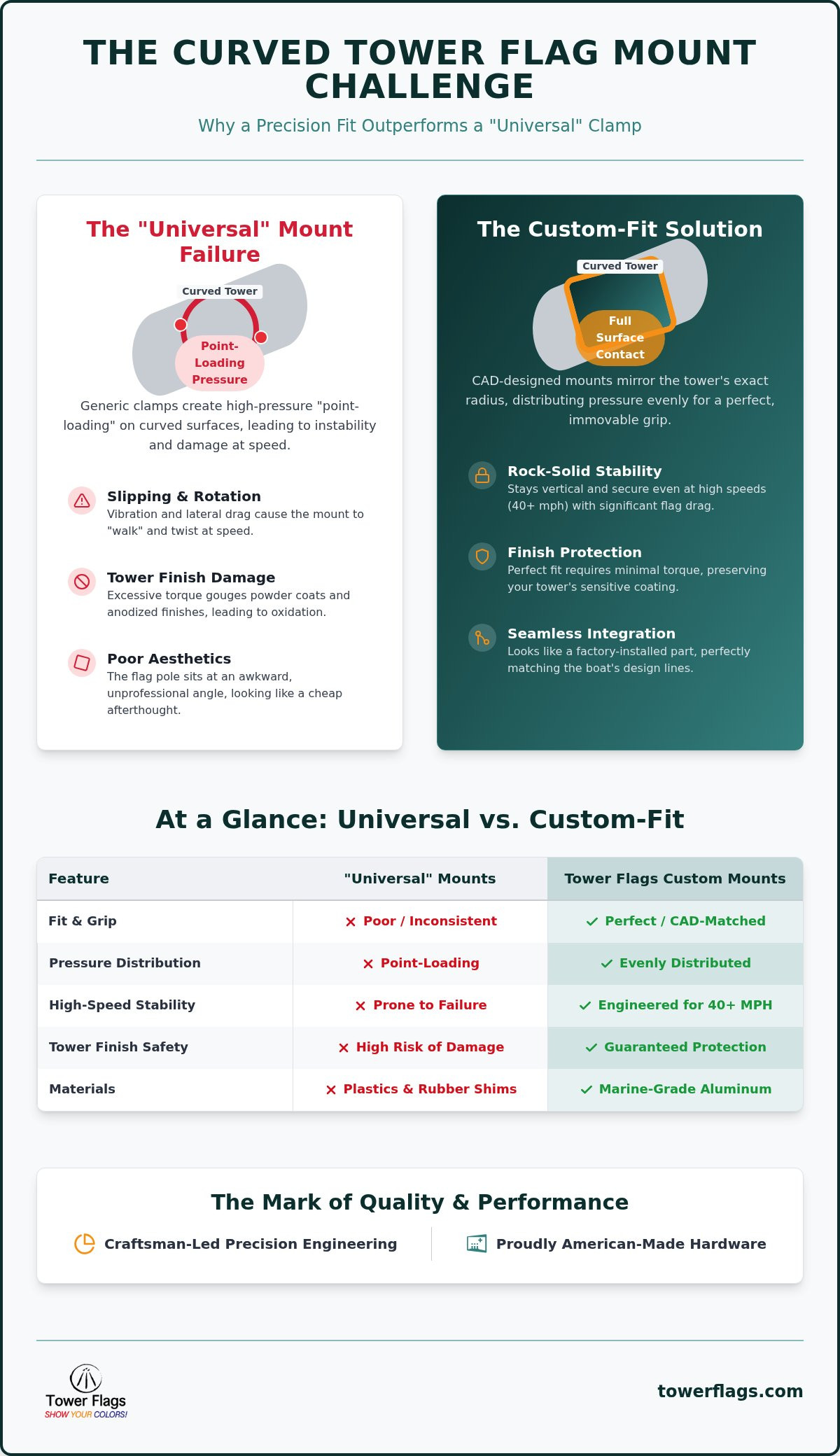
Modern Wakeboard Tower Design has evolved from simple straight-bar structures into complex, swept-back, and curved geometries. While these curves enhance the boat's profile, they create a significant engineering hurdle for standard accessories. The "Curved Tower Dilemma" occurs because most aftermarket hardware is designed for linear tubing. When you attempt to secure a flat-surfaced clamp to a non-linear arc, you lose the surface-area contact required for a secure hold. This lack of contact is the primary reason why a standard boat flag mount for curved tower applications often fails to stay in place.
The physics involved at cruising speeds are relentless. A standard flag generates substantial lateral drag. At 30 or 40 mph, this force acts like a lever on the flag pole. On a curved surface, this leverage isn't distributed evenly across the clamp. Instead, it concentrates pressure on the edges of the bracket. This uneven force, combined with engine and hull vibration, leads to mechanical failure. A misaligned flag does more than just function poorly; it ruins the clean lines of a premium boat. When a bracket isn't designed for the specific arc of the tower, the flag pole often sits at an awkward angle, looking like a cheap afterthought.
Why "Universal" Clamps Often Fail on Curves
Universal mounts prioritize sales volume over specialized fit. They typically use plastic inserts or rubber shims to bridge the gap between various tube diameters. On a curved tower, these shims create "point-loading," where the pressure is focused on tiny contact points rather than the entire circumference of the tube. This lack of full engagement is the primary reason a generic mount will eventually slip. Mounting walk is the gradual displacement of hardware due to vibration. This phenomenon often results in the flag pole slowly tilting backward or rotating inward until it strikes the tower or the bimini top.
The Impact of Tower Material and Finish
Modern towers often feature high-end powder coating or specialized anodized finishes. These coatings are durable against UV rays but vulnerable to mechanical friction. Universal mounts require high-torque screws to compensate for their poor fit. This excessive tightening often results in permanent gouging or cracked powder coating. Once the finish is breached, moisture and salt can penetrate the underlying aluminum, leading to oxidation. A precision-engineered boat flag mount for curved tower setups avoids this by using a custom-milled interior that matches the tower's exact radius. This ensures maximum grip with minimal torque, protecting the structural integrity and aesthetic value of your vessel.
Engineering Precision: How Custom Mounts Solve the Curve
Solving the geometry of a swept-back tower requires more than a simple clamp. It demands a shift in philosophy from merely clamping a device onto a tube to integrating hardware into the boat's design. This craftsman-like approach relies on CAD (Computer-Aided Design) to profile the exact radius of specific tower models. By mapping these arcs, we create a boat flag mount for curved tower structures that mirrors the tower's surface perfectly. This level of exactness is impossible with universal parts that rely on flexible spacers to hide a poor fit.
Material selection is equally critical. We reject the generic plastics and thin-walled composites found in mass-produced mounts. Instead, we utilize marine-grade aluminum alloys that provide the rigidity needed for high-speed environments. These alloys offer superior mechanical efficiency; they're strong enough to withstand lateral forces without adding unnecessary bulk or wind resistance. The result is a streamlined look that complements the boat's high-end aesthetics. If you're tired of hardware that can't keep up with your boat's performance, it's time to explore custom-engineered flag brackets designed for your specific vessel.
Precision Machining for Exact Fitment
Precision-milled brackets distribute pressure evenly across the curved surface of the tower. This eliminates the risk of point-loading and ensures the hardware stays exactly where you installed it. We maintain tight internal tolerances to prevent the irritating rattle and hum that often accompany inferior mounts. Because the internal radius matches the tower perfectly, you don't need to apply excessive torque to the mounting bolts. A snug, secure fit is achieved with minimal pressure, which is the best way to safeguard your tower's finish.
High-Speed Stability and Drag Management
Flying a 3x5 flag at 30 knots generates surprising physical force. Without an engineered solution, this drag can cause brackets to rotate or poles to bend. Maintaining Proper Flag Etiquette means your flag should remain visible and upright, even at speed. Our custom mounts are designed to maintain vertical alignment despite the aggressive lean of modern wake towers. Selecting a dedicated boat flag mount for curved tower geometry ensures the entire system acts as a single, stable unit. This synergy between the bracket and a heavy-duty flag pole allows you to maintain cruising speeds without worrying about hardware failure.
Custom-Fit vs. Universal Boat Flag Brackets
Choosing between a universal "one size fits all" bracket and a precision-engineered boat flag mount for curved tower application is a choice between a temporary fix and a permanent upgrade. Universal mounts are often marketed as convenient, but they trade stability for broad compatibility. A custom bracket feels like part of the boat's original equipment; a generic clamp often looks like an awkward add-on. Beyond the visual appeal, the mechanical differences become obvious the moment you hit choppy water or push past 30 knots.
The "hidden cost" of universal hardware often outweighs any initial savings. When a mount slips at high speed, it doesn't just result in a lost flag. It can cause the hardware to grind against the tower, leading to expensive refinishing bills or structural gouging. Adhering to proper U.S. Coast Guard flag protocol requires a secure and respectful display of the national ensign. A lost flag due to poor equipment is a failure of both engineering and etiquette. Custom solutions are also faster to set up because they don't require the trial-and-error shim adjustments common with universal kits.
Material Integrity and Corrosion Resistance
Marine environments are brutal on inferior materials. While some cheap mounts use plastic or low-grade alloys, these materials quickly succumb to UV degradation and stress fractures. High-grade aluminum and stainless steel are the industry standards for a reason. They offer the structural rigidity required to handle the constant vibration of a wakeboard boat. Carbon fiber is another premium option, providing an exceptional strength-to-weight ratio for high-speed performance. "Marine-grade" isn't just a marketing buzzword; it's a technical specification that ensures your hardware won't seize or snap after a single season in salt water.
Protecting Your Tower Investment
One of the most overlooked aspects of tower hardware is galvanic corrosion. This happens when mismatched metals come into contact in a moist environment, causing the softer metal to corrode. Custom designs often include internal liners or protective barriers to prevent this chemical reaction. These liners also serve a secondary purpose: they provide a non-marring interface that grips the tower without scratching the powder coating. For a deeper look at selecting the right hardware, check out our Ultimate Guide to Custom Boat Flag Brackets 2026. Investing in a specialized boat flag mount for curved tower geometry protects your boat's resale value by ensuring the tower remains in showroom condition.
Installation and Placement Strategy for Curved Towers
Strategic placement of your flag hardware is just as important as the engineering of the bracket itself. On a curved tower, identifying the "sweet spot" requires balancing visibility with aerodynamics. You should avoid mounting the flag too low where it sits in the "dirty air" created by the windshield and cockpit. This turbulent wake causes the flag to whip violently, which increases mechanical stress on the bracket and accelerates fabric wear. Placing your boat flag mount for curved tower at a higher point on the arc ensures the flag catches laminar airflow, resulting in a steady, proud display even at cruising speeds.
Safety remains the primary concern during installation. You must ensure the flag and pole do not obstruct the captain's rear-view or side-line visibility. Additionally, consider the path of the tow line. A flag mounted too close to the tow point can snag a rope during a deep-water start or a sharp turn. A methodical maintenance routine is also essential for high-performance hardware. We recommend checking the mounting bolts every three to four outings to ensure vibration hasn't loosened the assembly. Upgrade your vessel's hardware by selecting a precision-engineered flag bracket that respects your boat's geometry.
Step-by-Step Mounting for Maximum Security
Before attaching the bracket, thoroughly clean the mounting surface with isopropyl alcohol or a mild marine soap. Any grit or salt residue trapped between the tower and the mount acts as an abrasive, which can damage the finish over time. Much like how professional groomers use a BarberNation Cordless Air Duster to keep their precision tools debris-free, boaters can use high-velocity air to clear salt crystals from tower crevices before mounting. Alignment on curved and tapered tubing is notoriously difficult; use the boat's natural vertical lines as a reference point to ensure the pole stands straight. Precision-milled hardware doesn't require excessive force to stay secure. Follow the recommended torque specifications; tighten the bolts until they're snug, then add a final quarter-turn. This balance provides maximum friction without risking damage to the tower's structural integrity.
Optimizing Flag Display and Etiquette
Proper flag height is critical for maintaining clearances under low bridges or inside boat slips. Ensure the top of the pole doesn't exceed the height of your radar arch or bimini top if you frequently navigate restricted areas. If you're flying multiple flags, such as a national ensign and a personal burgee, space them at least twelve inches apart to prevent tangling. High-speed vibration is the ultimate test of any boat flag mount for curved tower setup. A secure mounting system ensures the pole doesn't rattle or lean, maintaining a professional appearance that reflects the quality of your boat.
The Tower Flags Solution: Specialized for Your Vessel
Tower Flags was founded on a simple realization: universal accessories are a compromise that high-performance boats don't deserve. We focus exclusively on custom-engineered marine solutions because we know that a one-eighth-inch difference in tube diameter can be the difference between a secure hold and a rotating bracket. Our manufacturing process takes place in Dallas, Texas, where we combine modern CAD technology with craftsman-led assembly. This approach allows us to produce hardware that isn't just functional but is also an aesthetic extension of your vessel's design, reflecting the same attention to detail found in custom commercial signage from Signarama. We reject the "close enough" mentality of mass production in favor of absolute exactness.
Our commitment to quality starts with our material selection. We utilize high-strength aluminum, 316 stainless steel, and carbon fiber to ensure our products survive the rigors of high-speed travel and constant salt-spray exposure. When you choose a boat flag mount for curved tower geometry from our workshop, you're investing in hardware that has been tested to withstand the specific drag coefficients of marine flags at cruising speeds. We don't mass-produce generic clamps; we build specialized tools for serious boaters who demand reliability. To order a mount tailored to your vessel, you simply select your tower model from our verified database, ensuring the internal radius of the bracket matches your hardware exactly.
Engineered for the Malibu G3 and Beyond
The Malibu G3 tower is a masterpiece of industrial design, but its unique swept-back curves and varying tapers make it a nightmare for standard mounting hardware. We spent hundreds of hours perfecting the geometry for this specific model to ensure our brackets provide a full contact patch. This precision engineering eliminates the need for unsightly rubber shims or plastic spacers that eventually compress and fail under load. Whether your boat features a G3 or another non-standard tube diameter, we handle the unique tapers with ease. The relief of a "perfect fit" experience means you can spend your time on the water instead of constantly re-tightening loose hardware.
Join the Ranks of Performance Boaters
Performance boaters value equipment that works as hard as their engines. Our customers frequently report that our mounts remain perfectly vertical even during aggressive maneuvers and high-speed runs. This stability protects your tower's finish and ensures your flag is always displayed with the respect it deserves. Choosing American-made quality means you're supporting a local workshop that prioritizes mechanical integrity over high-volume profit margins. Don't settle for a bracket that might hold when you can have one that's designed to perform. Upgrade your tower with a custom flag mount today and experience the difference that precision engineering makes on the open water.
Elevate Your Vessel with Precision Hardware
Relying on a universal bracket often leads to mechanical failure and permanent damage to your boat's finish. We've explored how custom-engineered solutions address the specific physics of curved wakeboard towers, providing the stability required for cruising at 40 mph. By choosing a boat flag mount for curved tower geometry that matches your specific model, such as the Malibu G3, you eliminate the risk of mounting walk and unsightly shims. Our craftsman-led manufacturing process ensures every bracket is a durable, high-performance upgrade rather than a temporary add-on.
Investing in American-made quality means you value the integrity of your vessel. High-grade marine materials like carbon fiber and stainless steel offer the longevity that generic alloys simply cannot match. You deserve hardware that integrates seamlessly with your tower's lines while keeping your flag vertical and secure. It's time to stop compromising with hardware that slips and start enjoying a professional, integrated look. Secure your boat flag with a precision-engineered mount from Tower Flags and take pride in every detail of your boat's appearance. See you on the water.
Frequently Asked Questions
Will a flag mount on a curved tower slip at high speeds?
Slippage is a common failure point for generic brackets that rely on friction shims to bridge gaps. A custom-engineered boat flag mount for curved tower geometry remains secure because the internal radius matches the tube exactly. This precision fit distributes clamping force evenly, preventing the mounting walk caused by engine vibration and wind drag. When the hardware mirrors the tower's arc, it maintains its position even at speeds exceeding 40 mph.
How do I protect my tower’s powder coating from mounting scratches?
Protecting an expensive powder-coated finish requires hardware that eliminates metal-on-metal friction. Custom brackets utilize integrated non-marring liners that act as a protective barrier between the alloy and the tower surface. Because these mounts fit perfectly, they require significantly less torque to stay secure. This reduced pressure prevents the gouging and cracking often caused by over-tightened universal clamps that struggle to grip non-linear surfaces.
Can I mount a flag on a tapered wakeboard tower tube?
Tapered tubes present a unique challenge because the diameter changes along the length of the pipe. Standard circular clamps cannot compensate for this change in geometry, leading to uneven pressure and inevitable failure. We solve this by milling brackets to the specific diameter of the intended mounting point. This ensures a specialized boat flag mount for curved tower applications provides the total surface contact necessary for high-speed stability on tapered tubing.
What is the best material for a high-speed boat flag pole?
Carbon fiber is the superior choice for high-speed environments due to its exceptional strength-to-weight ratio. It resists the bending and whipping that occur when a large flag creates high drag at 30 knots. For those seeking traditional aesthetics, 6061-T6 marine-grade aluminum offers the structural integrity needed to handle lateral forces. Both materials outperform generic plastics or thin-walled composites, which often suffer from stress fractures after a single season.
Is it better to mount a flag on the side or top of a curved tower?
Mounting higher on the tower arc generally provides cleaner airflow, which reduces flag whipping and mechanical stress. However, side mounting is often more practical for boats that navigate under low bridges or reside in covered slips. The key is finding a location that offers maximum visibility without obstructing the captain's view or interfering with tow lines. Always prioritize a spot that allows the flag to catch laminar air away from cockpit turbulence.
Do I need special tools to install a custom boat flag bracket?
Installation typically requires only basic hand tools, such as a set of high-quality hex keys or a standard wrench. Because our brackets are precision-milled for your specific tower model, you won't need to struggle with cutting shims or fabricating spacers. The process is straightforward: clean the mounting surface, align the bracket with the tower's vertical lines, and tighten the bolts to the snugness recommended. Precision fitment makes the setup process significantly faster.
How do I measure my curved tower for a custom flag mount?
The most accurate method is to reference the boat manufacturer's technical specifications for your specific tower model, such as the Malibu G3. If those aren't available, use a digital caliper to measure the tube diameter at the exact point where you intend to install the bracket. Measuring the circumference with a flexible tape and dividing by 3.14 also works, though precision milling benefits from the exactness of a caliper reading taken directly from the tube.
Can a custom mount handle a 3x5 flag at 40 mph?
A custom-engineered boat flag mount for curved tower geometry is designed specifically to handle the substantial drag generated by a 3x5 flag at 40 mph. While universal mounts often rotate or snap under this level of force, marine-grade alloys and precision-fit geometry maintain total stability. The synergy between a heavy-duty bracket and a high-strength pole ensures that your flag remains a proud, vertical display even when you're pushing the limits of your boat's performance.


Comments