

Solving Universal Boat Flag Mount Problems: Why Custom Engineering Wins
Updated: Aug 22
Most boat flag mounts aren't actually designed to survive the forces they encounter on a performance vessel. You've likely dealt with the frustration of a flag that won't stay upright or a bracket that rotates the moment you hit the throttle. These universal boat flag mount problems often stem from a "one-size-fits-all" approach that relies on cheap plastic inserts and degrading rubber shims. Instead of securing your flag, these components often fail, leading to scratched powder coating and gouged wakeboard towers that are expensive to repair.
We understand that your boat is a significant investment; every piece of hardware should reflect that level of quality. You deserve a solution that stays put regardless of the wind load. This article identifies the mechanical root causes of mount failure and explains why custom-engineered hardware is the only way to achieve a rock-solid, rattle-free display. We will preview how custom-machined 6061-T6 aluminum brackets eliminate the need for shims and protect your boat's aesthetic, ensuring your hardware survives 40+ knot runs without ever needing an adjustment.
Table of Contents
Why Universal Boat Flag Mounts Fail: The Hidden Risks of One-Size-Fits-All
The Physics of High-Speed Drag: Why Generic Mounts Slip and Rotate
Material Science Failures: The Problem with Rubber Shims and Plastic Inserts
Precision Engineering vs. Universal Compromise: A Boater’s Comparison
Upgrading to Custom-Fit Hardware: Measuring for a Permanent Solution
Why Universal Boat Flag Mounts Fail: The Hidden Risks of One-Size-Fits-All
The term "universal" is often a marketing euphemism for a product that doesn't fit anything perfectly. In the marine industry, universal boat flag mount problems start with what we call the "Universal Fallacy." Manufacturers design a single, oversized clamp and provide a bag of rubber shims or plastic inserts to bridge the gap between the bracket and your tower. This approach prioritizes low manufacturing costs and inventory management over the actual security of your hardware. Instead of a mechanical lock based on exact geometry, these mounts rely entirely on friction to stay in place.
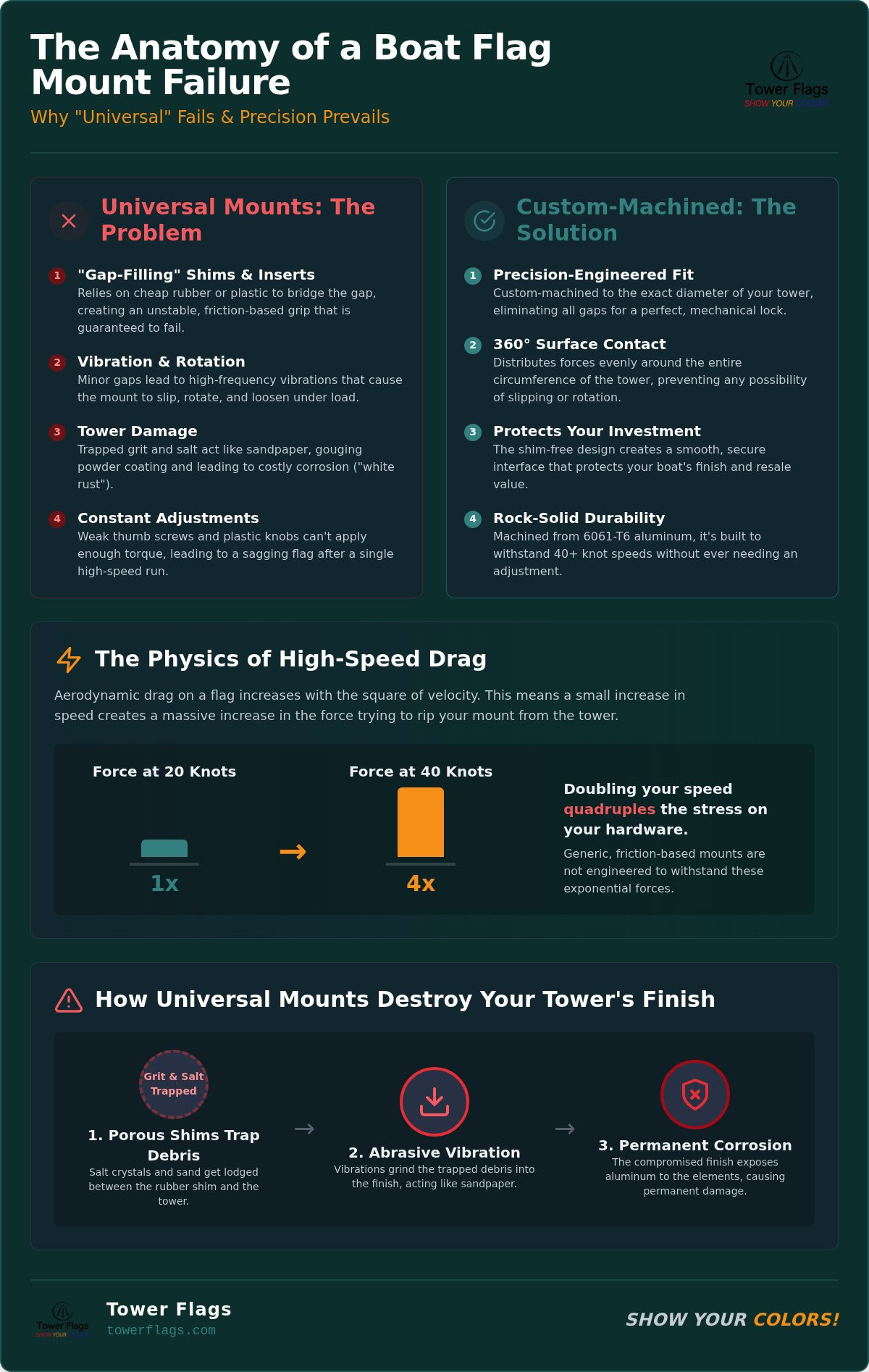
Relying on friction is a losing battle on the water. As your boat reaches planing speed, the aerodynamic drag on a flag creates significant torque. If the bracket doesn't have 360-degree contact with the tower, it will eventually slip. Even a minor gap creates the "rattle factor." This high-frequency vibration slowly backs out fasteners and creates a cycle of constant readjustment. You often find yourself tightening the bracket until the hardware strips, yet the flag still rotates under pressure.
The Destruction of Tower Finishes
When a universal mount vibrates, it doesn't just make noise; it acts like a milling machine on your boat's finish. Standard rubber shims are porous and tend to trap salt crystals and fine grit against the tower. As the boat moves, these crystals act as an abrasive, gouging through expensive powder-coating or anodized aluminum surfaces. Once the finish is compromised, the underlying aluminum is exposed to the elements. This leads to structural oxidation and unsightly "white rust" that permanently devalues your vessel.
The Inevitability of Hardware Rotation
Most generic brackets utilize thumb screws or small plastic knobs that simply cannot generate the torque required for high-speed runs. These designs often boast "360-degree rotation" as a feature, but they lack a mechanical locking pin to hold that position once it's set. Without a precision fit, your flag will inevitably end up horizontal or wrapped tightly around the tower after a single aggressive turn or a 40-knot run. You didn't buy a performance boat to spend your afternoon fixing a sagging flag. True stability requires a bracket machined to the exact diameter of your tower, ensuring the hardware stays exactly where you installed it. Our approach replaces these failed friction points with precision-machined 6061-T6 aluminum for a permanent, secure fit.
The Physics of High-Speed Drag: Why Generic Mounts Slip and Rotate
High-speed boating transforms a simple flag into a powerful sail. A standard 3x5 foot flag can exert hundreds of pounds of force when you're running at 40 knots or higher. This aerodynamic drag creates immense torque at the base of your mount. Because universal boat flag mount problems are rooted in poor fit, this force is rarely distributed evenly. Instead, it concentrates on the small contact points of a generic clamp, causing it to fail exactly when you need it to hold.
The leverage principle further complicates the situation. A flag pole acts as a long lever arm; even a small amount of wind resistance at the top of the pole translates into massive rotational force at the bracket. Generic mounts rely on rubber shims to fill the gap between the clamp and the tower. Under high-speed loads, these shims compress. This creates a "slip zone" where the bracket can lose its grip and rotate. Custom-machined mounts eliminate this failure point by providing 360-degree surface contact, ensuring the force is distributed across the entire circumference of the tower tube.
Aerodynamic Drag and Flag Size
Physics dictates that drag force increases with the square of your velocity. This means doubling your speed actually quadruples the drag on your hardware. If you move from a 20-knot cruise to a 40-knot run, the stress on your mount doesn't just double; it becomes four times more intense. This is why marine flag poles must be specifically engineered and rated for high-speed use. Using decorative or lightweight poles in a wakeboard tower application is a safety risk, as they can snap or become projectiles when the mount fails.
Vibration Fatigue in Universal Clamps
Beyond wind drag, your hardware must contend with engine harmonics and the impact of crossing wakes. These factors create constant micro-vibrations. In a loose, universal fit, these vibrations act like a jackhammer on your fasteners. Set screws in generic hardware often back out because they lack the tight tolerances or mechanical locking features of precision-built gear. A solid-metal connection made from marine-grade 6061-T6 aluminum dampens these vibrations. It creates a unified structure with your tower rather than a separate, rattling accessory. For boaters who demand "set it and forget it" reliability, moving away from adjustable parts is the only logical step. You can browse precision-fit brackets that are designed to handle these exact physical stresses without slipping.
Material Science Failures: The Problem with Rubber Shims and Plastic Inserts
Material science is where most generic designs fail. To make one bracket fit multiple tower diameters, manufacturers rely on rubber shims and plastic inserts. While these look functional in a showroom, they quickly succumb to the harsh marine environment. Rubber is highly susceptible to UV degradation; after a single season in the sun, these inserts become brittle and crack. Once the shim loses its structural integrity, the mount begins to wobble. This instability is the primary driver of universal boat flag mount problems, leading to hardware that feels loose no matter how much you tighten it.
Plastic inserts suffer from a separate engineering failure known as cold flow. When you tighten a universal clamp, the plastic insert is placed under constant compressive stress. Over time, the material permanently deforms and thins out. This creates a gap that friction alone can't bridge. Additionally, these porous materials are often hygroscopic, meaning they trap moisture and salt spray against your tower. This creates a hidden micro-environment for corrosion that eats away at your finish behind the bracket. We reject these temporary fixes. We prioritize direct, precision-machined metal-to-metal contact using 6061-T6 aluminum to ensure a permanent fit that never deforms.
Galvanic Corrosion in Marine Environments
Mixing low-grade stainless fasteners with aluminum brackets in a saltwater environment is a recipe for disaster. This leads to galvanic corrosion, where the two metals essentially weld themselves together through chemical bonding. It's why we emphasize the importance of using high-quality marine grade flag pole brackets. Precision-engineered hardware utilizes compatible alloys and specialized finishes to prevent this seizing. This ensures you can remove or adjust your mount years later without the frustration of snapped bolts or permanent bonding to your tower.
The Failure of Plastic Adjustment Knobs
Mass-produced flag holders often feature plastic adjustment knobs or thumb screws. These components simply cannot handle the thermal expansion and contraction cycles of a day on the water. You'll frequently encounter stripped threads or cracked handles as the plastic weakens under heat and torque. High-tensile, marine-grade bolts are the only reliable way to secure a tower mount for performance use. By using robust, metal-on-metal fastening systems, we provide the mechanical strength needed to keep your flag vertical during high-speed runs and aggressive turns.
Precision Engineering vs. Universal Compromise: A Boater’s Comparison
Choosing between precision and compromise defines your experience on the water. Installing a generic mount typically involves a frustrating game of trial and error with a bag of various shims. You find yourself hoping the friction holds while you crank down on a bolt that isn't quite the right size. In contrast, a custom-engineered bracket offers a satisfying "snap-fit" experience. It slides onto the tower with zero play because it was machined for that specific diameter. This eliminates universal boat flag mount problems before you even leave the dock, replacing guesswork with mechanical certainty.
Total Cost of Ownership
Many boaters view universal mounts as a budget-friendly entry point. However, the true cost includes the inevitable replacement of degraded rubber and plastic parts every few seasons. When you factor in the potential for tower repair costs, such as buffing out gouges or repainting damaged powder coating, the initial savings quickly vanish. Just as luxury designers choose the Turkish Marble Company for its enduring quality in high-end builds, American-made hardware, crafted from solid 6061-T6 aluminum, is designed to outlast the vessel itself. It represents a one-time investment in reliability. This is a "set it and forget it" solution that ensures your flag stays vertical without requiring a tool kit or constant readjustment on every trip.
For boaters who extend this commitment to quality to their land-based infrastructure, selecting barndominium floor plans with shop ensures their vessel has a secure, purpose-built home that matches the engineering standards of their marine hardware.
Modern wakeboard towers are sophisticated pieces of marine architecture featuring complex tapers and premium finishes. Bulky, oversized universal clamps with exposed rubber edges often ruin this streamlined aesthetic. By choosing custom boat flag brackets, you maintain the visual integrity of your boat. These mounts are designed to follow the exact lines of your tower, providing a factory-installed look rather than an awkward aftermarket compromise. The result is a clean, professional profile that complements your boat's design rather than cluttering it with generic hardware.
The Safety Factor at High Speeds
Beyond the visual and financial benefits, there is the critical safety factor. A mount that rotates or slips under load can turn a flag pole into a high-speed projectile. This creates a significant hazard for your passengers and other vessels on the water. Precision engineering replaces the "slip zone" of universal mounts with a rock-solid connection. It provides the peace of mind that comes from knowing your equipment is physically incapable of failing at speed. If you are ready to upgrade your vessel's hardware, you can shop our full selection of custom brackets to find the perfect fit for your tower.
Upgrading to Custom-Fit Hardware: Measuring for a Permanent Solution
Transitioning from the frustration of a slipping bracket to the security of a custom fit requires a shift in mindset. You're moving away from "close enough" and toward mechanical exactness. To permanently solve universal boat flag mount problems, you must start with a precise measurement of your tower's diameter. While it's tempting to check an online forum or a manufacturer's spec sheet, those numbers often fail to account for real-world variables. Powder coating thickness can vary between production years, and even a fraction of a millimeter determines whether a bracket stays locked or begins to rotate at 40 knots.
We recommend using a digital caliper to capture the outer diameter of your tower tube. This tool provides a reading in thousandths of an inch, giving us the data needed to machine a bracket with zero internal play. If you're running a specialized tower like a Malibu G3 or a MasterCraft ZFT series, identifying the specific model is helpful, but the physical measurement remains the gold standard. This ensures the hardware accounts for the specific geometry of your vessel's tower.
The Precision Measurement Checklist
Before you finalize your measurements, perform a quick sweep of the intended mounting area. You'll want to clear any potential obstacles that could interfere with the bracket's 360-degree contact. Look for the following:
Speaker Pods and Lights: Ensure the bracket won't crowd wiring harnesses or existing audio equipment.
Bimini Interference: Check the clearance of your top in both the open and stowed positions.
Tower Tapers: Many towers change diameter as they move toward the tow point. Measure the exact spot where the mount will sit.
If you don't have a caliper, you can use the paper strip method. Wrap a thin strip of paper around the tube, mark the overlap, and measure the length to find the circumference. Divide that number by 3.14 to find the diameter. However, for a high-performance vessel, the precision of a caliper is always the superior choice.
Finalizing Your Custom Order
Once you have your measurements, you can choose the configuration that best suits your boating style. We offer both fixed and quick-release wakeboard tower flag mount options. A quick-release system is ideal for boaters who frequently fold their towers or pass under low bridges. You'll also need to select a pole length that complements your tower's height. A 24-inch pole is standard for most wakeboard towers, providing enough "fly" to keep the flag visible without creating unnecessary leverage on the bracket. After we receive your specs, our workshop begins the fabrication process, transforming marine-grade aluminum into a specialized tool that protects your boat's finish and your peace of mind.
Secure Your Vessel with Precision Engineering
Relying on adjustable clamps and degrading rubber shims is a compromise that eventually leads to hardware failure or tower damage. We've identified that most universal boat flag mount problems are caused by a lack of mechanical fit. This results in rotation at high speeds and abrasive wear on your boat's finish. By choosing custom-machined hardware, you replace temporary friction with permanent stability. Our brackets are precision-machined for a scratch-free fit and designed to maintain 40+ knot stability without the need for constant adjustment.
Protecting your boat's aesthetic and resale value starts with hardware that matches the quality of the vessel itself. It's time to move past generic "one-size-fits-all" accessories and invest in American-made marine hardware that's built to last. You can Browse Custom-Engineered Boat Flag Brackets to find the exact match for your tower diameter. Once you experience the security of a "snap-fit" installation, you'll never go back to fiddling with shims again. Enjoy the peace of mind that comes with equipment that stays vertical and secure during every high-speed run.
Frequently Asked Questions
Why does my universal flag mount keep slipping when I go fast?
Your mount slips because it relies on friction rather than a mechanical fit. Universal mounts use rubber or plastic spacers that compress under high wind loads, creating a "slip zone." At high speeds, the aerodynamic drag overcomes the friction of the clamp. Custom-fit brackets eliminate this by providing 360-degree contact with the tower tube, ensuring the hardware stays locked in place regardless of the throttle position.
Will a universal flag holder scratch my boat tower’s powder coating?
Yes, universal mounts are a leading cause of tower damage. These brackets often trap salt crystals and grit between the rubber shim and the powder coating. As the boat vibrates or the mount slips, these particles act as an abrasive, gouging the finish. This exposure can lead to structural oxidation over time. Precision-machined brackets avoid this by eliminating the shifting and vibration that cause surface abrasion.
How do I accurately measure my wakeboard tower for a custom flag bracket?
Use a digital caliper to measure the outer diameter of your tower at the exact location where you plan to install the bracket. Measuring the specific spot is critical because many wakeboard towers feature tapers or varying diameters. Don't rely on manufacturer specifications, as powder coating thickness can vary. A precise reading ensures a "snap-fit" that solves the root of most universal boat flag mount problems.
What is the best material for a boat flag mount in salt-water environments?
High-grade 6061-T6 aluminum or 316 stainless steel are the superior choices for marine environments. We utilize marine-grade 6061-T6 aluminum because it offers an exceptional strength-to-weight ratio and excellent corrosion resistance. While cheaper mounts use low-grade alloys or plastic, precision-engineered aluminum hardware survives salt spray and intense UV exposure without becoming brittle or seizing due to galvanic corrosion.
Can I use rubber tape to stop my universal mount from rotating?
Rubber tape is a temporary fix that eventually fails under heat and pressure. While it might increase friction initially, the tape will compress or degrade after a few runs in the sun and salt. This is a common attempt to fix universal boat flag mount problems, but it doesn't address the lack of mechanical fit. True stability requires a bracket machined to the exact geometry of your tower.
How much force does a boat flag exert at 40 knots?
A standard 3x5 foot flag can create significant aerodynamic drag, exerting hundreds of pounds of force at 40 knots. Because drag increases with the square of your velocity, doubling your speed quadruples the stress on your mounting hardware. This massive torque is what causes inferior, adjustable clamps to rotate or snap. High-performance vessels require hardware specifically engineered to distribute these forces across the entire circumference of the tower.
Are custom-engineered boat flag brackets worth the extra cost?
Custom-engineered brackets are a long-term investment in your boat's reliability and resale value. While universal mounts have a lower initial price point, they often require frequent replacement of degraded parts and can cause expensive damage to your tower's finish. A custom bracket is a "set it and forget it" solution. It provides the security and aesthetic integration that generic, mass-produced alternatives simply cannot match.
Can I use a Tower Flags gift card for custom-fabricated hardware?
Yes, you can use a Tower Flags gift card toward any of our precision-fit hardware, including Flag Pole Brackets and Flag Poles. Our gift cards are a great way to help a fellow boater upgrade from a frustrating universal setup to a custom-engineered solution. They are delivered electronically and can be applied at checkout for any of our American-made marine products.


Comments