

The 2026 Checklist for a Secure Boat Tower Flag Attachment
A universal "one-size-fits-all" bracket is often just a shortcut to a ruined powder coat and a lost flag. If you've ever watched your flag rotate toward the water or tangle in your bimini while cruising, you know that a generic boat tower flag attachment isn't built for the realities of high-speed marine environments. We understand that you shouldn't have to choose between showing your colors and protecting your boat's expensive finish. It's a common struggle for owners who value both aesthetics and mechanical integrity.
This 2026 checklist provides a comprehensive, engineering-focused guide to ensuring your display remains rock-solid at speeds over 40 mph. We'll walk you through the mechanical necessity of a precision fit, the physics of wind load, and the specific hardware required to maintain a rattle-free experience without damaging your tower. By focusing on custom fabrication standards rather than generic solutions, you can finally achieve a secure display that reflects the quality of the boat itself and provides the peace of mind you deserve on the water.
Table of Contents
Understanding the Physics of Boat Tower Flag Attachments
A boat tower flag attachment is more than a simple accessory; it's a high-stress mechanical interface. While a hull-mounted socket sits near the boat's center of gravity, a tower mount operates at the end of a long lever arm. This elevated position exposes the hardware to amplified wind resistance and structural oscillations that can quickly shear through inferior materials. Understanding these forces is the first step toward a secure, permanent installation.
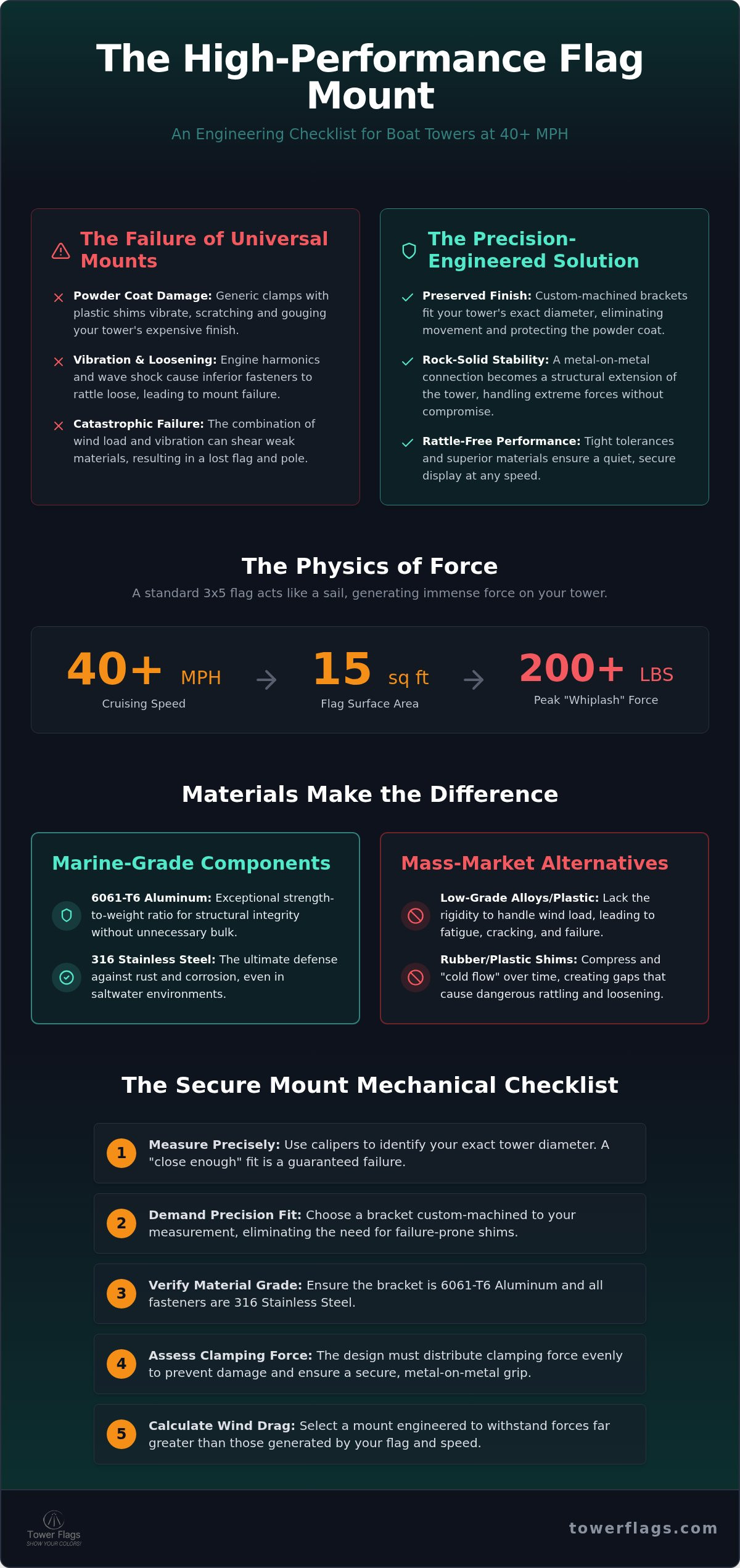
The "Wind Drag Factor" is the primary force at play. A standard 3x5 flag acts like a small sail, catching a massive volume of air. At cruising speeds of 30 mph, the surface area of the fabric can exert hundreds of pounds of force against the mounting bracket. This isn't a static load. As the boat hits waves or enters a turn, the flag snaps and redirects that energy. This "whiplash" effect creates peak force moments that easily overwhelm simple thumbscrews or tension-based clamps used by generic manufacturers.
Calculating Wind Load on Wakeboard Towers
Different flag materials possess varying drag coefficients. Heavy-duty polyester or double-sided flags catch significantly more air than lightweight mesh, which increases the physical burden on the bracket. High-speed towing demands more than just a "tight" fit. It requires a boat tower flag attachment that can withstand the constant, rhythmic pulling of the fabric. The leverage provided by the length of the flag pole dictates the total stress on the bracket; a longer pole creates a more powerful lever, multiplying the force applied to the tower tubing.
Vibration: The Silent Killer of Cheap Mounts
Towers often act like tuning forks for engine harmonics. These vibrations travel from the motor, through the hull, and up the aluminum tubing. In a generic boat tower flag attachment, mass-market brands often use plastic inserts or rubber shims to accommodate different pipe diameters. These soft materials are a major point of failure. Under constant vibration and wind load, they eventually compress or "cold flow," creating a microscopic gap between the mount and the tower.
Engine Harmonics: Rhythmic vibrations that loosen standard fasteners over time.
Compression Failure: Plastic spacers that thin out, leading to a loose, rattling bracket.
Surface Damage: Movement between the mount and the tower that destroys expensive powder coating.
We prioritize metal-on-metal precision to solve these issues. Custom-fabricated hardware, machined to the exact diameter of your specific tower, ensures the bracket becomes a structural extension of the boat. This eliminates the need for failure-prone spacers and provides the rigidity necessary to handle both engine harmonics and high-speed wind loads without compromise.
Key Components of a High-Performance Marine Attachment
High speeds and engine harmonics demand hardware that doesn't just "hold on" but integrates with the boat's structure. A professional-grade boat tower flag attachment relies on two pillars: material science and mechanical precision. When the wind load hits peak force, the difference between a secure display and a lost pole comes down to the quality of the components used in the assembly.
Marine-Grade Materials and Corrosion Resistance
In the harsh marine environment, material selection isn't a suggestion; it's a requirement for safety. We utilize 6061-T6 aluminum as the industry standard for custom brackets because of its exceptional strength-to-weight ratio and natural resistance to structural fatigue. While mass-produced alternatives often use lower-grade alloys or plastic components to save on costs, these materials lack the rigidity needed to withstand constant wind buffeting.
6061-T6 Aluminum: Provides the structural integrity required for high-speed transit.
316 Stainless Steel: Prevents "tea staining" and rust on all fasteners and retention pins.
Tighter Tolerances: Custom fabrication allows for a fit that is measured in thousandths of an inch, ensuring no movement under load.
Using 316 stainless steel for every bolt and pin is non-negotiable. Lower grades like 304 stainless will eventually show signs of oxidation when exposed to moisture and salt, leading to seized threads or weakened attachment points. By pairing high-grade aluminum with superior fasteners, the bracket remains a reliable, long-term fixture on your tower.
Clamping Force and Surface Protection
The method of attachment determines whether your tower remains pristine or ends up scratched and gouged. Universal mounts frequently rely on plastic shims or rubber spacers to bridge the gap between a generic bracket and your specific tower diameter. These shims create "point loading," where the pressure is concentrated in small areas rather than distributed evenly. This often leads to the bracket sliding or rotating when the boat hits a wake.
A custom-machined bracket provides maximum surface area contact by mirroring the exact curve of your tower tubing. This distribution of pressure ensures the mount stays put without needing to overtighten the bolts to the point of damaging the finish. Clamping torque is the rotational force applied to a fastener to create the necessary tension for a secure, non-slip mechanical bond between the bracket and the tower.
Precision fitment also protects against galvanic corrosion. By using specialized coatings and ensuring a perfect fit, you eliminate the friction that wears down the tower's protective powder coat. If you're tired of hardware that rattles or slips, you can explore our range of precision-engineered flag pole brackets to see the difference that custom fabrication makes for your boat's finish.
The Failure of Universal Mounts at High Speeds
The "one-size-fits-all" promise of mass-market hardware is a mechanical fallacy in the marine world. While a generic boat tower flag attachment might claim to fit any tube between 2 and 2.5 inches, it relies on a compromised design that sacrifices security for inventory convenience. These universal mounts typically use a series of plastic or rubber shims to bridge the gap between the bracket and the tower. This creates a multi-layered interface that lacks the structural rigidity required for high-speed operation. When you hit the throttle, the wind load doesn't just pull on the flag; it tests every layer of that attachment.
Universal mounts often feature adjustable "elbows" or pivot points designed to make them compatible with various tower angles. These joints are notorious for rattling loose under engine vibration. Once a single fastener loses tension, the entire assembly begins to oscillate, leading to permanent gouges in your tower's powder coating. The cost of refinishing a wakeboard tower can easily reach thousands of dollars, making a "cheap" universal mount an expensive long-term liability. We believe that true value comes from hardware that protects your investment rather than putting it at risk.
Why Shims Fail in Marine Environments
Rubber and plastic spacers are the weakest link in any mounting system. Constant UV exposure causes these materials to harden and crack, losing the elasticity needed to maintain a grip on the tower. In saltwater environments, the problem accelerates. Salt spray acts as a microscopic lubricant that seeps between the shim and the metal surface. This reduces friction to the point where even a tightened boat tower flag attachment will eventually slide or rotate. For a deeper look at material durability and selection, see our Ultimate Guide to Custom Boat Flag Brackets 2026.
Precision Engineering vs. Mass Production
A bracket designed specifically for a Malibu G3 or a MasterCraft Z6 tower doesn't need "adjustability" because the geometry is already perfected. Custom fabrication allows us to eliminate the hinges and spacers that define mass-produced hardware. By machining the bracket to the exact taper and diameter of your specific model, we ensure a rock-solid connection that won't budge at 40 mph. This metal-on-metal precision distributes the load evenly across the tower surface, protecting the finish and providing a seamless visual profile. You can learn more about these technical advantages in our article on why custom fabricated boat flag mounts outperform generic alternatives.
Choosing a custom-engineered solution isn't just about aesthetics; it's about mechanical certainty. When you eliminate the failure points inherent in universal designs, you gain the confidence to cruise at any speed without checking your rearview mirror every thirty seconds. It's the difference between a temporary accessory and a permanent upgrade.
The 12-Point Checklist for a Secure Tower Flag Attachment
A secure boat tower flag attachment begins with data, not guesswork. Before you even order hardware, use a set of digital calipers to measure the outer diameter of your tower at the specific mounting point. Towers often taper or change diameter near welds and joints, so a measurement taken six inches away from the intended spot may be inaccurate. This precision ensures that the bracket makes 100% surface contact, which is the only way to prevent rotation at high speeds.
Placement is equally critical. You should find a section of the tower with the least amount of structural vibration, typically away from the top center where the tower flexes most under load. Avoid mounting the bracket too close to rope tow points or speaker mounts. The mechanical interference from a tow rope can easily snag a flag pole, leading to catastrophic failure of the bracket or permanent damage to the tower itself.
The Pre-Flight Inspection for Your Boat Tower
Before every departure, a thirty-second inspection can prevent a projectile hazard. Check the following points to ensure your hardware is ready for the day's conditions:
Step 1: Verify the pole is seated fully in the marine flag pole socket and the retention pin is securely locked.
Step 2: Check for any "play" in the bracket by hand-testing. If it moves even a millimeter under hand pressure, it will rattle violently at 40 mph.
Step 3: Ensure the flag is attached with high-strength clips. Never use zip ties; they become brittle under UV exposure and snap without warning.
Step 4: Confirm the bracket is mounted away from rope tow points to prevent tangles during rider pickups or sharp turns.
High-Speed Maintenance and Longevity
Marine environments are notoriously hard on mechanical fasteners. Even the highest quality 316 stainless steel requires maintenance to prevent long-term degradation and seizing. Follow these steps to extend the life of your hardware:
Step 5: Apply a marine-grade anti-seize to all stainless fasteners. This prevents thread galling, a common issue where stainless threads weld together under pressure and heat.
Step 6: Inspect the tower powder coating for signs of friction, heat, or discoloration that suggest the bracket has been vibrating or slipping.
Step 7: Clean salt deposits weekly. Salt crystals can act as an abrasive between the bracket and the tower, eventually destroying the protective finish.
Regular audits are the difference between a lifetime of use and a sudden failure. After every high-speed run, perform a quick visual check for fastener integrity and signs of movement. For a detailed breakdown of what to look for during your monthly checkup, read our guide on Marine Flag Pole Mounting Bracket Safety Inspection. If you're ready to upgrade to hardware that passes every safety test, you can shop our custom flag pole brackets designed for maximum security.
Upgrading to Custom-Engineered Tower Hardware
Investing in a high-end wake boat reflects a commitment to quality and performance. Every accessory you add should meet that same standard. A generic, mass-produced boat tower flag attachment often looks like an afterthought, clashing with the sleek lines of a modern tower. Upgrading to custom-engineered hardware isn't just about aesthetics; it's about matching the mechanical integrity of your boat with components designed to last a lifetime. When you move away from "universal" compromises, you gain a level of fit and finish that mass production simply cannot replicate.
American-made quality is the foundation of our manufacturing process. We reject the "one-size-fits-none" approach because we've seen the damage it causes to expensive tower finishes. By focusing on precision fitment, we provide a solution that eliminates the need for failure-prone shims and spacers. This craftsman-like approach ensures that your hardware remains a permanent, rattle-free extension of your boat. You can cruise with the quiet confidence of knowing your display is secured by hardware built for the rigors of the marine environment.
The Aesthetic and Functional Benefit of Custom Fits
Modern wake towers feature complex geometries and specific tapers that universal clamps fail to accommodate. A custom-fit bracket offers a low-profile visual that enhances, rather than distracts from, your boat's design. These brackets distribute clamping force evenly around the tube, preventing the point-loading that leads to gouges and scratches. For a deeper dive into how specialized hardware improves performance, read our article on Custom Boat Tower Flag Pole: Precision Marine Engineering.
Final Steps: Securing Your Display for the Season
Before finalizing your setup, consider how you use your boat on a daily basis. Choosing the right mounting style and pole height is essential for both safety and visibility. We offer options that cater to different operational needs without sacrificing the security of the boat tower flag attachment.
Fixed vs. Quick-Release: Decide if you want a permanent fixture or a quick-release pin for easy removal during trailering or storage.
Height Calibration: Match your flag pole length to your tower height to ensure the flag flies clear of the bimini and remains visible to other boaters.
Non-Standard Shapes: If your tower has a unique oval or non-cylindrical profile, custom fabrication is the only way to ensure a secure, slip-free bond.
Precision is our specialty. If you're tired of hardware that slips, rattles, or ruins your boat's finish, it's time to demand better. We're here to provide the engineering expertise and high-grade materials your boat deserves. Explore our collection of bespoke flag pole brackets and poles to find the perfect match for your specific tower model today.
Elevate Your Marine Display with Precision Engineering
Achieving a secure display at high speeds is a matter of mechanical precision rather than universal convenience. The high-stress environment of a wake tower demands a boat tower flag attachment that can withstand hundreds of pounds of wind force and constant engine harmonics. By prioritizing custom-fabricated materials like 6061-T6 aluminum and following a rigorous maintenance checklist, you protect both your boat's expensive finish and the safety of everyone on board. This engineering-first approach eliminates the common frustrations of slipping mounts and tangled flags.
You don't have to settle for rattling clamps or compromised powder coating that reduces your boat's value. Our American-made hardware is custom-fabricated for a perfect fit and designed specifically for high-speed marine performance. Upgrade to a Precision-Engineered Tower Flag Mount today and enjoy the peace of mind that comes with a rock-solid, rattle-free display on the water. Your boat deserves the integrity of a specialist's touch.
Frequently Asked Questions
Will a boat tower flag attachment fit any wakeboard tower?
A precision-engineered boat tower flag attachment is not a universal product. While mass-market brands promise a "one-size-fits-all" solution using plastic shims, these often slip or rotate under pressure. We focus on custom-fabricated brackets designed to match the specific diameter and taper of your tower tubing. This exact fitment is the only way to ensure the hardware remains secure without damaging your boat's finish.
Can I leave my flag attached while trailering the boat at highway speeds?
You should always remove your flag and pole before trailering on the highway. Highway speeds often exceed 70 mph, which creates wind loads far beyond what most marine hardware is designed to handle. The turbulent air behind a towing vehicle can also cause the flag to whip violently, potentially damaging the pole or the bracket. It is best to store these items safely inside the boat during transit.
What is the best material for a boat tower flag pole clamp?
High-grade 6061-T6 aluminum is the industry standard for custom brackets because it offers superior strength and corrosion resistance. We pair this with 316 stainless steel fasteners to prevent rust and structural fatigue in harsh marine environments. Avoiding plastic components or low-grade alloys ensures that your boat tower flag attachment can withstand the constant vibrations and high wind loads encountered on the water.
How do I prevent my tower flag mount from scratching the paint?
The most effective way to protect your tower's powder coating is to use a bracket machined to your tower's exact specifications. Scratches occur when a loose or "universal" mount vibrates against the metal surface. By eliminating failure-prone rubber shims and achieving a perfect metal-on-metal fit, you distribute the clamping force evenly. This prevents the microscopic movement that eventually leads to gouges, scratches, and compromised finishes.
What size flag is safe to fly from a wakeboard tower?
A 3x5 foot flag is the standard maximum size for most modern wakeboard towers. Flying a larger flag increases wind drag exponentially, which puts unnecessary leverage and stress on the mounting bracket and the tower's structural welds. If you choose to fly a heavy-duty or double-sided flag, be aware that the increased weight and wind resistance will require a heavy-duty pole and a precision-fit bracket to remain secure.
Why does my flag pole rattle in the bracket when I am at idle?
Rattling is usually caused by engine harmonics traveling through the tower combined with a loose tolerance in the pole socket. Generic mounts often have wide internal clearances to accommodate various pole brands, which allows the pole to bounce at low RPMs. Our custom-fabricated sockets are machined to tight tolerances to ensure a snug fit. This precision engineering eliminates the annoying rattle and prevents long-term wear on the retention pins.
Is it better to mount the flag on the top or side of the tower?
Side mounting is generally preferred for both safety and functionality. Placing the bracket on a vertical or angled side support keeps the flag clear of the central rope tow point and prevents it from tangling in the bimini top. Side mounting also reduces the "tuning fork" effect of tower vibrations, which are often most intense at the top center of the arch. This placement provides better visibility for other boaters.
Do I need a special tool to install a custom boat flag bracket?
You don't need proprietary tools for the installation itself, as most brackets use standard stainless steel hex bolts. However, the most important tool in the process is a set of digital calipers used before you place your order. Taking an exact measurement of your tower's outer diameter ensures that the custom-fabricated bracket you receive will provide the secure, slip-free fit that your boat requires for high-speed performance.


Comments