

The Definitive Boat Flag Pole Bracket Buying Guide (2026 Edition)
Most boat flag brackets are designed for the showroom, not the open water at 40 knots. When you are choosing a custom boat flag bracket, you're looking for more than just a way to fly the ensign; you're looking to protect your investment. You have likely spent thousands on a custom tower and a flawless powder-coat finish, only to watch a generic mount vibrate loose and scratch the surface. It is a common frustration for boaters who value quality but find themselves settling for hardware that sags, spins, or corrodes after a single season.
This guide will teach you how to select precision-engineered mounting hardware that secures your flag at high speeds without damaging your boat tower or rails. We'll examine the technical differences between marine-grade 316L stainless steel and carbon fiber composites. You will learn how to achieve a rock-solid, zero-vibration display without the need for drilling or permanent modifications. By the end, you will have the knowledge to select hardware that matches the high-performance standards and aesthetic of your vessel.
Table of Contents
The Physics of Performance: Why Most Boat Flag Brackets Fail
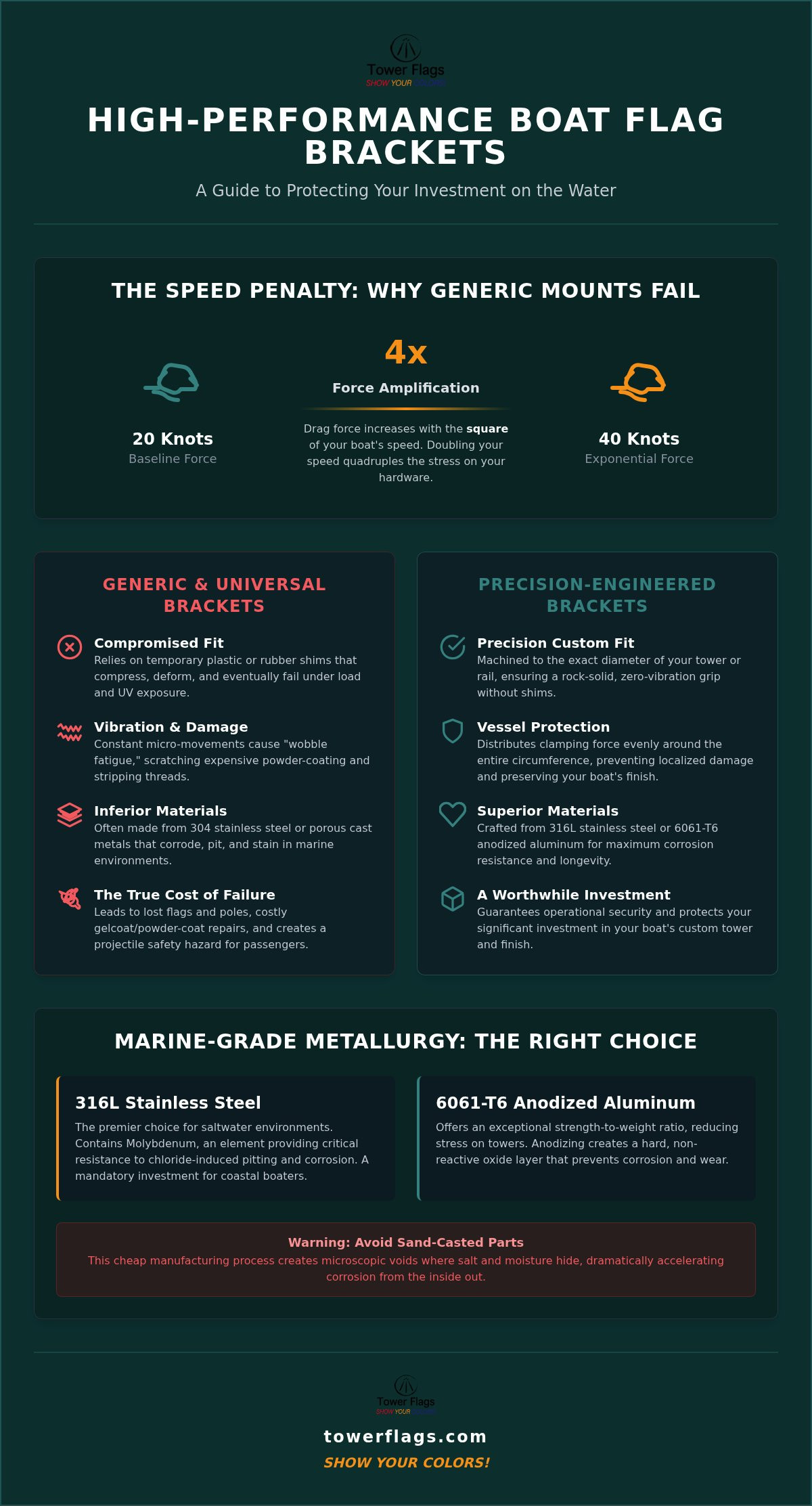
Most boaters treat a flag mount like a simple aesthetic choice. In reality, it's a mechanical engineering challenge. When you are choosing a custom boat flag bracket, you aren't just buying a holder; you're selecting a component that must withstand extreme aerodynamic loads. Mass-produced brackets often fail because they ignore the "Speed Penalty." This is a physics principle where drag force increases with the square of your boat's speed. If you double your speed from 20 to 40 knots, the force thrashing your flag hardware doesn't just double; it quadruples. This exponential pressure is why generic thumb-screws and set-bolts eventually back out, leaving your hardware at the bottom of the lake.
While following proper maritime flag etiquette is a mark of good seamanship, the hardware itself must be up to the task. Plastic mounts and universal brackets are a liability in high-performance settings. They rely on friction from rubber shims or plastic spacers that compress under load. Once these materials yield, vibration takes over. Constant engine harmonics and water slap create a cycle of micro-movements that strip threads and fatigue metal. A specialist mount eliminates these failure points by using exact geometries rather than "one-size-fits-all" compromises.
Understanding Drag and Mechanical Stress
A standard 12x18 inch boat flag has a surface area of 1.5 square feet. At cruising speeds, this fabric acts like a small sail, generating significant resistance. Because most flags are mounted at the highest point of a tower, this drag creates a long lever arm. This leverage amplifies the torque applied to the bracket base. If the fit isn't perfect, this torque causes "wobble fatigue." On aluminum towers, this constant movement can actually ovalize the mounting hole or wear through the powder-coating. Precision-engineered brackets distribute this stress across the entire circumference of the tube, preventing localized damage to your boat's structure.
The True Cost of Hardware Failure
The failure of a cheap bracket is rarely just about the mount itself. When a bracket lets go at 40 knots, it often takes an expensive custom flag and a carbon fiber pole with it. There is also a significant risk to your vessel's finish. A heavy metal mount tumbling down a tower can gouge gelcoat or deeply scratch expensive powder-coating, leading to repairs that cost hundreds more than a quality bracket. Most importantly, failing hardware is a safety risk. A flag pole or bracket becoming a projectile at high speeds poses a genuine danger to passengers in the cockpit or anyone being towed behind the boat. Investing in a rock-solid display isn't just about looks; it's about operational security.
Material Science: Choosing Hardware for the Marine Environment
The marine environment is a relentless testing ground for metallurgy. Retailers often slap a "marine-grade" label on products that aren't fit for a single season of salt air. When you're choosing a custom boat flag bracket, the distinction between 304 and 316 stainless steel determines whether your hardware stays bright or becomes a pitted, orange mess. While 304 stainless is common in freshwater applications, it lacks the molybdenum content found in 316L. This specific element provides the critical resistance needed to fight chloride-induced pitting. As of 2026, 316L stainless steel carries a 25 to 40 percent price premium over 304, but the longevity it provides for your tower or rails makes it a mandatory investment for coastal boaters.
Weight and balance are also essential considerations. High-performance towers benefit from 6061-T6 anodized aluminum, which offers an exceptional strength-to-weight ratio. This alloy is significantly lighter than steel, reducing the leverage stress on your tower during high-speed runs. However, raw aluminum is a liability; it must be anodized to create a hard, non-reactive oxide layer that prevents oxidation. Selecting precision-machined flag pole brackets ensures your hardware uses these high-performance alloys rather than cheap, porous castings that trap moisture and accelerate decay.
Metallurgy 101 for Boat Owners
Precision is the enemy of corrosion. Mass-produced brackets are often made through sand casting, a process that creates microscopic voids where salt and moisture hide. Precision machining from solid billet stock eliminates these vulnerabilities. This process allows for tighter tolerances, ensuring the bracket grips the tower tube perfectly without the need for thick, compressible rubber shims. In high-sun environments, even the non-metallic components must be scrutinized. Any gaskets or bushings should be made from UV-stabilized polymers to prevent the cracking and "chalking" that occurs with standard plastics after a few months of exposure.
Hardware and Fasteners: The Weakest Link
The bracket body is only as strong as the bolts holding it together. Zinc-plated hardware has no place on a boat; it will fail almost immediately when exposed to humidity. We use 316 stainless steel fasteners equipped with Nyloc nuts to ensure that engine vibrations don't back the hardware out. To protect your vessel, we emphasize the importance of galvanic isolation. This is a method of preventing tower corrosion by using non-conductive barriers to stop electrical contact between different types of metal. Without this isolation, a stainless steel bracket can actually pull ions out of an aluminum tower, leading to permanent structural damage and bubbling powder-coat finishes.
Custom Fit vs. Universal Brackets: Protecting Your Investment
Universal fit brackets are a compromise that rarely pays off. These mass-produced accessories rely on a "one-size-fits-none" philosophy, using a series of rubber shims or plastic spacers to bridge the gap between a generic clamp and your specific tower diameter. When you are choosing a custom boat flag bracket, you are moving away from these temporary fixes. Shims eventually compress, dry out, or slip under the intense vibration of a running engine. Once that internal spacer fails, the bracket loses its grip, leading to the hardware failures discussed earlier. A custom-engineered solution eliminates the need for fillers by matching the exact geometry of your vessel's hardware.
Modern wake towers, such as the Malibu G3 or Axis series, feature unique profiles that standard round clamps cannot accommodate securely. A custom bracket is designed to look like an original component of the boat rather than an afterthought. This aesthetic integration is achieved through precise manufacturing that follows the lines and angles of your tower legs. The result is a rock-solid display that maintains its position even when the boat is hitting heavy chop or executing tight turns at cruising speeds.
The Precision Fit Advantage
We use CNC machining to ensure a 360-degree contact patch on the tower tube. This total surface contact is vital for stability. Universal mounts often only touch the tower at two or three points, creating a "lever effect" that focuses all the flag's drag force onto a tiny area. By distributing this load across the entire circumference of the mounting point, custom brackets remain stable without requiring excessive tightening. This precision also allows for proper flag orientation. Because towers are often raked at aggressive angles, a custom mount is engineered to keep your flagpole vertical, ensuring your flag flies proud rather than sagging toward the water.
Protecting Your Tower's Finish
Your boat's tower is often its most visible feature, and protecting its powder-coated or anodized finish is a priority. Ill-fitting universal clamps are notorious for "walking" or vibrating against the tower surface. This movement acts like sandpaper, grinding away the protective coating and exposing the underlying metal to corrosion. We utilize specialized liners and precision-fit rings that prevent metal-on-metal contact. Because our custom brackets match the tube diameter exactly, they require significantly less torque to stay secure. You don't have to over-tighten the bolts to stop the mount from spinning, which reduces the risk of structural stress or crushing the thin-walled tubing common in modern high-performance towers.
The 5-Point Selection Framework for Your Vessel
Selecting the right hardware requires a methodical approach to ensure long-term stability and vessel safety. When you are choosing a custom boat flag bracket, you must move beyond the "looks good" phase and enter the engineering phase. This framework ensures your flag stays secured while protecting your boat's structural integrity. Following a systematic process prevents the common mistakes that lead to lost hardware or damaged towers.
Step 1: Identify your mounting location. Decide if the bracket will sit on a tower leg, a bow rail, or the transom. Each location experiences different vibration patterns and wind loads.
Step 2: Measure your tube diameter. Precision is non-negotiable. Use digital calipers to find the exact outer diameter of your mounting point rather than relying on manufacturer spec sheets.
Step 3: Determine cruising speed and flag size. High-speed runs with large flags create massive drag. Ensure your chosen bracket is rated for your boat's top-end performance.
Step 4: Evaluate material compatibility. As established, matching your bracket material to your tower or rail prevents galvanic corrosion and maintains the aesthetic.
Step 5: Verify clearance. Check for obstructions like bimini tops, board racks, or speakers that might interfere with the flag's flight path or the bracket's footprint.
Measuring for a Perfect Fit
Measuring a tapered tower leg requires focus. You must measure the exact spot where the bracket will be installed, as even a few inches of vertical movement can change the tube diameter on many wake boats. Common rail sizes differ significantly; pontoon rails are often square 1.25-inch tubes, while wake boat towers range from 1.9 to 3 inches. Don't forget to account for the thickness of your powder coating. A heavy coat can add nearly 0.010 inches to the diameter, which is enough to make a precision-machined bracket feel too tight if not considered during the selection process.
Matching the Bracket to the Pole
The connection between your bracket and pole is a critical failure point. Socket depth is the most important factor for high-speed retention; a shallow socket allows the pole to "walk" out under heavy vibration. Most high-end marine flag poles utilize either a 1-inch or 1.25-inch diameter. Ensure your bracket's internal diameter matches your pole exactly to eliminate any internal play. If you are ready to upgrade your setup, you can order custom-fit flag pole brackets designed for your specific boat model today.
Engineering Your Display with Tower Flags Precision Brackets
Generic, off-the-shelf brackets are the weak link in an otherwise high-performance vessel. They are designed for a price point, not for the structural demands of a boat running at 40 knots. We founded Tower Flags to eliminate the common frustrations boaters face with mass-produced hardware that sags, spins, or ruins expensive tower finishes. When you are choosing a custom boat flag bracket from our workshop, you're investing in a component that mirrors the engineering standards of your boat's manufacturer. Our hardware provides a rock-solid mounting point that holds its position through heavy chop and high-speed transit, ensuring your display remains as flawless as your boat's gelcoat.
Performance boaters choose our precision-engineered mounts because they understand that "universal" is a synonym for compromise. We utilize advanced manufacturing techniques to create brackets that integrate seamlessly with modern wakeboard towers. Whether your boat features a specialized geometry or a standard rail, our custom-fabricated marine accessories provide a perfect fit without the need for drilling or permanent modifications. This commitment to precision ensures that your flag flies proud and vertical, maintaining the aesthetic integrity of your vessel while providing the mechanical security required for the open water.
The Tower Flags Difference
Our engineering process focuses on the fine details of fit and finish. We specialize in custom-engineered fitment for high-end marine vessels, utilizing materials like 316L stainless steel and 6061-T6 anodized aluminum to ensure maximum longevity. For owners of specialized boats like the 2022-2026 Nautique series, we even offer custom carbon fiber composite brackets that provide a 30 to 50 percent weight reduction compared to traditional metal structures. Our typical turnaround time for a custom-designed bracket is just 2 to 3 days after we receive your measurements. You can explore our full range of custom boat flag brackets to see how we solve the specific challenges of high-speed flag mounting.
Ready to Secure Your Style?
Upgrading your hardware provides the peace of mind that comes with engineered reliability. You no longer have to worry about your flagpole vibrating loose or your bracket acting like sandpaper on your tower's powder-coating. Our collection of flag pole brackets is designed to be the final hardware you'll ever need for your boat. It's time to move past the temporary fixes of shims and spacers. You can browse our precision flag accessories today and experience the difference that American-made quality and specialized engineering bring to your boating experience. Secure your flag with the confidence of a master craftsman.
Elevate Your Vessel with Precision Engineering
Choosing a custom boat flag bracket is the final step in aligning your hardware with the high-performance standards of your boat. You now understand how drag forces increase exponentially at cruising speeds and why generic, mass-produced mounts are a liability for your tower's finish. By prioritizing 316L stainless steel and exact tube geometries, you eliminate the vibration and corrosion that plague inferior alternatives. These specialized custom-fit designs provide the structural integrity required to protect your investment.
Our hardware is high-speed performance tested to withstand the rigors of the open water while maintaining marine-grade durability. It is time to stop settling for universal compromises that act like sandpaper on your powder-coating. Upgrading to a professional mounting solution ensures that your flag flies proud without risking damage to your boat's aesthetic or structural components. It is a simple modification that yields significant results in both security and style.
Ready to secure your display with a rock-solid mount? Shop Precision-Engineered Boat Flag Brackets today and experience the peace of mind that comes with American-made quality. Your boat is a masterpiece; ensure every accessory reflects that level of craftsmanship.
Frequently Asked Questions
Will a universal boat flag pole bracket fit my wakeboard tower?
Universal brackets rarely provide a secure fit on modern wakeboard towers. These mounts rely on compressible rubber shims or plastic spacers that inevitably slip under high wind loads or engine vibration. Wakeboard towers often feature non-standard diameters or tapered geometries that "one-size-fits-all" hardware cannot accommodate. Choosing a custom boat flag bracket ensures the hardware matches your tower's exact specifications, preventing the mount from spinning or falling off during high-speed transit.
What is the best material for a boat flag pole mounting bracket?
Marine-grade 316L stainless steel and 6061-T6 anodized aluminum are the superior choices for the marine environment. 316L stainless steel contains molybdenum, which provides essential resistance against chloride-induced pitting in saltwater. Anodized aluminum offers an exceptional strength-to-weight ratio, which is ideal for reducing the leverage stress on tower structures. You should avoid zinc-plated steel or low-grade plastics, as these materials fail quickly when exposed to UV rays and constant humidity.
Do I need to drill holes in my boat tower to install a flag bracket?
You should not have to drill into your tower to secure a flag. High-quality custom brackets utilize a clamp-on design that grips the tower tube with precision-machined tolerances. This method maintains the structural integrity of your vessel while allowing for easy adjustments or removal. Drilling holes can weaken the aluminum structure and potentially void manufacturer warranties, making a non-destructive, bolt-on mounting solution the preferred choice for performance boaters who value their vessel.
How do I prevent my boat flag from spinning or tangling at high speeds?
Preventing tangles requires a combination of high-tension clips and a rock-solid mounting angle. When you are choosing a custom boat flag bracket, ensure it features a secure socket depth that holds the pole at a consistent vertical or raked position. This stability allows the flag to stream out cleanly without oscillating. Using anti-wrap sleeves or weighted flag ends can also help maintain the display's integrity when cruising at speeds above 30 knots.
Can I use a rail mount on a tapered wakeboard tower?
Standard rail mounts are designed for consistent 1-inch or 1.25-inch diameters and will fail on a tapered tower leg. Tapered legs change diameter along their length, requiring a bracket machined to fit that specific vertical location perfectly. Using a generic rail mount on a taper results in a loose fit that vibrates against the finish. A custom-engineered bracket is necessary to achieve the 360-degree contact patch required for safety and stability on tapered geometries.
What size flag pole bracket do I need for a 1-inch flag pole?
You need a bracket with an internal socket diameter of exactly 1 inch to ensure a snug, vibration-free fit. Any internal "play" or gap between the pole and the bracket socket will lead to excessive mechanical stress and potential pole loss at high speeds. Most performance flag poles utilize a 1-inch or 1.25-inch outer diameter. Always verify your pole's measurement with digital calipers before ordering to ensure the mechanical lock is absolute.
How do I protect my boat's powder-coated tower from bracket scratches?
Protection starts with a precision fit that eliminates all micro-movements. Scratches occur when a loose or poorly sized bracket "walks" against the tower surface during vibration. We use specialized non-marring liners and precision-machined rings that distribute clamping force evenly without metal-on-metal contact. Custom brackets require significantly less torque to stay secure, which prevents the "crushing" effect that often damages powder-coating when boaters attempt to over-tighten ill-fitting universal hardware.
Is stainless steel or anodized aluminum better for saltwater flag mounts?
Both are excellent, but 316L stainless steel remains the gold standard for maximum corrosion resistance in saltwater. It is heavier than aluminum but virtually immune to the pitting that destroys lesser metals over time. Anodized aluminum is a great lightweight alternative, provided the anodizing is high-quality and thick enough to withstand salt spray. For high-performance wake towers, the weight savings of aluminum often make it the most attractive choice for maintaining tower balance.


Comments