

Ultimate Guide to Custom Boat Flag Brackets 2026
Updated: Aug 14
A universal boat mount isn't a "one size fits all" solution. It's a compromise that risks your equipment every time you hit the throttle. Most boaters have experienced the frustration of a generic bracket slipping down the tower or a plastic mount snapping under the pressure of a 40 mph wind load. These failures don't just lose your flag; they often leave permanent scars on your tower's expensive powder coat.
We understand that your boat deserves better than mass-produced hardware that corrodes in saltwater environments. This guide focuses on the technical superiority of custom boat flag brackets. These precision-engineered components are designed to look like they came from the factory while providing a rock-solid grip that never shifts. You'll learn how American-made fabrication using high-grade 6061 aluminum solves the common pains of slippage and hardware failure. We will also preview the latest 2026 trends in marine customization and the specific engineering standards required to keep your flags secure at high speeds. By the end of this article, you'll know exactly how to achieve a secure, craftsman-level mount that lasts for seasons to come.
Table of Contents
The Engineering Behind Custom Boat Flag Brackets
Custom boat flag brackets are precision-machined mechanical components designed for specific tower geometries. They aren't generic clips or printed novelties. Instead, these brackets are engineered to match the exact diameter and taper of your boat's tower tubes. This precision ensures a total contact surface area that generic hardware cannot replicate. When a bracket fits perfectly, the clamping force is distributed evenly across the metal rather than concentrating on a single stress point. This engineering approach achieves a factory-installed look that complements the lines of a high-end vessel.
The term "Universal Fit" is a misnomer in the marine industry. Most universal clamps use a series of plastic spacers or oversized bolts to bridge the gap between different tube sizes. These compromises lead to slippage, especially when the boat is underway. While adhering to maritime flag regulations and etiquette is essential for any serious captain, the hardware used to display those flags must be as reliable as the boat's own engine. Proper custom fabrication eliminates the guesswork and the risk of a flag pole becoming a projectile at high speeds.
Why Precision Fit Matters for Performance Boats
Performance boats face a unique combination of high-frequency vibration and intense wind resistance. A standard 3x5 flag creates a massive amount of drag at 40 mph. If the mounting bracket has even a millimeter of play, that drag turns into a violent vibration. A loose bracket doesn't just slip; it acts as an abrasive against your boat's powder-coated or painted tower. Custom-engineered solutions utilize specific bushings and gaskets that provide a "soft" grip on the tower while maintaining a "hard" mechanical lock. This prevents the metal-on-metal contact that ruins resale value and ensures the mount remains exactly where you installed it, regardless of the conditions.
The Limitations of Generic Marine Hardware
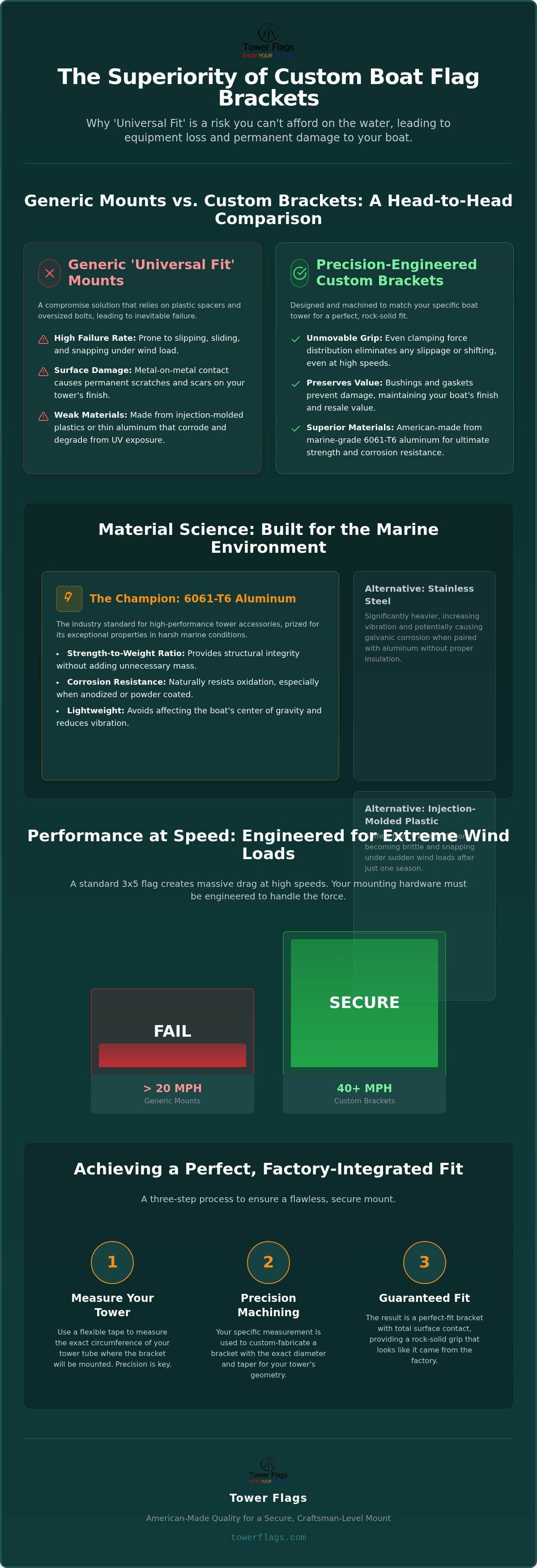
Mass-produced marine hardware typically relies on injection-molded plastics or thin, stamped aluminum. These materials are the primary failure points in the display chain. Plastic mounts suffer from UV degradation, becoming brittle after just one season in the sun. They often snap under the sudden wind load of a sharp turn or a gust of wind. Generic clamps also struggle to hold at speeds over 20 mph, often sliding down the tower leg the moment you get on plane. The long-term cost of replacing lost flags and cheap hardware far exceeds the initial investment in a custom boat flag brackets solution. Choosing American-made quality means you buy the hardware once and never worry about it again.
Selecting the Best Materials for Marine Mounting Hardware
Marine environments are unforgiving. Between the constant exposure to UV rays and the corrosive nature of salt spray, every component on your boat tower must be built to survive. We prioritize 6061-T6 aluminum for our custom boat flag brackets because of its exceptional strength-to-weight ratio. This specific alloy provides the structural integrity needed to withstand high wind loads without adding unnecessary mass to your tower. Marine-grade aluminum is the industry standard for high-performance tower accessories.
Corrosion resistance is the primary factor that separates professional hardware from generic alternatives. In freshwater, the risk is lower, but saltwater environments will quickly oxidize inferior metals. To combat this, high-quality hardware relies on specialized finishes. Anodizing creates an electrochemical layer that becomes part of the metal itself, providing a hard, scratch-resistant surface. Powder coating offers a thicker protective shell that is often preferred for its superior UV protection and ability to match factory tower colors. For those seeking hardware that survives the salt, exploring specialized flag pole brackets ensures you get the right material for your environment.
Anodized Aluminum vs. Stainless Steel
While stainless steel is known for its strength, it is significantly heavier than aluminum. On a boat tower, excess weight can affect the center of gravity and increase vibration. Aluminum is the agile choice, providing ample strength while remaining lightweight. However, mixing metals can lead to galvanic corrosion. This occurs when stainless steel bolts are used in aluminum brackets without proper insulation. We mitigate this by using specific hardware coatings or barriers to ensure the two metals don't react. Maintenance for anodized aluminum is simple; a quick rinse with fresh water after a day on the lake is usually all that's required to keep the finish looking new.
The Role of UV-Resistant Internal Liners
The internal liner is a small detail with a massive impact. High-quality liners prevent metal-on-metal contact, which is the leading cause of tower scratches and "chatter" during operation. Cheap rubber liners are a liability because they degrade under intense UV exposure. As they break down, they often "bleed" black streaks onto white boat towers, leaving stains that are difficult to remove. Our engineering process utilizes custom-molded, UV-stabilized inserts. These liners maintain their shape and grip for years, providing a consistent cushion that absorbs vibration and protects your tower's finish from the mechanical stress of the bracket.
Measuring Your Boat Tower for a Perfect Fit
Achieving a factory-installed look requires more than a visual estimate. Because towers are often custom-built for specific boat models, their geometries vary significantly. While some manufacturers utilize standard round tubing, others opt for oval profiles or proprietary designs like the Malibu G3. Identifying your specific tower model is the first step in selecting custom boat flag brackets that won't fail. Placement is equally critical; you should position your bracket on a straight section of the tower leg where it won't interfere with navigation lights, bimini tops, or internal wiring routes.
Precision is the difference between a secure mount and a damaged tower. Generic hardware often relies on guesswork, but a specialist approach uses exact measurements to create a mechanical lock. Before ordering, confirm the clearance around your chosen mounting point. You'll want to ensure the flag can fly freely without tangling in tower speakers or tow points. Choosing the right location now prevents frustration on the water later.
How to Measure Tower Diameter Correctly
Precision starts with a simple measurement. Follow these three steps to ensure your hardware fits perfectly the first time:
Identify the mounting location: Choose a spot on the tower leg that is free from obstructions. Ensure there is enough vertical clearance for the flag to fly freely at high speeds.
Calculate the diameter: If you don't have calipers, use a soft tape measure or a piece of string to find the circumference. Wrap it tightly around the tube and mark the meeting point. Divide that circumference by 3.14 (pi) to find your exact diameter.
Check for taper: Many modern towers are tapered, meaning they are thicker at the base than at the top. Measure the exact spot where you intend to mount the bracket rather than relying on a measurement from a different section.
Matching Brackets to Specific Boat Brands
Industry leaders like MasterCraft, Nautique, and Moomba often use standardized diameters for their round-tube towers, typically ranging between 1.5 and 2.5 inches. However, assuming a standard size is a risk. For boats with non-cylindrical towers, such as the cast aluminum designs found on late-model wake boats, a standard clamp simply cannot provide a secure grip. These "wing" style towers require specialized machining to match the unique flat or curved surfaces of the metal. If your tower has a proprietary shape, View our specific tower fitment guides at Tower Flags to find the exact match for your vessel. Using custom boat flag brackets engineered for these specific profiles ensures your hardware remains rock-solid at any speed.
Performance at Speed: Ensuring Your Flag Stays Secure
Speed changes the mechanical requirements of your hardware. While a flag looks majestic at the sandbar, it becomes a high-drag sail the moment you push the throttle forward. A standard 3x5 flag generates significant aerodynamic load that increases exponentially as you accelerate. At 20 mph, the drag is manageable for most mounts; however, at 40 mph, that force is four times as strong. This is the point where generic hardware typically fails. The custom boat flag brackets we manufacture are designed specifically to handle these high-velocity environments by providing a total mechanical lock on the tower.
The bracket is the most critical link in your display chain. If the mount fails at high speed, the bracket and pole can become dangerous projectiles. This creates a severe safety risk for passengers and can cause thousands of dollars in damage to your gelcoat or upholstery. Investing in precision-engineered hardware isn't just about aesthetics; it's about ensuring that your equipment remains part of the boat rather than a liability. To maintain peak performance, upgrade your setup with professional-grade flag pole brackets that are built to withstand the rigors of performance boating.
Physics of the "Kite Effect" on Boat Towers
The "kite effect" occurs when wind drag applies constant rearward pressure on the flag pole. This pressure creates a massive amount of torque at the mounting point. During sharp turns or when crossing wakes, lateral forces add even more stress to the bracket. Mass-produced clamps often pivot or slide under this load because they rely on friction alone. In contrast, custom-fabricated brackets distribute the aerodynamic load across the entire circumference of the tower leg. This distribution prevents the "lever effect" from focusing all the energy on a single bolt or plastic clip, ensuring the hardware stays exactly where you installed it.
Best Practices for High-Speed Flag Display
Maintaining a secure display requires a combination of high-quality hardware and sensible operation. Follow these guidelines to protect your boat and your flags:
Size your flag appropriately: For speeds over 30 mph, consider a smaller flag (such as 12x18 inches) to reduce drag, or ensure you are using custom boat flag brackets rated for 3x5 displays.
Perform a pre-departure inspection: Before leaving the dock, check that all mounting bolts are tightened to specification and inspect the internal liner for any signs of compression or wear.
Use heavy-duty poles: A custom bracket is only as strong as the pole it holds. Ensure your flag pole is made of a compatible high-strength material that won't flex or snap under load.
Stow flags during long hauls: If you're traveling long distances at maximum speed or trailering the boat, removing the flag will preserve the fabric and reduce unnecessary stress on the tower.
Why Custom Fabricated Solutions Define the Modern Boating Experience
Modern boating is about more than just utility; it's an expression of standards. When you choose custom boat flag brackets, you're rejecting the "good enough" culture of mass-produced accessories. These solutions represent a commitment to American craftsmanship and mechanical integrity. A custom mount looks like it belongs on the boat because it was engineered for that exact purpose. Beyond the visual appeal, high-quality hardware preserves the resale value of your vessel by preventing the structural and cosmetic damage common with inferior clamps.
Veteran boaters often live by the "buy once, cry once" philosophy. Investing in a specialized bracket today prevents the recurring costs of replacing lost flags, snapped plastic mounts, or repairing a marred tower finish. It's a pragmatic approach to luxury. For owners who value aesthetics, a precision-fit mount serves as a point of pride, much like how a signature scent from TONY TORPEDO completes a refined personal style. It signals that every detail of the boat, down to the flag hardware, has been selected for its performance and durability. This specialized focus ensures that your accessories never look like an afterthought.
The Tower Flags Difference: From Workshop to Water
Our Dallas-based workshop operates with the mindset of a dedicated specialist. We don't outsource our manufacturing to distant factories; instead, we maintain total control over every stage of the custom fabrication process. This direct-to-consumer model allows us to implement customer feedback quickly and ensure that every piece of hardware meets our exact standards for fit and finish. When you order directly from the fabricator, you gain a product that has been tested in real-world marine conditions. This evolution in design ensures that our hardware remains at the forefront of the industry.
Completing Your Setup: Brackets, Poles, and Flags
To complete your boat's aesthetic, Banner 4 Sale offers custom-printed flags and banners with fast turnaround times, ensuring that your high-quality mounting hardware is paired with equally impressive graphics.
A truly professional display requires a holistic approach. While the bracket is the foundation, pairing it with high-strength flag poles and premium flags ensures the entire system functions as a single, durable unit. This synergy provides the best visual results and the longest lifespan for your equipment. We also offer gift cards, which are an ideal choice for fellow boaters who take pride in their vessel's appearance. To get started on a setup that won't fail, Shop our full collection of custom boat flag brackets at Tower Flags and experience the difference that precision engineering makes on the water.
Secure Your Display for the Seasons Ahead
Choosing the right hardware is a direct investment in your boat's longevity and performance. We've seen how universal mounts lead to tower damage and equipment loss; whereas, precision-engineered custom boat flag brackets provide the mechanical lock needed for high-speed operation. By utilizing heavy-duty marine-grade aluminum and custom-fit geometries, you eliminate the vibration and slippage that plague generic alternatives. These aren't just accessories; they're craftsman-level components built to match the standards of your vessel.
Every bracket we produce is American-made in our Dallas, Texas workshop to ensure it meets our strict requirements for fit and finish. Whether you're navigating saltwater spray or pushing for maximum speed on the lake, our hardware remains rock-solid. Don't settle for "good enough" when you can have a solution designed specifically for your tower model. Upgrade your tower with precision-engineered flag brackets from Tower Flags today. We look forward to helping you fly your flags with total confidence and functional elegance.
Frequently Asked Questions
Will a custom boat flag bracket fit my specific wakeboard tower?
Yes, we engineer our custom boat flag brackets to match the precise diameter and profile of specific tower models. Unlike universal clamps, these brackets are machined to account for the unique tapers and geometries found on major boat brands. This ensures a factory-level fit that provides a total mechanical lock. If your tower features a non-standard shape, a custom-fabricated solution is the only reliable way to ensure a secure, permanent mount.
How do I prevent my flag bracket from scratching the towers powder coat?
Preventing damage to your tower's finish requires the use of high-quality, UV-stabilized internal liners. These inserts create a protective barrier that eliminates metal-on-metal contact. By distributing the clamping force across the entire surface area of the liner, the bracket stays secure without biting into the powder coat. Cheap rubber spacers often degrade and stain white towers; we utilize custom-molded bushings that maintain their physical integrity over years of sun exposure.
Can I leave my flag mounted while towing my boat on the highway?
You should always remove your flag and pole before towing your boat on the highway. Wind speeds at 70 mph, combined with the turbulence behind a tow vehicle, create extreme drag that far exceeds typical on-water conditions. This "kite effect" can cause even the strongest bracket to shift or the flag fabric to shred. Stowing your hardware during transit preserves the life of the flag and prevents unnecessary mechanical stress on your boat tower.
What is the best material for a boat flag bracket in saltwater?
Anodized 6061-T6 aluminum is the superior choice for saltwater environments due to its high strength-to-weight ratio and excellent corrosion resistance. While 316 stainless steel is also effective, it's significantly heavier and can contribute to galvanic corrosion if not properly insulated. Anodized aluminum creates a protective oxide layer that is chemically bonded to the metal, ensuring the hardware won't pit or oxidize when exposed to constant salt spray and UV radiation.
Why is my universal flag mount slipping down the tower leg?
Universal mounts slip because they rely on generic spacers that fail to provide adequate contact surface area. These "one size fits all" designs often use flexible plastic shims that compress or shift under the wind load of a flying flag. As the boat vibrates at speed, the friction lock fails, causing the bracket to slide down the tower leg. Switching to custom boat flag brackets solves this by providing a rigid, precision-machined fit.
How do I measure the diameter of an oval boat tower?
Measuring an oval tower requires using a pair of calipers to find the widest and narrowest points of the tube. If you don't have calipers, wrap a flexible tape measure around the tube to find the total circumference. For proprietary shapes like the Malibu G3, it's often more accurate to identify the tower model directly from the manufacturer's specifications. This data allows for the fabrication of a bracket that matches the specific curvature of the metal.
What size flag is safe to fly at wakeboarding speeds?
A 12x18 inch flag is the safest choice for typical wakeboarding speeds between 18 and 24 mph. While our custom boat flag brackets are engineered to handle the load of a larger 3x5 flag, the increased drag of a bigger display can affect the boat's handling and put more stress on the tower. If you choose to fly a larger ensign, ensure your mounting hardware is rated for high-velocity wind loads to prevent mechanical failure.
Do custom boat flag brackets come with all necessary mounting hardware?
Yes, our precision-fit brackets are shipped as complete kits with all the necessary stainless steel mounting hardware included. We provide the specific bolts and internal liners required for your chosen tower model to ensure a seamless installation process. Every component is selected for its marine-grade durability and compatibility with our 6061 aluminum bodies. This eliminates the need for hardware store runs and ensures the mechanical integrity of the entire display system.


Comments