

Wake Tower Flag Mount: How to Choose the Right Fit
The flag may be the easiest part to choose. The wake tower flag mount determines whether the setup suits your boat, because tubing diameter and shape can make a generic holder a poor fit. A bracket that doesn’t sit securely may loosen or get in the way when you use the tower.
Compare mounts by fit, adjustment needs, and how they accommodate your flag and pole. Fit comes first. This guide explains which tower details to compare, how broadly marketed holders differ from custom-fit mounting hardware, and how to match a mount to your flag and boating habits.
You’ll learn what to measure, why the tower’s shape and available mounting space matter, and what information to gather when selecting custom hardware. With those details in hand, you can narrow the options to a practical setup designed around your tower rather than relying on a fit label alone.
Table of Contents
Why Wake Tower Flag Mount Fit Matters Before You Buy
A wake tower flag mount is the hardware that secures a flag setup to a boat’s wake tower. Its job is to connect the tower to the flagpole, and that connection needs to suit the tower’s shape and dimensions. A bracket designed for round tubing may not sit properly on an oval or angled section. Even a clamp that fits the tube may be impractical if there isn’t enough room to position it.
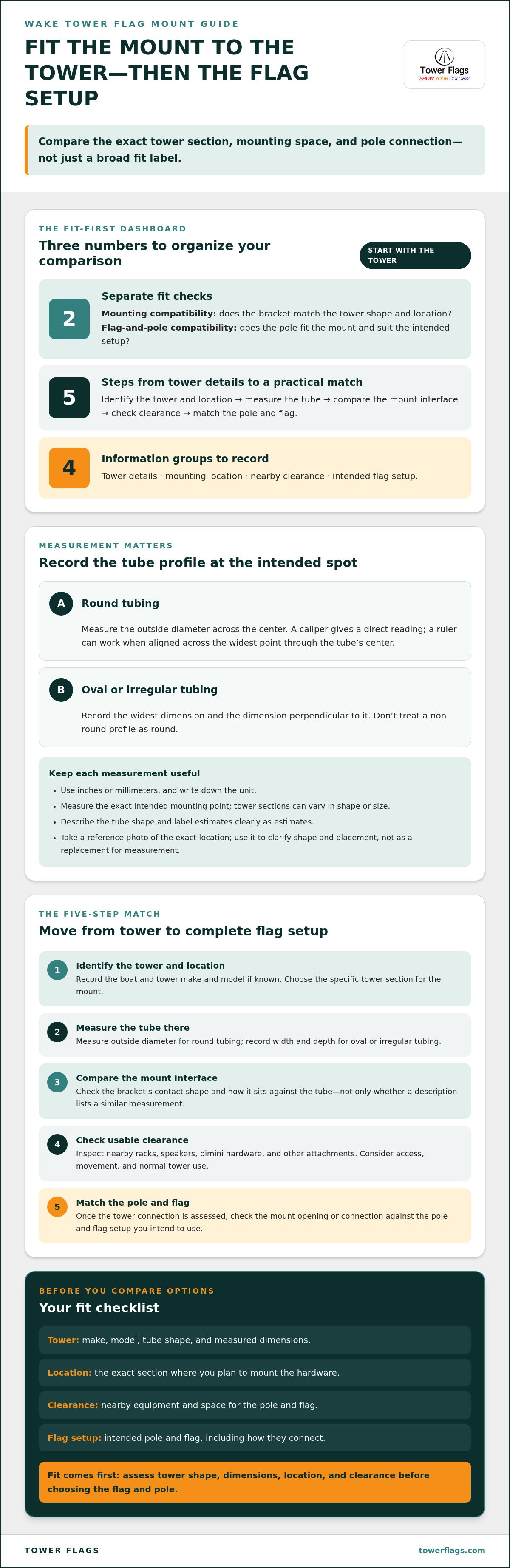
Think of fit as two separate checks. Mounting compatibility asks whether the bracket’s interface matches the tower and whether the chosen location has room for it. Flag and pole compatibility asks whether the pole fits the mount and the flag suits the intended setup. A close match on one side doesn’t settle the other. General information about a flagpole can clarify the pole’s role, but the tower-to-bracket connection still needs its own assessment.
Fit-first selection means matching the mount to the tower’s shape, dimensions, location, and clearance before choosing the flag and pole. This order makes comparisons more useful. Instead of relying on a broad fit label, evaluate the actual mounting interface and the complete flag setup.
What makes a wake tower mount different from a general boat holder?
A wake tower isn’t the same mounting surface as a deck, rail, or other boat structure. Each has a different profile, orientation, and surrounding hardware. A bracket intended for a rail may rely on a different contact area or mounting direction than a tower clamp. Even if both are described as general-purpose holders, that wording doesn’t show whether the hardware matches your tower’s tube shape, diameter, or available space.
Focus on the interface: where and how the bracket contacts the boat, which part of the tower it’s designed to fit, and how the pole sits once attached. A fit label is a starting point, not a substitute for comparing those details.
Which details should you identify before comparing mounts?
Start with the tower make and model, then identify the exact tube and location you’re considering. Record the tube’s shape and dimensions, and note whether the surface is straight, curved, or angled where the bracket would sit. Measure the intended area rather than assuming every section of the tower is identical.
Tower: Make, model, tube shape, and measured dimensions.
Location: The specific section where you plan to mount the hardware.
Clearance: Nearby racks, speakers, bimini hardware, and other potential obstructions.
Flag setup: The pole and flag you intend to use, including how they connect.
Keep confirmed measurements separate from estimates. If a dimension is approximate, label it clearly rather than treating it as exact. These records give you a reliable basis for comparing a broadly marketed holder with custom-engineered hardware, and help identify which details need a more precise measurement before you decide.
How to Match a Wake Tower Flag Mount to Your Tower
Use this sequence to turn tower details into a practical comparison. Match the mount’s contact surface and dimensions to the exact place you plan to use it, then check that the flag setup fits the available space.
Identify the tower and location. Record the boat and tower make and model if known. Choose the specific tower section for the mount, since tubing can vary in shape or size from one area to another.
Measure the tube at that spot. For round tubing, measure its outside diameter across the center. For oval or irregular tubing, record the width and depth instead of treating it as round. Use inches or millimeters, and note the unit.
Compare the mount interface. Check whether the mounting surface and contact shape correspond to the tower section. Consider how the bracket sits against the tube, not just whether a product description includes a similar measurement.
Check usable clearance. Look at nearby accessories and the space needed for the pole and flag. Consider access and movement during normal boat and tower use.
Match the pole and flag. After checking the tower connection, compare the mount opening or connection with the pole and flag setup you intend to use.
How do you measure tower tubing for a flag mount?
Measure the outside of the tube at the intended mounting point. A caliper can provide a direct diameter reading on round tubing. A ruler can also work if you align it across the widest point through the tube’s center. For a non-round profile, record both the widest dimension and the dimension perpendicular to it. Don’t substitute a nearby measurement if the target section changes shape or size.
Write down the result with its unit, describe the tube shape, and take a clear reference photo showing the exact location. A photo can help distinguish a straight section from a curved or angled one, but it doesn’t replace the measurement. Mark estimates as estimates so they aren’t mistaken for confirmed dimensions during comparison.
How can you check clearance and placement?
Inspect the proposed area alongside racks, speakers, bimini hardware, and other attachments. Consider whether the bracket or flagpole could obstruct access, conflict with nearby equipment, or affect how you use the tower. Think about the flag setup’s movement and visibility from the positions where it needs to be seen. There’s no single correct mounting position for every tower layout, so assess the actual space on your boat.
Before selecting a mount, gather the tower make and model, exact mounting location, tube shape and measured dimensions, nearby clearance, and pole-and-flag details. These are useful starting points when comparing custom boat flag brackets with your tower’s geometry and intended setup.
Wake Tower Flag Mount Options: Compare Fit, Flexibility, and Use
Mount styles differ in how closely they’re designed around a tower and how much adjustment they may require. A broadly marketed universal-style holder may appeal when flexibility is the priority, while custom-fit hardware can suit a specific tower profile and mounting location. Neither approach is automatically right for every boat. Compare the interface, the information available, and the setup you intend to use.
When does a custom-fit wake tower flag mount make sense?
A custom-fit approach makes sense when tower dimensions, tube profile, or the intended mounting position don’t align neatly with a general product description. It can also help when you have measurements but can’t confidently map them to a broad compatibility label. The more the tower’s specific geometry shapes the decision, the more useful it is to compare hardware against those details.
Tower Flags designs and manufactures custom-engineered marine flag hardware, including brackets and poles. For a wider look at bracket styles and selection considerations, read this custom boat flag bracket guide.
What trade-offs should you consider with universal-style holders?
Broad compatibility can reduce the need to find hardware described for one exact tower, but the fit still depends on the actual interface. A holder’s adjustment range, contact shape, and stated tubing dimensions all matter. If those details don’t describe your mounting point, the word “universal” doesn’t resolve the uncertainty. Tower Flags focuses on custom marine flag hardware designed around specific mounting needs.
Consider whether you’re comfortable comparing adjustment requirements against your tower’s geometry, or whether a more specific fit is the priority. For a separate discussion of speed-related considerations, read the high-speed wakeboard tower flag mount guide. Choose based on verified fit information and intended use, not the label alone.
Use This Wake Tower Flag Mount Checklist Before Ordering
A little preparation makes product comparisons more precise. Before choosing a wake tower flag mount, collect details about the tower, the exact mounting area, the space around it, and the flag setup you plan to use. Then compare your notes with the specific dimensions and compatibility information for each mount. A brand name or general fit label isn’t a substitute for matching the hardware to the actual mounting point.
What information should you have ready when selecting a mount?
Build a short reference record for your boat. Include the tower make and model, measurements taken at the intended mounting area, and a clear photo showing the tube profile and nearby hardware. If the tube shape changes along the tower, make sure the measurement and photo correspond to the same location. Note the measurement units and identify any estimate as approximate.
Tower details: Make, model, tube shape, and confirmed dimensions at the planned mounting point.
Mounting area: The specific section you’re considering and its usable space.
Nearby equipment: Racks, speakers, bimini hardware, and anything else that could affect clearance or access.
Flag setup: The pole and flag you intend to pair with the mount, along with any relevant connection dimensions you can verify.
For placement considerations, the wake tower flag mount placement guide can help you think through how the chosen area fits the layout of your boat. Keep the notes together so each option is judged against the same reference, not against memory or an assumed measurement.
How can you avoid common buying mismatches?
Start with the exact tower configuration. A boat or tower brand alone doesn’t establish that every model, year, or configuration has the same tube profile or usable mounting space. Likewise, matching a stated tube diameter is only one part of fit. The mount’s contact shape and intended interface also need to correspond to the selected section of tower.
Before ordering, compare your confirmed dimensions with the specific mount information shown for purchase. Check that the shape, measurement, and proposed location align with what’s described. If your notes rely on a rough estimate, or a photo suggests the tube changes near the mounting area, resolve that uncertainty before narrowing your options. This keeps an apparent match from resting on a measurement taken somewhere else on the tower.
Use your tower identification, measured mounting area, clearance notes, and flag setup to compare options systematically. Review custom boat flag hardware with those details in mind.
Choose Custom Wake Tower Flag Hardware from Tower Flags
Choosing a wake tower flag mount comes down to more than finding a bracket that appears close in size. The tower’s make and model, mounting location, available clearance, and flag-and-pole setup all shape what makes sense for your boat. Keep those details together as you compare options, and use the product information to assess how each setup corresponds to your intended use.
What does Tower Flags bring to a custom mount decision?
Tower Flags specializes in custom marine flag hardware, designing and manufacturing boat flag brackets and poles for owners who need to account for their vessel’s specific mounting details. A careful record of your tower and planned location gives you a concrete basis for evaluating custom-fit solutions, rather than relying on a broad compatibility label that may not describe your configuration.
The flag setup matters too. Think about the pole and flag you plan to use, where the mount will sit, and how nearby tower equipment affects the available space. These details help frame the decision as a complete setup, not just a bracket choice. Tower Flags’ custom-engineered flag accessories are available to order directly through the online store.
What is the next step after narrowing your options?
Review the relevant flag bracket and pole categories in the store, then compare the product details with your recorded tower measurements and placement notes. Look for information that corresponds to the mounting interface and flag setup you intend to use. If a detail is unclear in your own notes, refine the measurement before treating a potential match as certain.
A practical final review can help keep the decision focused:
Tower: Confirm the make, model, tube shape, and dimensions for the selected area.
Placement: Revisit clearance around racks, speakers, bimini hardware, and other equipment.
Flag setup: Compare the intended pole and flag with the connection details provided for the bracket.
Use: Consider how the location fits your routine and access to the tower and flag setup.
This fit-first approach gives you a clearer basis for selecting custom boat flag hardware and helps bring the bracket, pole, and flag together as one considered setup. Review Tower Flags marine hardware alongside your measurements and placement notes.
Make Your Next Flag Setup a Considered Choice
Your tower’s configuration is part of what makes your boat distinctive, so your flag setup should feel like a deliberate fit rather than an afterthought. As you choose a wake tower flag mount, consider how the finished setup will look and function in your regular boating routine. A well-matched bracket and pole bring the practical details together with the flag you want to fly.
For boat owners seeking hardware shaped around marine use, Tower Flags designs and manufactures custom flag brackets and poles, with mounting solutions tailored to vessels. Browse the available options with your tower notes in hand, and compare product details with your intended setup before choosing.
Explore custom marine flag hardware from Tower Flags and choose a setup that suits your boat.
Frequently Asked Questions
Can a universal flag holder fit every wakeboard tower?
No. “Universal” describes broad intended compatibility, not a verified match for every wakeboard tower. A clamp may cover a range of round tube diameters yet differ from a tower’s profile or mounting interface. Compare the holder’s stated dimensions and contact design with the exact section you plan to use. Then check clearance around racks and bimini hardware. Treat the label as a starting point, not proof of fit.
How do I measure a wake tower for a flag mount?
Measure the outside diameter at the exact intended mounting point on round tubing. For shaped tubing, record its relevant width and depth instead. Use a consistent unit, such as inches or millimeters, and note the tower model and location. Another section may have different dimensions. Keep a clear reference photo and record nearby accessories that could affect clearance. The photo also helps you identify which section you measured when comparing options later.
Can I install a wake tower flag mount without drilling?
It depends on the specific mount design and how it interfaces with the tower. Some hardware may attach differently from other designs, so don’t assume every holder clamps on or that every option requires drilling. Review the product’s installation information for the particular mount before making a selection. Checking whether a mount’s dimensions suit your tower is a separate decision from carrying out its installation.
Will a wake tower flag mount work with any flag pole?
No, not automatically. The pole needs to match the mount’s connection and dimensions, so compare those details rather than assuming poles interchange. For example, a pole that appears close in diameter may still have a different connection style. Assess the flag, pole, and mount as one setup, using verified product details for each component. That comparison helps avoid choosing a bracket first and discovering the intended pole won’t connect as expected.
Should I remove a boat flag before towing or running at speed?
There isn’t one answer for every setup. Appropriate use depends on the mount design, flag and pole, vessel, and operating conditions. Follow the product instructions and the boat or tower guidance for your specific configuration. Don’t infer a speed limit from another holder’s rating or assume a general recommendation applies to your equipment. If instructions specify removing or securing the flag for a particular situation, follow that guidance.
Can I move the same wake tower flag mount between different boats?
Possibly, but only if the mount matches both towers’ dimensions, shape, and interface. Two boats from the same brand can have different tower configurations, so don’t assume a bracket transfers just because the manufacturer is the same. Compare the intended mounting areas on both boats and reassess clearance at each location. If the mount’s documented fit information doesn’t cover the second tower, treat interchangeability as unestablished.
How can I keep a marine flag mount in good condition?
Inspect the mount periodically for looseness, visible wear, corrosion, or damage, and follow the care guidance provided for that hardware. Marine exposure and regular use can affect components over time, so check the connection as part of routine equipment attention. Don’t assume appearance alone proves a mount is secure. If you notice damage or movement, stop using the setup until you’ve assessed it according to the product instructions.


Comments