

Wakeboard Tower Flag Mount: 2026 Marine Engineering Guide
What good is a flag mount if it shifts as soon as your boat picks up speed? A wakeboard tower flag mount needs to handle changing aerodynamic drag without rotating on the tube or scarring its finish. A multi-fit clamp with rubber shims may seem secure at the dock, but repeated vibration and airflow can expose a poor fit underway.
If you’re concerned about a flag coming loose, a bracket slipping, or hardware damaging an expensive tower, fit and construction deserve close attention. A mount designed for the tower’s actual dimensions can provide a more stable connection than a one-size-fits-many collar. Fit is especially important with oval or non-standard tubing, where a generic clamp may not sit evenly.
This guide explains how fit, construction, and installation affect a flag mount’s stability and the tower’s finish. You’ll learn what to consider when assessing bracket fit, pole retention, and corrosion resistance, and how to plan for tow-rope, bimini, and storage clearance. The goal is a secure flag setup that stays in place without compromising your tower.
Table of Contents
Why Flying Flags on Wakeboard Towers Demands Specialized Marine Hardware
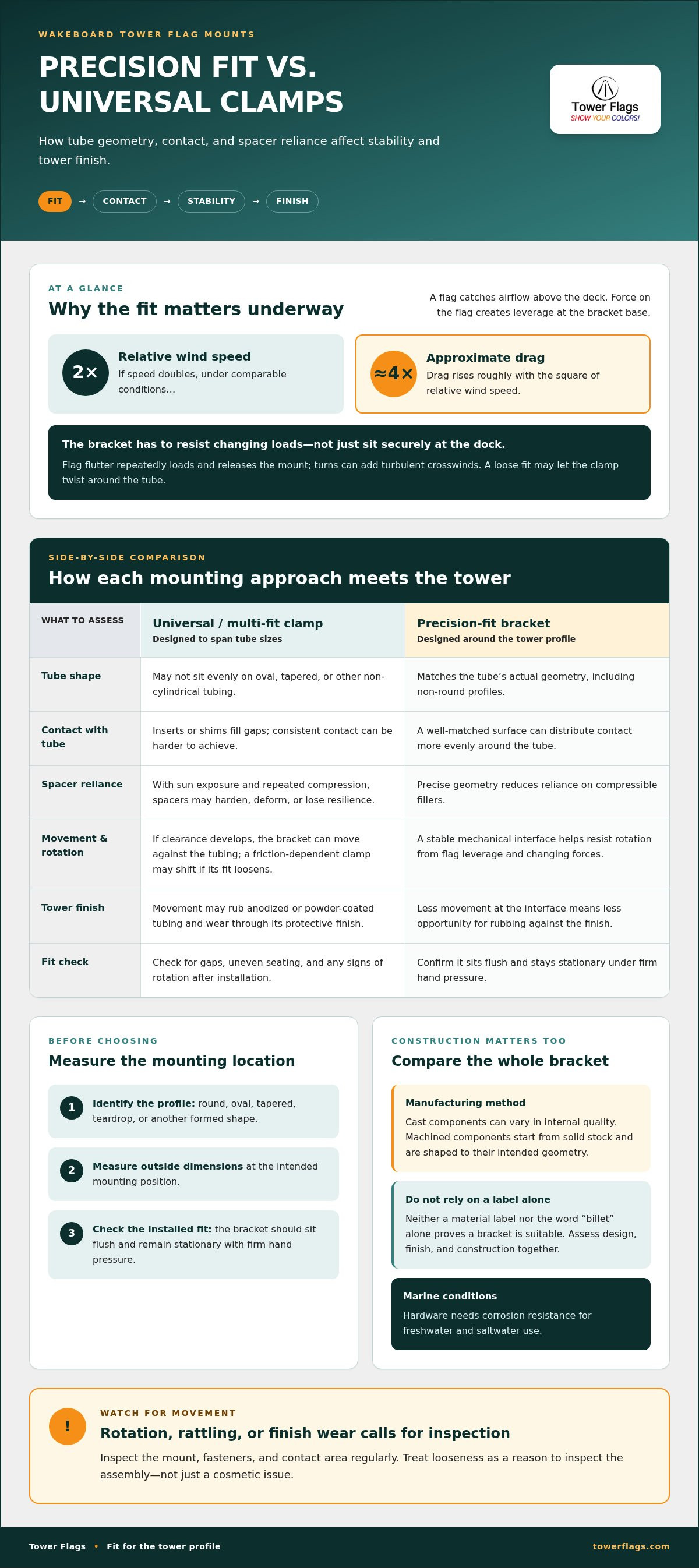
A flag on a wakeboard tower is more than a visual accessory once the boat gets moving. It catches airflow above the deck, where wind and turbulence put force on the pole, bracket, and tower tubing. A secure wakeboard tower flag mount needs to handle that force without shifting or transferring unnecessary movement into the tower.
The Dynamic Forces Acting on Tower-Mounted Flags
Wind load rises sharply with speed. In basic aerodynamic terms, drag is approximately proportional to the square of relative wind speed, so doubling that speed can produce roughly four times the drag under comparable conditions. The flag’s area and shape also affect the load. A 3-by-5-foot flag at 30 knots presents a broad surface to the airflow, creating leverage at the bracket base rather than just a minor pull on the pole.
The force is not perfectly steady. Flag flutter creates repeated cycles of loading and release, and that vibration can loosen weak connections over time. Sudden turns introduce turbulent crosswinds. If a clamp does not seat securely, those changing forces may twist it around the tube.
The Hidden Cost of Clamp Movement at Cruising Speeds
A slipping bracket can rub against anodized or powder-coated tubing. Even slight movement may wear through the protective finish, leaving visible marks and exposing the surface to further damage. Repeated vibration can also affect nearby tower joints and welds. Precise contact and a properly matched bracket help limit rotation instead of letting a loose collar work against the tower.
Structural integrity matters, too. A cracked bracket or failed clamp can release the pole and hardware while passengers or wakeboarders are nearby. Inspect the mount, fasteners, and contact area regularly, especially if you notice rotation, rattling, or finish wear. Treat looseness as a reason to inspect the assembly, not just a cosmetic issue.
Marine mounting hardware has to withstand airflow, vibration, moisture, and movement. An exact-fit bracket sits against the tower without relying on a stack of compressible shims to make up for mismatched dimensions. A firm interface helps keep the flag stable while reducing abrasive movement against the tower’s finish.
For more guidance on managing drag and securing a flag at speed, read this high-speed wakeboard tower flag mount guide.
Precision Fit vs. Universal Clamps: Engineering Stability for Wake Towers
A clamp designed for a range of tube sizes often depends on inserts or shims to fill gaps. That flexibility can make consistent contact harder to achieve. With sun exposure and repeated compression, spacer materials may harden, deform, or lose resilience. If clearance develops, the bracket can move against the tubing instead of holding its position firmly.
A precision-fit wakeboard tower flag mount is designed around the tower’s actual profile. That matters for more than diameter: some towers have oval, tapered, or otherwise non-cylindrical sections. Matching the bracket to the tube’s geometry reduces reliance on compressible fillers and helps create broad, stable contact.
Diameter Tolerances and Powder Coat Preservation
Fit affects how clamping force reaches the tower. A bracket that touches only at narrow points can concentrate pressure, while a well-matched surface distributes contact more evenly around the tube. Less movement at the interface also means less opportunity for the mount to rub against powder coating. Before choosing a bracket, identify the tube’s shape and measure its outside dimensions at the intended mounting location. For more on material durability, read our durable boat flag hardware guide.
Resisting Rotational Torque on Smooth Tubing
Airflow against a flag applies force above the clamp, creating leverage that can rotate the mount around a smooth tower tube. Wake impacts and changing wind direction can add to that movement. A friction-dependent clamp may gradually shift if its fit loosens. Exact-fit geometry creates a more stable mechanical interface and helps resist movement without relying only on a compressed spacer. After installation, check that the bracket sits flush and remains stationary when you apply firm hand pressure.
Marine-Grade Metallurgy: Compare Construction, Not Labels
Material and manufacturing method both influence how a bracket handles repeated loading. Cast components can vary in internal quality, while a machined component starts from solid stock and is shaped to its intended geometry. Neither a material label nor the word “billet” alone proves a bracket’s suitability. Examine the design, finish, and construction together. Marine hardware also needs corrosion resistance for freshwater and saltwater use. Tower Flags designs and manufactures custom boat flag brackets around precise tower fit. Explore custom boat flag brackets for an alternative to multi-fit designs.
Crucial Engineering Features to Evaluate in a Tower Flag Bracket
A reliable bracket depends on more than a tight clamp. Assess how its structure, tower contact, pole retention, and finish work together in a wet, vibrating environment. A well-matched wakeboard tower flag mount should stay secure without damaging the tower or allowing the pole to work loose.
Match the Bracket to the Tower Profile
Wake towers use different tubing shapes, including round sections and formed or contoured profiles. A bracket made for round tubing may contact an elliptical or teardrop tube unevenly, concentrating pressure and leaving room for movement. Identify the mounting location’s shape and outside dimensions before choosing hardware. For more detail on bracket options, see the ultimate guide to custom boat flag brackets 2026.
Check How the Pole Is Retained
A set-screw or thumb-screw holds a pole through pressure at a single point. Vibration can loosen a friction-based connection, and tightening it harder may mark the pole. Where compatible with the bracket, look for a retention design that positively engages the pole, such as a cross-bolt or detent pin. Confirm that the pole seats fully and the locking element is captured securely before heading out.
During an inspection, check these details:
Fit: The bracket sits flush against the tower without rocking.
Retention: The pole cannot lift or rotate freely once locked.
Fasteners: Threads engage cleanly, and hardware stays accessible for inspection.
Finish: Coatings and contact surfaces are intact, with no signs of corrosion or wear.
Consider Corrosion and Fastener Compatibility
Marine exposure can challenge both the bracket and its fasteners. Salt, moisture, and dissimilar metals may contribute to corrosion or make hardware difficult to remove. Review the material and care information for the bracket and fasteners, and follow the manufacturer’s assembly and maintenance instructions. On an aluminum tower, compatible hardware and appropriate isolation at contact points can help reduce corrosion risks. Inspect fasteners periodically rather than waiting for rust, binding, or thread damage to appear.
Construction details matter more than broad labels such as “marine grade.” Choose a bracket engineered for the tower’s geometry, then pair it with a pole-retention system suited to repeated vibration. Explore custom boat flag brackets from Tower Flags for precision-fabricated mounting hardware.
Step-by-Step Installation and Rigging on Wakeboard Towers
A secure installation starts with choosing a location that works on the water and during storage. Before fastening a wakeboard tower flag mount, check how the flag, pole, and bracket interact with tow ropes, the bimini, speakers, and lights. Then follow the bracket maker’s installation instructions, especially for fastening sequence and tightening limits. There is no universal torque value for every tower and bracket combination.
Choose a Position with Clearances in Mind
Hold the pole in a few possible mounting positions and check its full range of movement. Consider wide rider cuts, not just the tow line’s path when the boat is still. Keep the flag clear of passengers and accessories, and confirm that the bimini can open and fold without contact. Also consider bridges and other overhead obstacles on your usual routes. If the mount has a quick-release feature, make sure you can operate it easily when the pole needs to come down.
Prepare the Surface and Tighten Evenly
Protect the tower’s finish before clamping. Clean the contact area with a soft cloth and a cleaner approved for the tower’s surface, then let it dry. Avoid abrasive pads or solvents unless the tower manufacturer says they’re safe for that finish.
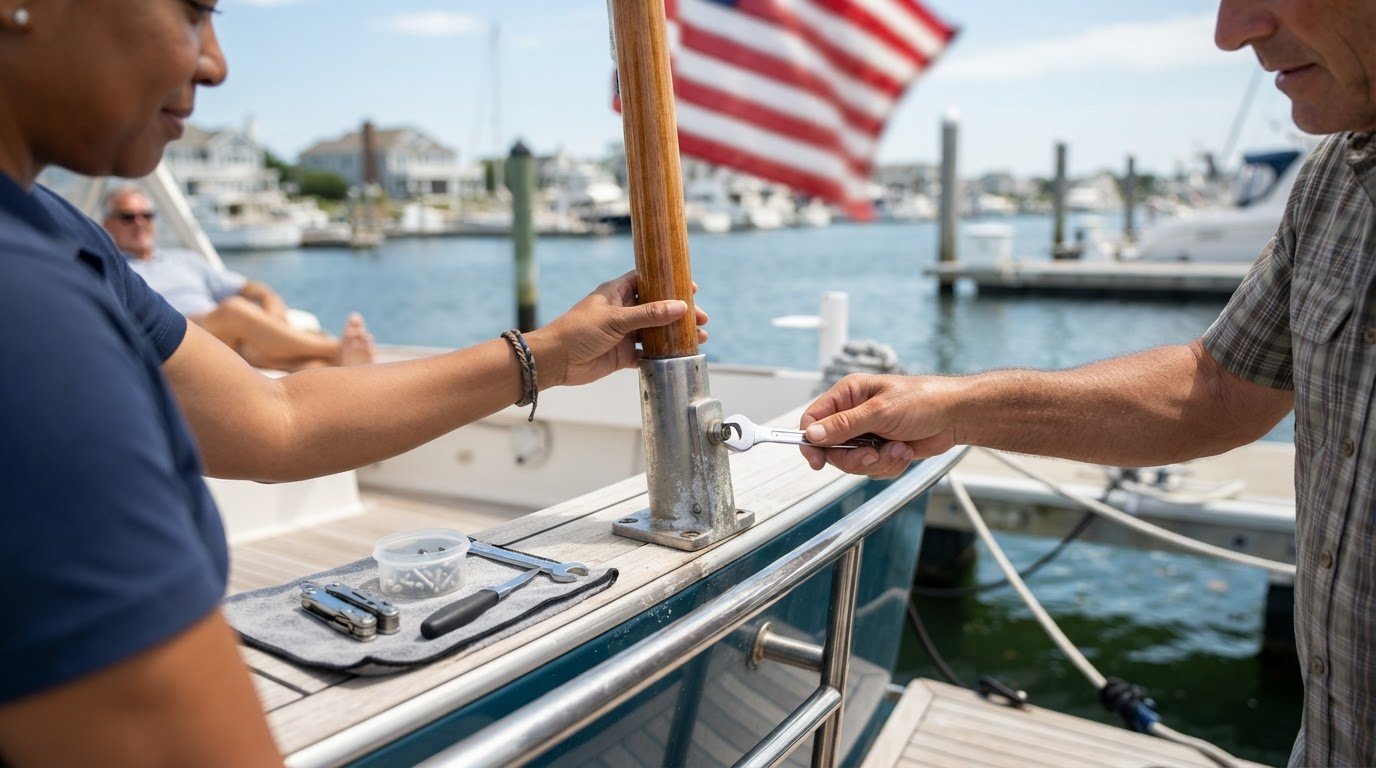
Seat the bracket squarely against the tube. If the mount uses opposing bolts, tighten them in small alternating increments so the halves draw together evenly instead of cocking to one side. Use the specified torque if the manufacturer provides it, and don’t compensate for a poor fit by overtightening. Apply thread locker only if the bracket or fastener instructions call for it, since compounds can affect different materials and finishes.
Run a Pre-Launch Check
Before each outing, inspect the assembly and confirm that each part is seated and secured. A quick hands-on check can catch movement before the boat accelerates.
Look for shifting, loosened fasteners, cracked parts, or fresh marks on the tower finish.
Apply firm hand pressure to the bracket and check that it doesn’t rotate or rock.
Confirm the flag clips or swivel move freely and the fabric won’t wind around the pole.
If the pole uses a quick-release pin, verify that it passes fully through the receiver and locks in place.
Check tow-rope, bimini, and overhead clearance again after installation.
If any component moves, binds, or shows damage, resolve the issue before running at speed. For a bracket designed around your tower’s fit, explore custom boat flag brackets from Tower Flags.
Upgrade Your Boat with Custom-Engineered Brackets from Tower Flags
A flag bracket should suit the tower it attaches to, rather than force the tower to accommodate a generic clamp. Tower Flags designs and manufactures custom boat flag brackets for marine use, with fit based on the vessel’s tower profile. A tailored bracket avoids relying on stacks of rubber shims to bridge gaps between mismatched surfaces.
For owners of performance boats, the details matter. A bracket that sits securely can reduce unwanted movement and help protect the tower’s finish from rubbing. That care supports the boat’s overall condition and appearance. No mount replaces careful installation and inspection, but hardware designed for the tower provides a sound foundation.
Custom Fabrication for Demanding Boats
Each tower has its own geometry, finish, and available mounting space. A custom-fabricated bracket can be shaped to match those conditions instead of relying on a broad, multi-fit design. The result is a more integrated installation, without loose spacers, avoidable rattle, or a clamp that sits awkwardly on the tubing. Precision fit is not just about appearance. It helps create a stable connection suited to repeated vibration and marine use.
Tower Flags focuses on boat flag mounting hardware, with specialized fabrication for a component that generic accessories may treat as an afterthought. For boaters who value clean fit and considered construction, a custom bracket is a practical upgrade to the tower setup.
Build a Complete Flag Setup
Pair a custom bracket with a marine flag pole and a flag suited to how you use your boat. A national, state, or watersports flag can add a personal touch, while a properly fitted pole and bracket help keep the setup organized and secure. Before heading out, confirm that the pole is retained correctly and the flag clears ropes, passengers, and tower accessories.
Choose a wakeboard tower flag mount with the same attention you give other equipment on your boat. Tower Flags offers brackets, flag poles, and flags with a focus on marine function and precise craftsmanship. Explore custom boat flag mounting solutions from Tower Flags for hardware designed around your vessel.
Choose a More Secure Flag Setup for Your Tower
A dependable flag setup starts with a bracket matched to the tower’s shape. Precision fit reduces reliance on rubber shims, while sound construction helps the mount handle the forces of cruising. Careful positioning, even fastening, and regular pre-launch checks complete the setup.
A well-designed wakeboard tower flag mount should also protect your boat’s finish. Custom-fit marine hardware creates a stable connection and helps reduce rubbing that can mark tower surfaces. Fit, retention, and finish protection all contribute to a practical setup for time on the water.
Tower Flags designs custom marine brackets, flag poles, and flags. Explore precision-engineered custom flag brackets at Tower Flags to find a mounting solution designed around your vessel.
Frequently Asked Questions
Will a wakeboard tower flag mount scratch or dent my tower tubing?
It can if the bracket fits poorly, traps grit, shifts under load, or is overtightened. Before mounting, clean the contact area and check how the bracket sits against the tower profile. Tighten fasteners evenly and follow the manufacturer’s instructions instead of using extra force to compensate for a loose fit. Check periodically for movement or fresh marks. A correctly matched mount helps reduce rubbing and concentrated pressure on the finish.
Can I leave my flag mounted on the wakeboard tower while driving at high speeds?
Only if the bracket, pole, and flag are suitable for the conditions and speeds you plan to run. A flag catches airflow and creates drag, so a setup that seems secure at rest may behave differently underway. Follow the hardware maker’s guidance, consider the flag’s size, and inspect the assembly before each trip. If the equipment’s speed limits are unknown, remove the flag before high-speed runs rather than assume it’s safe.
Why do universal-fit flag clamps slip down the tower tube when cruising?
A multi-size clamp may rely on spacers to fill gaps between the clamp and tower. If those spacers compress, harden, or wear, the fit can loosen. Vibration and changing wind loads can then make the bracket rotate or slide, particularly on smooth tubing. Movement may abrade the tower finish. A bracket made to match the tube’s shape and dimensions reduces dependence on compressible shims and helps maintain consistent contact.
How do I determine the exact diameter of my wakeboard tower for a mount?
Measure the outside of the tube at the exact spot where the bracket will sit. Use calipers for a round tube, or a flexible tape to measure circumference, then divide the circumference by pi to estimate diameter. For oval or contoured tubing, record both the widest and narrowest dimensions because one diameter won’t describe the profile. Measure over the existing finish, and note the tube shape and any taper to guide bracket fit.
What size flag is safe to fly from a boat wakeboard tower?
There isn’t one flag size that’s safe for every tower, pole, and operating speed. Larger flags catch more wind and increase drag, so choose a size suited to the mounting hardware and follow its use guidance. A skier-down flag is a separate safety matter: requirements vary by state, and some commonly require a flag at least 12 by 12 inches. Check the rules that apply where you boat.
Do wake tower flag mounts interfere with tow ropes or bimini tops?
They can if positioned without checking the full operating space. Before fastening the bracket, consider the tow rope during wide rider cuts, the bimini as it opens and folds, and nearby speakers, lights, or passengers. Also account for the flag’s movement in the wind. Test clearances with the pole and flag in place, and consider overhead obstacles on your usual routes before settling on a mounting position.
How does marine-grade billet aluminum outperform cast aluminum brackets?
“Billet” describes material machined from solid stock, while cast aluminum is formed by pouring molten metal into a mold. The manufacturing method alone doesn’t determine strength or marine durability. Alloy, heat treatment, bracket geometry, finish, and quality control all matter. Compare the bracket’s construction and corrosion protection rather than relying on a label. For a wakeboard tower flag mount, precise geometry and secure retention are just as important as material selection.
Comments