

How to Choose and Maintain a Salt Water Resistant Flag Pole for Your Boat
Your boat tower shouldn't be a magnet for rust stains just because a manufacturer cut corners on their metallurgy. You've likely felt that frustration after spending a weekend scrubbing orange streaks off your gelcoat, only to realize your new hardware is already pitting. Most generic accessories simply aren't built for the relentless reality of salt spray and high speed vibration. Finding a true salt water resistant flag pole requires looking past the shiny finish to the actual engineering and material science beneath.
We agree that your vessel deserves hardware that matches its quality without demanding constant, exhausting maintenance. This expert led guide provides the technical knowledge you need to protect your marine hardware from the relentless corrosive power of salt air. We will examine why 316 stainless steel is the non-negotiable industry standard over cheaper 304 alternatives, how precision fit brackets prevent the friction that accelerates metal fatigue, and the specific steps required to keep your flags flying proudly at speeds over 40 MPH without any fear of mechanical failure.
Table of Contents
The Science of Salt Water Corrosion on Marine Flag Poles
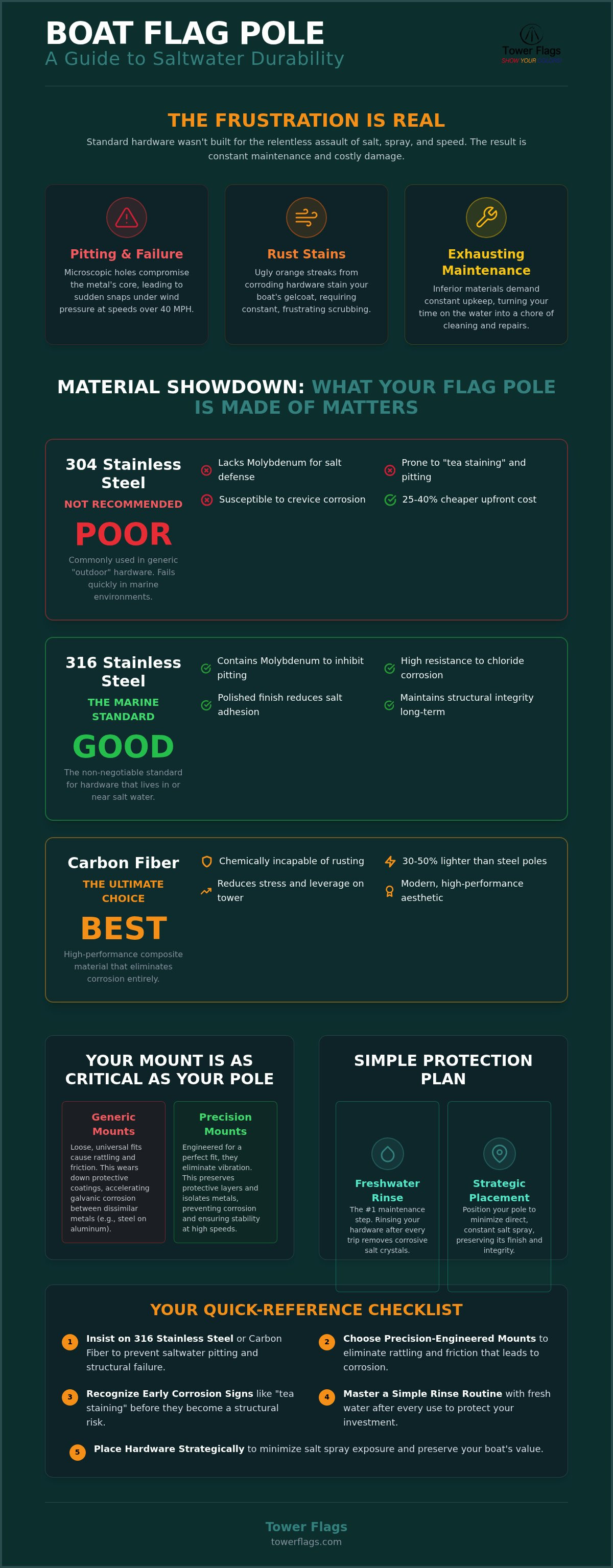
Salt water is a harsh chemical environment. When salt spray hits your hardware, it forms an electrolyte that triggers electrochemical oxidation. The science of corrosion explains how this process strips electrons from metal, leading to rapid decay. On a boat, this isn't just a surface stain. It often manifests as "pitting," where localized corrosion creates deep, microscopic holes. Pitting is the silent killer of standard hardware because it compromises the structural core of the metal while leaving the surface looking relatively intact. Eventually, the weakened metal snaps under the pressure of a 40 MPH wind. UV exposure compounds this by degrading the protective clear coats found on inferior products, leaving the raw metal defenseless against chloride ions.
Salt water resistance is the material's ability to maintain structural integrity under constant chloride exposure.
Why Standard 'Outdoor' Poles Fail at Sea
Standard flagpoles designed for a backyard or a coastal porch aren't built for the deck of a wake boat. There's a massive difference between resisting atmospheric humidity and surviving direct, pressurized salt spray. As salt water evaporates on your hardware, it leaves behind concentrated salt crystals. These crystals are hygroscopic, meaning they constantly pull moisture from the air and trap it against the metal surface. When you're cruising at high speeds, the wind force pushes this brine deep into mechanical joints and mounting points where it can't easily be rinsed away. Investing in a true salt water resistant flag pole ensures the materials can withstand this aggressive, pressurized environment.
The Danger of Galvanic Corrosion on Boat Towers
Marine hardware faces an additional threat known as galvanic corrosion. This occurs when two dissimilar metals, such as a stainless steel pole and an aluminum tower, are connected in the presence of an electrolyte like salt water. This setup essentially creates a low-voltage battery that leaches metal from one component to the other. To prevent this, the mounting bracket is just as important as the pole itself. Precision-engineered mounts are vital because they eliminate the rattling and micro-movements that cause friction. Constant vibration in a loose fit bracket will eventually wear down protective anodized finishes or passivated layers. Once that barrier is gone, the galvanic process accelerates, leading to the unsightly rust stains and seized hardware that plague generic boat accessories. Choosing a high-quality salt water resistant flag pole paired with a custom-engineered bracket is the only way to isolate these materials and stop the decay before it starts.
Comparing Marine-Grade Materials: Stainless Steel vs. Carbon Fiber
Selecting the right material is a choice between traditional craftsmanship and advanced engineering. In the marine world, "stainless" is often a misleading marketing term. Most generic hardware uses 304-grade stainless steel because it's cheaper to produce, often carrying a 25% to 40% lower price point than premium alternatives. However, 304 lacks the chemical composition required to survive constant exposure to brine. Choosing a high-quality salt water resistant flag pole requires a shift toward materials that can handle the specific stresses of the open water.
Metallurgy 101: Why 316 Stainless Matters
316 stainless steel is the non-negotiable standard for hardware that lives in salt water. The defining difference is the addition of molybdenum, an element that specifically inhibits chloride-induced pitting. The curriculum for Naval Material Science and Engineering at the United States Naval Academy emphasizes that material selection is the first line of defense in ocean systems. Without molybdenum, steel suffers from "tea staining," which are those unsightly brown streaks that appear shortly after your first trip out. We prioritize a high-polish finish on our metal components because a smoother surface provides fewer microscopic crevices for salt crystals to grip, significantly reducing the rate of adhesion and corrosion.
Carbon Fiber: The Modern Marine Solution
Carbon fiber has emerged as a high-performance alternative for boaters who want to eliminate the risk of rust entirely. As a composite material, carbon fiber is chemically incapable of rusting, making it an ideal candidate for a salt water resistant flag pole. Beyond its immunity to corrosion, it offers a 30% to 50% weight reduction compared to traditional metal poles. This weight savings is crucial for high-speed boating, as it reduces the leverage and stress placed on your boat tower during tight turns or heavy chop. While composites are immune to salt, they do require a UV-resistant resin or clear coat to prevent the fibers from breaking down under intense sun exposure.
When you compare the two, 316 stainless steel offers classic aesthetic appeal and immense physical weight, while carbon fiber provides a modern, lightweight, and rust-proof experience. Both materials offer superior fatigue resistance compared to the brittle "mystery metals" found in universal-fit kits. If you're tired of replacing hardware every season, it's time to invest in professional-grade flag poles built from these verified marine materials. Whether you prefer the polished look of steel or the tactical edge of carbon fiber, the goal remains the same: hardware that performs at 40 MPH without failing.
Strategic Placement: Protecting Hardware from Constant Spray
Most boaters assume any flat surface or open rail is a suitable spot for a flag. This is a common mistake that leads to premature hardware failure. On a pontoon, the low-profile rails are constantly bombarded by the mist kicked up by the wake. On a wake boat, the transom and swim platform are high-saturation zones where water pools and evaporates. Understanding these specific "wet zones" is critical for the longevity of your hardware. A salt water resistant flag pole performs best when it isn't constantly submerged in the splash zone. High-speed airflow can be your ally or your enemy. At 30+ MPH, wind can either strip moisture away or force salt water into every crevice and joint.
Mounting height is your most effective defense against direct wake splash. The Science of Salt Water Corrosion highlights that atmospheric zones are significantly less aggressive than direct splash zones. By moving your hardware higher up on the vessel, you reduce the concentration of chloride ions that reach the metal. This is why we advocate for specialized placement rather than universal mounting that forces you to compromise on location. Proper height keeps your flag visible and your hardware drier.
Tower Mounting vs. Rail Mounting
Boat towers provide a naturally drier environment than gunwale or rail mounts. They sit well above the heaviest spray and allow the wind to naturally dry the hardware after a run. However, towers introduce high-frequency vibration and leverage stresses. Generic "one size fits all" mounts often "chatter" against the tower pipe. This chatter creates micro-abrasions in the metal's surface that are invisible to the naked eye. These tiny chips allow salt to bypass the protective passivated layer of the steel. Using custom boat flag brackets ensures a precision fit that eliminates this movement. This isolation protects the integrity of your salt water resistant flag pole during aggressive maneuvers or high-speed runs.
Orientation and Wind Loading
The angle of your pole affects how salt water collects and drains. A perfectly vertical pole allows water to run straight down into the base or the bracket's internal mechanism. This often traps brine in the mounting point, where it sits and eats away at the finish. A slight aft-leaning angle, typically between 15 and 30 degrees, promotes better runoff and keeps the base drier. This orientation also reduces the physical wind load on the hardware at cruising speeds. You should also ensure the mounting point is easily accessible from the cockpit. If you can't reach the base comfortably with a freshwater hose after a long day on the bay, you won't rinse it. Accessibility isn't just about convenience; it's the foundation of a successful maintenance routine. Proper placement makes care effortless.
How to Maintain Your Salt Water Resistant Flag Pole
Even the highest grade 316 stainless steel or carbon fiber requires a disciplined maintenance routine to combat the relentless nature of the ocean. A salt water resistant flag pole is an investment in your vessel's aesthetic and functional value. Neglecting it allows salt crystals to build up in tight tolerances, which eventually leads to seized threads and surface pitting. We approach maintenance with a craftsman's eye for detail, focusing on the points where moisture naturally pools. Proper care ensures your hardware remains as reliable as the day you installed it.
The 5-Minute Post-Salt Rinse Routine
Your primary defense against corrosion is a thorough freshwater rinse after every single outing. Salt water is only dangerous when it's allowed to dry and crystallize on the metal surface. Start by flooding the entire pole and bracket with low-pressure freshwater to dissolve surface brine. Pay close attention to the flag pole socket; this is a common failure point where salt traps moisture against the base. Use a soft cloth to dry the hardware immediately after rinsing. This prevents water spotting and the buildup of minerals that can dull a high-polish finish. If you leave the boat in a slip, perform this rinse weekly to remove the salt film carried by the humid sea air. This simple habit preserves the integrity of your durable boat flag hardware for years.
Seasonal Deep Cleaning and Protection
Every few months, your hardware requires a more intensive inspection to address the risks of galvanic activity. Stainless steel relies on a microscopic passive oxide layer to resist rust. Use a specialized marine-grade metal polish to remove any "tea staining" and restore this protective barrier. While cleaning, inspect the mounting bolts for any signs of loosening caused by engine vibration. If you have mounted a stainless bracket directly to an aluminum tower, check the isolation barriers. We recommend using nylon washers or a specialized compound like Tef-Gel on all threads to prevent the metals from bonding. These lubricants act as a non-conductive bridge that stops the flow of electricity between dissimilar metals. Replacing worn gaskets or isolation barriers during the off-season prevents the permanent pitting that ruins boat towers.
Maintaining high-performance marine gear doesn't have to be a chore if you have the right components from the start. If your current hardware is already showing signs of irreversible decay, it's time to upgrade to a system designed for the task. You can shop our salt-ready flag poles and brackets to find a solution that stands up to the elements with minimal effort.
Why Precision-Engineered Mounts are the Final Fix
Universal fit hardware is a compromise that rarely pays off in a marine environment. These generic kits rely on rubber inserts and plastic shims to adjust to different pipe diameters. This creates uneven pressure and microscopic gaps where salt water remains trapped long after you've rinsed the boat. In contrast, a precision-engineered solution is designed for the exact specifications of your tower. By eliminating the micro-movements that occur at high speeds, you prevent the friction that wears down protective finishes. Engineering always beats a "marine" label when the goal is a truly salt water resistant flag pole setup that won't fail during a heavy run.
The Tower Flags Difference in Salt Environments
We focus on the exact fit because it's the only way to protect your boat tower’s finish. Our brackets are custom-machined from high-grade marine alloys to match specific towers, such as the Malibu G3. This level of precision ensures that the bracket becomes a structural extension of the boat rather than a vibrating attachment. We use American-made craftsmanship to maintain strict quality control over every metallurgical detail. This commitment to quality means our hardware doesn't just look better; it functions with a mechanical efficiency that mass-produced alternatives can't match. Choosing our marine flag poles means you're opting for a system built to handle the unique stresses of high-speed vibration and corrosive spray.
Investing in Longevity
The cost of boat ownership is high, but the cost of replacing cheap hardware every season is even higher. You can buy three generic poles over three years or invest in one high-quality system that lasts the life of your vessel. Beyond the financial savings, premium hardware preserves the resale value of your boat. You won't have to explain away rust stains or pitted aluminum to a future buyer. Our salt water resistant flag pole and bracket combinations provide a set-it-and-forget-it solution for the serious boater. We pride ourselves on the fit and finish of every piece that leaves our workshop. You deserve to display your flags with pride at 40+ MPH without checking your rearview mirror for hardware failure. Explore our custom marine flag poles and brackets to find the perfect fit for your vessel.
Elevate Your Marine Hardware Standards
Maintaining the aesthetic and structural integrity of your boat shouldn't be a constant battle against the elements. By prioritizing high-grade 316 stainless steel or carbon fiber, you eliminate the primary cause of hardware failure in marine environments. A true salt water resistant flag pole relies on more than just high-quality alloys. It requires a precision-engineered fit that stops the vibration and friction that strip away protective finishes.
Generic hardware often fails because it forces a compromise on fit and placement. Investing in custom-fabricated solutions ensures your flag remains secure even at speeds exceeding 40 MPH. Our hardware is built for 2026 standards, using specialized materials designed specifically for the rigors of high-speed boating and constant salt exposure. Don't settle for mass-produced mounts that leave rust stains on your tower or gunwales.
Secure your flag with Tower Flags' custom marine hardware and enjoy the peace of mind that comes with craftsman-level engineering. You've worked hard to own a premium vessel, so make sure your accessories match that quality. We'll see you on the water.
Frequently Asked Questions
Is stainless steel 100% rust-proof in salt water?
No metal is completely rust-proof, but 316 stainless steel is the standard for marine durability. While it resists corrosion better than other alloys, it can still suffer from surface tea staining if salt is allowed to sit. This happens when the protective oxide layer is compromised. Regular freshwater rinsing and occasional polishing are necessary to maintain the integrity of your salt water resistant flag pole over several seasons of heavy use.
Can I use a standard aluminum flag pole on my boat?
You should avoid using standard aluminum poles designed for residential use. These products lack the heavy-duty wall thickness and specialized anodized coatings required to survive a marine environment. Aluminum is highly susceptible to pitting and structural failure when exposed to pressurized salt spray and high-speed wind loads. A dedicated marine pole is engineered to handle these specific stresses without bending or snapping while you are cruising at high speeds.
How often should I rinse my flag pole if I boat in salt water?
You should rinse your hardware with freshwater after every single outing in salt water. Salt crystals are hygroscopic, which means they pull moisture from the air and hold it against the metal surface. This constant dampness accelerates the electrochemical process that leads to corrosion. A quick five-minute rinse removes these crystals before they can bond to the finish or seize the mechanical threads in your mounting bracket.
What is the best material for a high-speed boat flag pole?
The best materials for high-performance boating are 316 stainless steel and carbon fiber. 316 stainless provides the weight and traditional aesthetic many boaters prefer, while carbon fiber offers a 30% to 50% weight reduction. Carbon fiber is also chemically incapable of rusting, making it an excellent choice for a salt water resistant flag pole. Both materials provide the necessary rigidity to withstand the vibration and leverage forces of high-speed wake boating.
Does salt water affect the flag itself or just the pole?
Salt water significantly impacts the flag's fabric by making the fibers stiff and brittle. As the salt dries, it forms sharp crystals within the weave that act like sandpaper when the flag whips in the wind. This leads to premature fraying and shredding. To extend the life of your flags, rinse them with freshwater alongside your hardware and allow them to air dry out of direct sunlight to prevent fiber degradation.
What is galvanic corrosion and how do I prevent it on my boat tower?
Galvanic corrosion occurs when dissimilar metals, like a stainless steel pole and an aluminum tower, are connected in a salt water environment. This creates an electrical circuit that leaches metal from the weaker component. You can prevent this by using isolation barriers like nylon washers or Tef-Gel on all mounting threads. Precision-engineered mounts also help by eliminating the vibration that wears down protective anodized layers on your boat's tower.
Can I leave my flag pole mounted while trailering near the coast?
You can leave your hardware mounted while trailering, but you must account for road salt and debris. Coastal roads often have high salt concentrations that are just as corrosive as sea spray. If your pole and bracket are rated for high speeds, they can handle the wind load of highway travel. However, we recommend a freshwater rinse once you reach your destination to clear any road grime and salt from the mounting points.
How do I remove 'tea staining' from my marine flag hardware?
You can remove tea staining using a specialized marine metal polish and a non-abrasive cloth. Tea staining is a surface-level oxidation that doesn't necessarily indicate structural failure, but it ruins the aesthetic of your boat. Polishing removes the brown streaks and helps restore the microscopic passive oxide layer that protects the steel. Regular cleaning prevents these stains from turning into deep pits that could permanently damage your expensive marine hardware.


Comments